

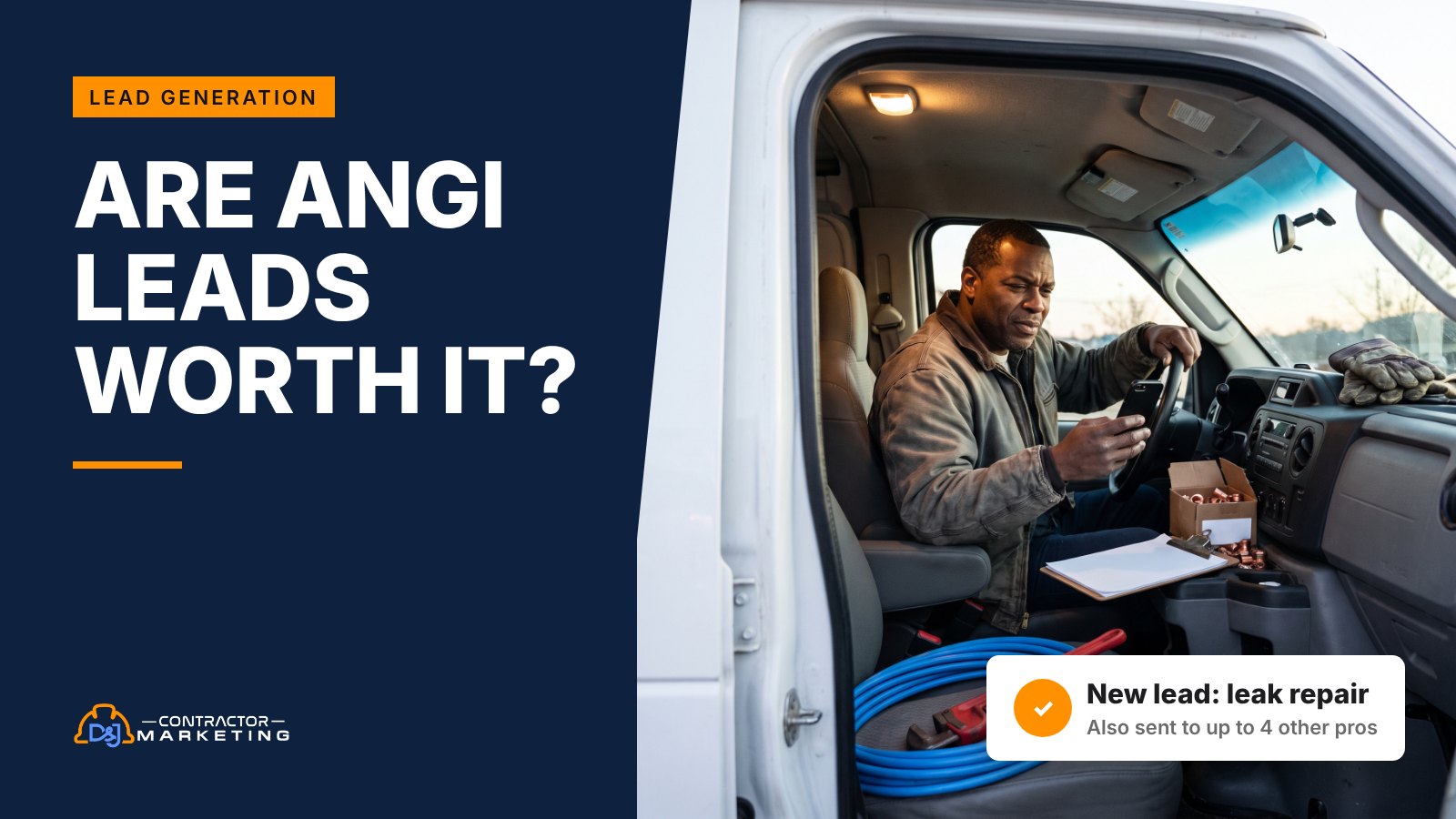
Every contractor gets the call sooner or later: an Angi rep with a pitch about homeowners in your area who need your service right now. Sometimes Angi leads pay off. Other times you get a monthly bill and a list of people who never call back.
We read Angi’s Pro Agreement and its help pages line by line. Below is what you pay, what you can get back, and a quick way to tell if it’ll pay off for your shop.
The short answer: Angi leads are shared job requests. Up to five pros can get the same request, and you pay for the lead whether or not you win the job. They can work for shops that reply in minutes, close well and have decent margins. For most contractors, we’d treat Angi as a short, measured test on pay per lead, not a core lead source and not a yearly contract.
Key takeaways
- Angi matches each homeowner request with no more than five pros, and you’re charged once you both show interest. How the leads work
- There’s no public price list, and Opportunities are billed on top of your monthly budget. What leads cost
- You pay for leads you never open and jobs you don’t win, and a subscription can renew up to 10% higher. The fine print
- Your close rate and job size matter far more than the lead price. Break-even math
- Subscription leads can’t get credits. Start on pay per lead. Subscription vs pay per lead
- To keep credit rights, call within 24 hours and ask before the lead is 45 days old. Getting credits
- Run a 60-day test with a kill number you set before the first lead. The test plan
How Angi leads work in 2026
Angi leads are homeowner job requests that Angi sells to contractors. A homeowner asks for help and picks up to five pros. Each of those pros pays a fee, whether or not they ever reach the homeowner. You’re paying for a shot at the job, not the job.
If you’ve been around a while, you knew this product as HomeAdvisor. The app is now called Angi for Pros. The big change is who picks you. The homeowner now looks at the pros Angi suggests and chooses who they want to hear from.
Here’s how it works:
- A homeowner submits a project request on Angi.
- Angi shows them pros that match the task and ZIP code. Angi now uses what it calls homeowner choice: “pros who receive leads are specifically chosen by the homeowner.”
- Angi says it matches each request with no more than five pros.
- Once you and the homeowner both show interest, it becomes a lead and you’re charged. Angi says you’re charged for these leads whether or not you open or respond to them.
There are two ways leads reach you. Automatic leads come in against your monthly budget. Opportunities are requests you browse yourself, where you see the task and the lead fee before you say yes. There, you make the first move.
Either way, plan on racing up to four other shops to the same phone number. A call from your own Google profile is different. Nobody else gets that number. More in our guide to lead generation for contractors.
How much Angi leads cost
Angi doesn’t publish a price list. Its billing help page says lead pricing varies based on task, homeowner location, and demand. A Jobber guide, last updated in 2024, put HomeAdvisor leads at about $15 to $100 each. Plenty of articles still repeat a range like that. It’s more than two years old and Angi doesn’t confirm it. Ask the rep for your range in writing.
The lead fee is only one piece. Here’s what actually lands on the card, per Angi’s help pages and Pro Agreement:
| Cost piece | How it works | Watch for |
|---|---|---|
| Lead fee | Charged when you and the homeowner both show interest | You pay even if they never pick up |
| Monthly budget | The dollar target Angi fills with automatic leads | One last lead can push you past it |
| Opportunities | Leads you pick by hand from the Opportunities tab | Charged on top of your budget |
| Subscription | Annual contract that prepays leads at a discount | Renewal price can rise, early exit fee |
| Billing timing | Weekly without a subscription (Wednesday if you pay by bank, Friday by card). Monthly on a subscription. | A busy lead week hits your card before those jobs pay you |
The budget line trips people up. The same billing page gives an example: with a $500 budget and $480 already spent, you can still get one more $40 lead and end the month at $520. Your budget is a target, not a hard cap.
Opportunities can leak money too. They don’t count toward your monthly budget. So if your office manager taps “interested” on a few extra jobs in a slow week, your real spend can run well past the number you agreed to.
Some older articles mention a yearly HomeAdvisor membership fee. Angi’s 2024 annual report says its leads business still sells memberships and subscriptions, and leads cost extra on top. Ask the rep, in writing, if any fee hits before your first lead.
Fine print most contractors miss
These lines from Angi’s Pro Agreement (updated October 6, 2026) and its help center are the ones that cost contractors money:
- No promises on volume. Any lead estimate in your contract (Angi calls it Guidance) is “an estimate only and is not guaranteed.” Getting fewer leads than that isn’t a breach on Angi’s part.
- You pay if you lose. The agreement says you’ll pay for the leads you receive “even if you do not win the job.”
- Unopened leads still count. The help center says you’re charged whether or not you open or respond.
- Renewals can cost more. On a subscription, Angi can raise the fee up to 10% over the last term when it renews on its own.
- Leaving early has a price. If your contract has an early termination fee, you pay it to cancel.
- No money back. If the agreement ends, you aren’t entitled to a refund of fees you’ve paid, prepayments included.
- Pausing isn’t stopping. On a subscription, pausing leads doesn’t pause your contract.
None of this is hidden. It’s just not what anyone reads at 9 p.m. after a long day on a roof.
Before you sign, ask the rep to put the contract length, the early exit fee and the renewal date in an email. If they won’t put it in writing, don’t sign.
Is Angi legit? What the FTC case means for you
Yes, Angi is a real, publicly traded company. Its leads start as homeowner requests, but some come in with bad numbers or from people just shopping prices. And in 2023 the FTC finalized an order against HomeAdvisor, a company tied to Angi, over how it described its leads.
The final order required HomeAdvisor to pay up to $7.2 million. It also bars false claims that leads are people ready to hire. The FTC’s complaint said HomeAdvisor claimed leads turned into jobs far more often than it could back up.
So don’t buy based on what a sales rep says leads “usually” close at. Buy based on what your own leads close at, and track it from day one.
Are Angi leads worth it? Run the break-even math
It comes down to one number: what you pay for each job you actually book. If that number is a third of your gross profit or less, it can work. If it’s more, you need a better close rate or bigger jobs, or Angi isn’t for you.

Here’s the math we use:
- Cost per booked job = everything you paid Angi (leads, Opportunities, any subscription) divided by jobs won
- Before you start, estimate it as lead price times the number of leads it takes to win one job. Count every lead you’re charged for, even the ones who never answer.
- Gross profit per job = what you charge minus labor and materials
- If cost per booked job is more than about a third of gross profit, it’s a bad deal for most shops
That one third line is our rule of thumb, not a law. It leaves room for overhead, callbacks and a little profit.
Here’s how it plays out. These numbers are made up to show the method. Swap in your own from your last 30 days.
| Example job | Lead price | Wins 1 in | Cost per booked job | Gross profit | Verdict |
|---|---|---|---|---|---|
| Roof repair | $70 | 8 | $560 | $1,200 | Doesn’t work. Almost half. |
| Water heater swap | $45 | 5 | $225 | $900 | Works. About a quarter. |
| Handyman half day | $25 | 6 | $150 | $200 | Eats most of the profit. |
| Interior paint, two rooms | $30 | 7 | $210 | $600 | Borderline. Just over a third. |
| Water mitigation | $90 | 4 | $360 | $2,500 | Works, if you answer at 2 a.m. |
| Kitchen remodel | $80 | 15 | $1,200 | $12,000 | Works, but you may pay for 15 leads over months before one signs. |
Look at the handyman row. The cheapest leads give the worst deal. Lead price matters less than you’d think. Close rate and job size decide most of it.
Two things can tip a close call your way. A water heater customer might call you again for a softener or a drain, so lifetime value counts. A happy Angi customer is also a good person to ask for a Google review. Here’s how to get more Google reviews that bring in calls you don’t pay for.
Don’t know your close rate? Track every call from every source for a month first: how many you quoted and how many you won.
Pay per lead or the annual subscription?
Angi offers two ways to pay: per lead with a monthly budget, or an annual subscription. The Pro Agreement says subscribers pre-pay for leads and “earn a discount.” Ask how much, in dollars per lead, because you give up a lot to get it.
| Pay per lead | Annual subscription | |
|---|---|---|
| Lead price | Full price | Discounted |
| Monthly budget | You change it anytime | Set by your contract |
| Credits for bad leads | Yes, if you meet the rules | No. You can report leads, but no credits |
| Billing | Weekly | Monthly |
| Pausing | Pauses your spend | Doesn’t pause the contract |
| Getting out | Pause or lower your budget anytime | Early termination fee if your contract has one |
| Renewal | Nothing to renew | Renews on its own, price can go up to 10% |
Read the credits row twice. Angi’s credit page says that annual subscription leads aren’t eligible for credits. On a subscription, a disconnected number is money gone.
Our take: start on pay per lead, even if it costs more per lead. Run it for two months and track every lead. Only sign a subscription once your numbers prove Angi pays in your market, and even then, put the renewal date on your calendar.
How to get credits for bad Angi leads
If you’re on pay per lead, you can ask for credits on bad leads, but only for a few reasons.
Per Angi’s lead credit page, these reasons may qualify after Angi looks into it:
- Bad contact info: the number is disconnected or isn’t the homeowner’s
- Wrong location: the job is outside the ZIP codes in your profile
- Service mismatch: the job isn’t one of the tasks you offer
- Duplicate: you were charged twice for the same homeowner within 45 days
- Paused: you got charged while your leads were paused

What won’t get a credit? A homeowner who never answers. One who hired someone else, changed their mind or is just getting quotes. Angi says those cases are built into the lead price.
To ask in the app, open the Leads tab and tap the lead. Tap the menu in the top right corner, then Request Credit (menu names as of October 2026). On the web, sign in to your Angi pro account, open the Leads tab, pick the lead and click Request lead credit. Angi says it reviews requests within 5 business days.
Watch the clock. Angi expects you to have tried calling within 24 hours. You have to ask before the lead is 45 days old. Your account also can’t have an overdue balance, or the request can be turned down. Credits expire if you don’t use them in six months. So call every lead the same day, even the junk-looking ones, even on a Saturday. Skip that first call and you hand Angi an easy reason to say no.
How to win shared leads in the first five minutes
If up to five pros get the same homeowner, being first and sounding like a real person gives you the best shot. Angi itself tells pros to use automated messages to reply within five minutes. Here’s what to send.
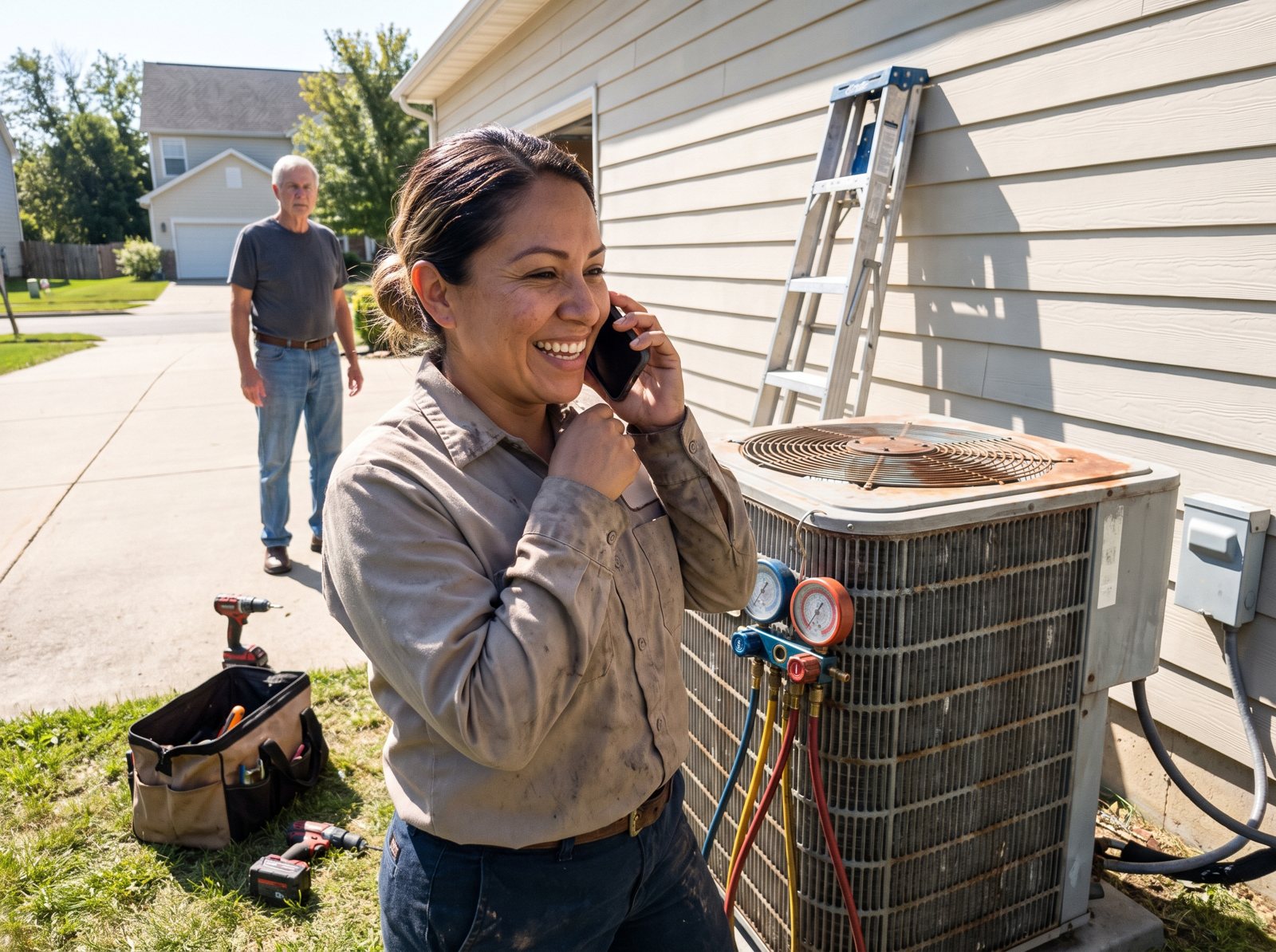
The auto text (set it up under Messages, then Automations, in the Angi for Pros app, as of October 2026):
“Hi [first name], this is [your name] with [your company]. Got your request for [task]. I’ll call you in the next hour. If that’s a bad time, just text me a better one.”
It names their job and tells them when you’ll call. That’s more than most pros send. “Thank you for your interest in our services” gets ignored. Only promise the hour if someone will really call. If your leads come in at night, change it to “I’ll call you at 8 a.m.” before you go to bed.
The first call, inside the hour, sounds like this:
“Hi, it’s [name] from [company], calling about your [task] request on Angi. A couple quick questions so I show up ready: [question one]? [question two]? I can be there [day] at [time]. Does that work?”
Good first questions by trade:
- HVAC: “Is the system running at all, and about how old is it?”
- Roofing: “Is water coming inside right now, or is it a stain you noticed?”
- Painting: “How many rooms, and are we changing colors or freshening up?”
Then keep the call in this order:
- Say who you are and the job they asked about.
- Ask two quick questions about the problem. It shows you know the work.
- Offer a time slot before you talk price.
- Text a link to your Google reviews right after you hang up.
If they don’t answer, leave a 15 second voicemail and send a second text. Try once more the next morning, then once on day three. A lot of homeowners miss the first call because they’re at work. Stay polite, stick to those few tries, and you may be the only one still calling by day three.
Can’t reply in five minutes from a ladder? Turn on the auto text, then have the office make the call. If there’s no office, price out a live answering service. Compare the monthly fee to the profit on one or two jobs. If it saves even one job a month you’d have lost, it likely covers itself.
How to get picked in the first place
Speed only matters if the homeowner picks you. Angi’s Pro Agreement says its lead estimates are based on your ratings, review count, response time and how well you keep up your reputation on Angi.
So before you spend a dollar, fix your profile:
- Ask your last 10 customers for an Angi review. A profile with zero reviews is a hard sell next to one with 40.
- Add real job photos, before and after, from your own work.
- Only list the tasks you want. Every extra task is another kind of lead you’ll pay for.
- Answer fast from day one. Response time is on Angi’s own list, so slow replies can cost you more than one job.
How to test Angi without getting burned
If you want to try Angi, treat it like a test with rules. Ask the right questions before you sign, then give it 60 days and a clear number to hit.
Questions to ask the Angi rep
- Is this pay per lead or a subscription? If a subscription, how long is the term?
- What’s the early termination fee, in dollars?
- What’s the renewal date, and what will the renewal price be?
- What’s the lead price range for my exact tasks and ZIP codes?
- Which of my leads are eligible for credits?
- Can you send all of that in writing before I agree?
A 60-day test with kill rules
- Before you start, write down your target cost per booked job. Use the one third rule from the math above.
- Pick only the two or three tasks with your best margins. Tight ZIP codes, no long drives.
- Set a budget you’d be fine losing, and leave Opportunities alone for the first month.
- Log every lead in a sheet: date, task, price, reached or not, quoted, won, job value.
- Every Friday, request credits on any lead that qualifies.
- At day 60, divide total spend by jobs won. Over your target? Shut it off. Under it? Keep going, and only then add budget.
- Fewer than about 15 to 20 leads by day 60? Extend the test before you judge. (That’s our rule of thumb.)
Decide your kill number before the first lead shows up. Once you’re in it, every lost job feels like it was almost a win.
This is how we judge any paid lead source: if it doesn’t hit the number, it doesn’t get more money.
Angi alternatives: what we’d do with the same money
The money you’d spend on Angi can also build lead sources you own. Here’s how we’d split the same budget for a contractor who wants calls now and calls next year too. These splits are our suggestion, not a formula.
| Monthly budget | Calls now | Calls you own later |
|---|---|---|
| $500 | About $400: a small Angi pay-per-lead test, or Google Local Services Ads if your trade qualifies | About $100 for good job photos or a review tool. The weekly Google profile posts and review asks are your time. |
| $1,500 | About $1,000: Local Services Ads as the main paid source | About $500: a new service page for one of your top jobs each month, until your main jobs are covered |
| $3,000 | About $1,800: Local Services Ads plus a tight Google Ads search campaign, including any management fee | About $1,200: ongoing local SEO, reviews and a fast site that turns visits into calls |
Why Local Services Ads first? With Local Services Ads, the homeowner usually calls or messages your business directly instead of filling out one form that goes to several shops. The homeowner can still call other pros on the same page, and you still pay per lead.
Google’s lead credit page says leads it judges invalid aren’t charged. It has its own catch, though: the same page says Google no longer gives credits for wrong job type or wrong area, so your settings have to be tight. Here’s how Google Local Services Ads work in full.
The right side of that table is the part that’s easy to skip when you need calls this week. A Google profile with steady reviews can keep bringing calls after you stop paying for ads. Our free Google review link generator gives you one link to text after every job.
Thumbtack, Yelp and Houzz work like Angi. They own the homeowner, and you pay for access. They can fill a slow month. They shouldn’t be your whole plan. If you run a heating and cooling shop, our breakdown of HVAC lead sources shows how we’d balance rented and owned leads.
Angi leads FAQ
How much does Angi charge contractors for leads?
Angi doesn’t post a price list. It says lead prices depend on the task, the homeowner’s location and demand for the work. A Jobber guide last updated in 2024 put HomeAdvisor leads at about $15 to $100 each, but Angi doesn’t confirm any range. Ask the rep for the range for your exact tasks and ZIP codes, and get it in writing.
Do I pay for an Angi lead if I don’t get the job?
Yes. Angi’s Pro Agreement says you pay for the leads you receive even if you don’t win the job. You’re also charged whether or not you open or respond to the lead. That’s why reply speed and close rate decide whether Angi pays off.
How many contractors get the same Angi lead?
No more than five, according to Angi’s help center, and the homeowner now picks which pros. So you’re competing with up to four other shops on every lead. The pro who replies first with a real plan for the job has the best shot.
Can I get a refund on a bad Angi lead?
Not a cash refund, but you may get a credit toward future leads. It covers things like a disconnected number, the wrong ZIP code or a job you don’t offer. You should try calling within 24 hours, and you have to ask before the lead is 45 days old. Annual subscription leads aren’t eligible.
How do I cancel Angi?
Angi’s Pro Agreement says you cancel by calling Customer Care at (877) 947-3639 and paying the early termination fee if your contract has one. Fees you’ve already paid aren’t refunded. On pay per lead, pause your leads first so nothing new comes in while you call. On a subscription, ask for the exact early exit fee and your last billing date, and have them email both to you before you hang up.
Is Angi free for contractors?
Not really. Angi doesn’t post a sign-up price, and some plans carry a membership or subscription fee. Every lead costs money too. You can see an Opportunity’s lead fee before you show interest, so ask the rep what you’ll pay before your first lead.
What to do this week
- Already on Angi? Pull last month’s statement and divide total spend by jobs won.
- On a subscription? Find your renewal date and early exit fee, and put both on the calendar.
- Thinking about it? Write down your kill number, then ask the rep the questions above.
- Either way, turn on an auto text so no lead waits more than five minutes.
If you’d rather own your calls than rent them, start with your Google profile. Our free local SEO audit shows what’s holding it back and what to fix first.


