
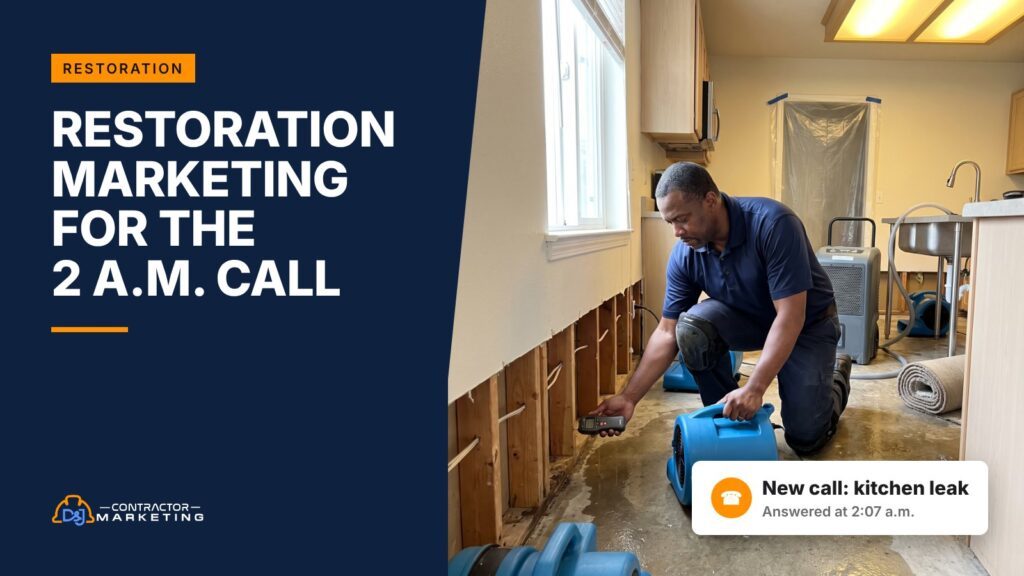
The first restoration company that looks legit and picks up the phone usually gets the water job.
A supply line lets go at 2 a.m. The homeowner grabs a phone and searches. That night, the only thing that matters is whether your phone rings and someone picks up. Then you need to know which dollars signed the job.
Below is how we run restoration accounts, from our SERVPRO and independent work: which channel books which kind of loss, what Google’s current Local Services Ads rules mean for restorers, what to spend, and what to ask any agency.
The short answer: restoration marketing works when you win the emergency search and answer every call. For water and sewage, that means the Google map pack, Local Services Ads and emergency search ads, backed by someone who picks up day and night. Fire and mold jobs lean more on trust: reviews, strong service pages, and relationships with agents, adjusters and plumbers. Then you measure each channel by signed jobs, not leads.
Key takeaways
- Triple-I data puts water and freezing claims at 1.50 per 100 insured homes a year and fire claims at 0.23, but the average fire claim is nearly six times bigger. Why restoration is different
- Water and sewage calls are decided in minutes, while fire and mold jobs lean on trust, so each gets its own plan. Channel by loss type
- Ahrefs estimates about 82,000 US searches a month for “water damage restoration near me,” and when we search it in our clients’ markets, the map pack usually sits near the top. What customers search
- Google no longer accepts “job type not serviced” or “geo not serviced” as Local Services Ads credit reasons, so set both tightly. Services we run
- A missed Local Services Ads call during your listed hours and active ad schedule can be charged if the caller stays on more than 20 seconds. Phone coverage
- At about $1,500 a month we’d skip broad search ads and fix your profile, reviews and water page first. Three budget levels
- Judge every channel by cost per signed job, not cost per lead. How we measure
- Before you sign with any agency, make sure your ad accounts, tracking numbers and domain stay in your name. Questions to ask
What restoration marketing has to do differently
Most contractors market to people who are shopping. A water damage customer usually isn’t comparing quotes. They call whoever answers first and sounds like they’ve done this before.
A roofer can win a job over two weeks of follow-up. You usually win or lose a water job in the first phone call.
Three things make restoration different from the other trades we work with:
- Few people plan ahead. Most homeowners don’t have a restoration company picked out before the pipe bursts. So you have to be easy to find the moment it happens, at any hour.
- Speed is part of the job. The EPA says it’s important to dry water-damaged areas and items within 24 to 48 hours to prevent mold growth.
- There’s usually a claim. Many water jobs go through insurance, and the homeowner is often already worried about the deductible and whether it’s covered. Your website and your first call have to answer those worries.
The insurance numbers also tell you where the volume is. Triple-I, using Verisk data for 2019 to 2023, puts water damage and freezing claims at 1.50 per 100 insured homes a year, with an average claim of $15,400. Fire and lightning claims came in at 0.23 per 100 homes, but averaged $88,170.
So water losses happen about six and a half times as often. Fire losses are rarer, but the average claim is nearly six times bigger. It’s the average the insurer paid per claim, not what a restoration company invoices. From what we see on our accounts, a fire job still invoices well above a typical dry-out. That’s why we plan water marketing around steady volume and speed, and fire marketing around being the company people trust with a big claim.

Which channel books which kind of loss
Water, fire, mold and sewage don’t come in the same way. If you lump them into one “restoration lead” bucket, you overpay for some and miss the rest.
This is how we split them when we plan a restoration account. It’s from our accounts, not a survey, so check it against your own call log. Yours may look different.
| Kind of loss | How the customer finds you | How fast they decide | What we lean on |
|---|---|---|---|
| Burst pipe or appliance leak | Searches on a phone, often “near me,” and calls from the map or an ad | Minutes | Map pack, Local Services Ads, emergency search ads, fast pickup |
| Sewage backup | Searches right away, often after a plumber clears the line | Minutes | Plumber referrals, a sewage cleanup page, emergency ads |
| Fire and smoke | Often hears your name from the adjuster, the agent or a neighbor, then looks you up | Hours to days | Reviews, a strong fire page, agent and adjuster relationships where your state allows it |
| Mold | Searches, reads and compares, often after a musty smell or a home inspection | Days to weeks | SEO, mold pages that explain the process, reviews |
| Storm and flooding | Searches in a wave after a storm, along with everyone else nearby | Hours | Ad budget you can raise fast, phone overflow, Google Business Profile updates |
| Commercial and property managers | Calls a company they already know | Set up long before the loss | Relationship marketing, a commercial page, response time promises you can keep |
The faster the decision, the more it rides on the map pack, ads and who picks up first. Slower decisions ride on trust: reviews, job photos and pages that answer the insurance questions.
Most of our restoration accounts start with the top row, because that’s where a new account can see signed jobs soonest. Water is where the volume is. A missed water call goes to the next company on the map, and unless you track missed calls, it never shows up in your reports.
Two more notes from the table. If you run a fire or mold shop and you’re adding water, start with a water page, Local Services Ads screening and night phone coverage. Your existing reviews carry over. For commercial work, we build a page around a pre-loss plan you offer property managers, with your contacts, response steps and shutoff locations, so you’re the company already on file when something breaks.
The searches restoration customers actually type
Before we spend a dollar, we look at what people in your area search. The national numbers for the big restoration terms set the scale.
| Search term | US searches a month | What the person wants | Where we send them |
|---|---|---|---|
| water damage restoration near me | 82,000 | Someone now, close by | Map pack, Local Services Ads, water damage page |
| water damage restoration | 75,000 | Mixed: some need help now, some are researching | Water damage page |
| mold remediation near me | 52,000 | A local mold company | Mold page |
| fire damage restoration | 50,000 | A company for a fire loss | Fire and smoke page |
| emergency water removal | 12,000 | Water out tonight | Emergency ads, water damage page |
| sewage cleanup | 9,800 | Help with a backup | Sewage cleanup page |
| smoke damage cleanup | 4,900 | Smoke and soot cleaning | Fire and smoke page |
| flood cleanup | 2,600 | Help after flooding | Storm and flood page |
First, “near me” searches are huge. When we search them in our clients’ markets, the map pack usually sits near the top, often under Local Services Ads. If your Google Business Profile is weak, you’re out of the map pack for the biggest term in the trade, and you’ll pay for ads to make up for it.
Second, the other loss types have their own demand. In our audits, one catch-all services page rarely ranks for any single loss type. Give water, sewage, fire, mold and storm their own pages.
Restoration marketing services we run
We don’t sell a bundle. A two-truck water shop and a full-service fire and water company get very different plans. A few things we’d usually skip for a restorer: social ads aimed at emergencies (an emergency isn’t when anyone opens Facebook), a mold blog post every week, and shared lead sites as your main source.
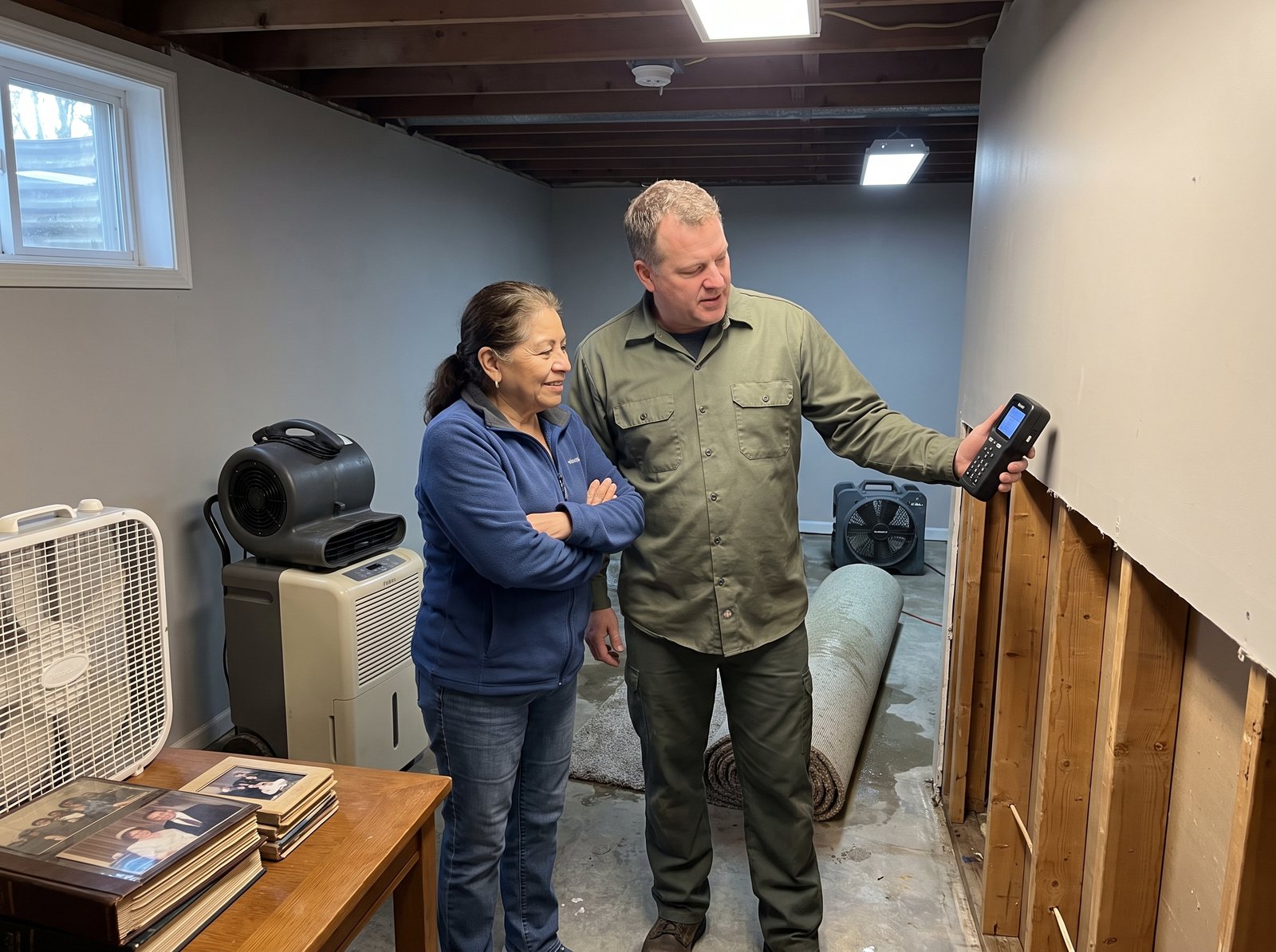
Google Business Profile and the map pack
This is where the “near me” calls come from, so it’s where we start. On restoration profiles we manage, we use “Water damage restoration service” or “Fire damage restoration service” as the primary category, whichever matches the work you want most, and add others only for work you actually do.
When we audit a restoration profile, the category is the first thing we check, because we often find it set to something broad like a general contractor.
We keep your business name clean. Google says your name should reflect your business’s real-world name, and stuffing extra words in it can get your profile suspended. “Blue Ridge Restoration” is fine. “Blue Ridge Restoration Water Damage Mold 24/7” is a risk we won’t take with your profile.
Then we add job photos from your crews and set hours you can actually answer. Our full Google Business Profile setup guide covers the rest.
Local Services Ads
Local Services Ads show on Google Search and Maps, and you pay per lead instead of per click. Google has a “Water damage services” category, and in the US it lists background check, business registration, insurance and license requirements for it. That’s a stack of paperwork, so we start it in month one, before anything else has to wait on it.
Two changes matter a lot for restorers. Google no longer gives credits for “job type not serviced” and “geo not serviced” leads. So if your service area or job types are set too wide, you pay for those calls. We set them to the work and the towns you really want.
The second is the move into Google Ads. Google announced it would begin moving Local Services Ads into Performance Max campaigns with pay-per-lead goals starting August 1, 2026. You still pay only for valid leads.
Google is moving accounts in phases through 2027 and emails the account admin before yours moves. If your account hasn’t moved yet, export any old reports you want to keep now. Google says historical campaign reporting won’t transfer, though your leads and verification status will. Our Local Services Ads guide goes deeper, and so does our post on the Google Verified badge.
Google Ads for emergency searches
We build separate campaigns for water, sewage, fire and mold, so mold spend can’t drain the water budget.
We also block the searches that waste money: jobs, DIY drying tips, equipment rentals and “how much does it cost” research. Ad copy should read like what your dispatcher says on the phone: “Water in the basement? We answer all night.” We only write that if it’s true.
We also keep a storm plan ready. It has pre-written storm ads, a higher daily budget cap and an overflow answering line we can switch on. So after a big storm, we can raise the budget the same day instead of next week.
Service pages that answer the insurance questions
Every main service gets its own page: water, sewage, fire and smoke, mold, and storm. Each one says what happens in the first hour, shows your own crew and trucks, and explains how the claim usually goes.
We also build a plain-English insurance page. It covers what the homeowner should do first, what photos to take, and how you work with their carrier. If you bill the carrier directly, the page says so in one line.
Reviews from every finished job
The reviews that help most after a loss say you showed up fast, you were honest, and you handled the insurance mess. We set up a simple ask once the drying is done and the customer is relieved.
A text like this works: “Hi Linda, glad the house is dry. Would you leave us a quick Google review? It helps people find us after a leak. Here’s the link.” Send it to every finished job, not just the happy ones. Google’s rules say businesses can’t selectively solicit positive reviews from customers, and the ask shouldn’t tell people what to write. Our guide to getting more Google reviews has the scripts.
Social posts and video from real jobs
Few people follow a restoration page, but plenty check it before letting you tear out a kitchen. We use BuilderBase to turn your crews’ job photos into steady posts, and short dry-out videos show a nervous homeowner who’s coming. We never post a customer’s address.
Referral partner marketing
Plumbers, insurance agents and property managers see losses before anyone else. We help you stay in front of them with a short leave-behind, a page they can send customers to, and a steady email or text touch.
One warning. Before you pay anyone for a referral, check your state’s rules with your attorney.
Phones decide whether any of it pays
Every channel on this page ends in a phone call. If nobody answers, you paid for a job your competitor got.
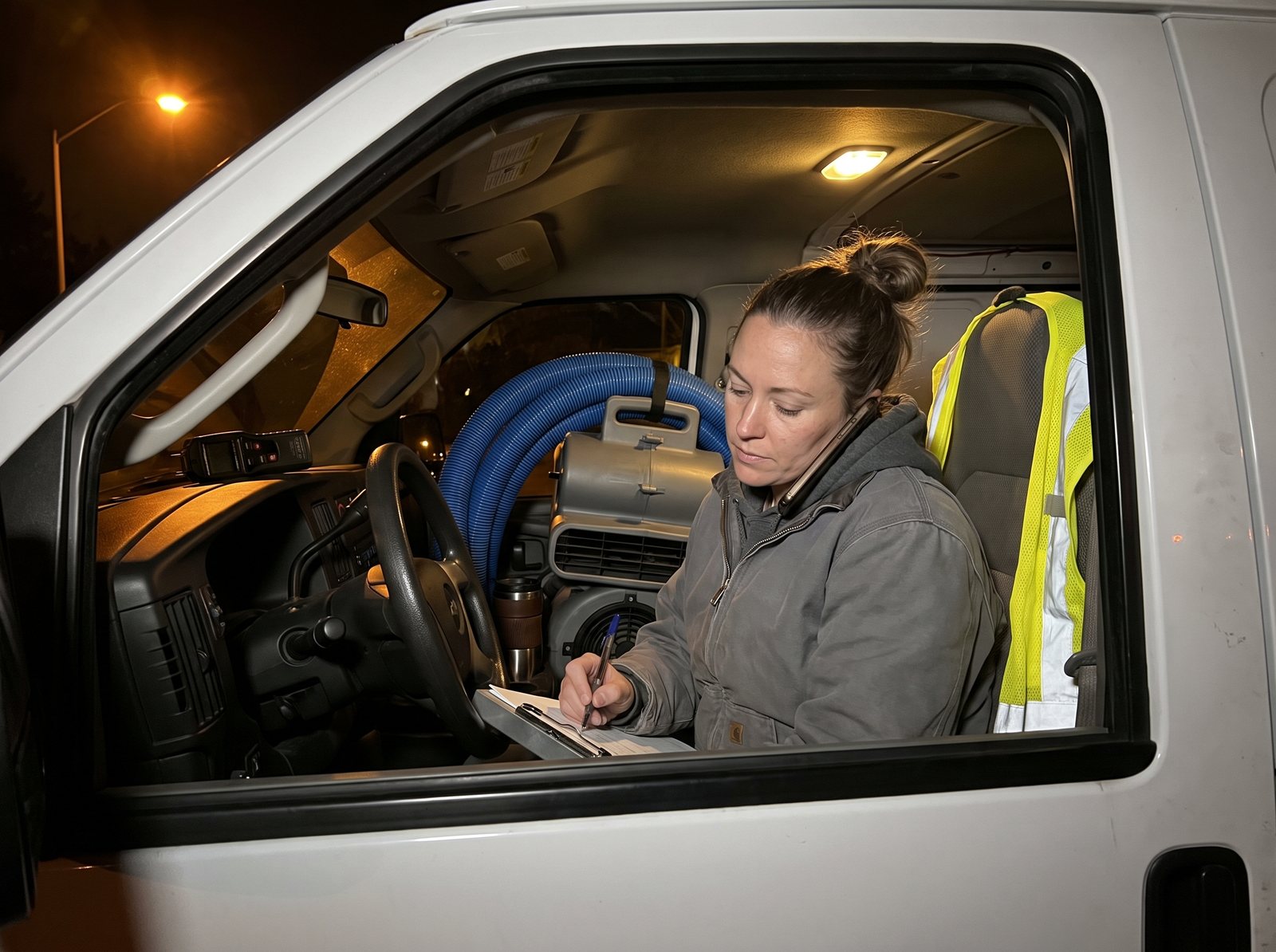
Google charges for a missed call during your business hours when the caller stays on the line for more than 20 seconds. A call that goes to voicemail or a recorded greeting in those hours counts too, if the caller stays on past 20 seconds. And “business hours” means the hours on your Google Business Profile.
Under those rules, if your profile says “Open 24 hours” and your ads run overnight, an unanswered night call can still cost you if the caller stays on past 20 seconds.
Most shops land on one of these setups:
- On-call rotation. A tech or manager carries the line on nights and weekends, with a backup if the first person doesn’t pick up.
- Answering service or AI receptionist. A live service or an AI receptionist takes the details, tells the caller when to expect a call back and texts it to the on-call tech. Our own AI receptionist, Restoral, can answer, take the details and book the job onto your calendar.
- Staffed hours for ads. If nobody can answer at night, keep the ad schedule to the hours you can staff. Google only charges a missed call when it lands inside both your profile hours and your ad schedule. Think hard before you mark the profile closed at night, because burst pipes don’t keep office hours.
Whoever answers needs a script for the first 30 seconds. Ours is short: “Blue Ridge Restoration, this is Dana. What’s a good number in case we get cut off? Is water still coming in? Is it clean water or a sewage backup? If you can reach it safely, shut off the main valve. If water’s near outlets or the panel, stay out of that room. Do you own the home, or rent it? What’s the address? Are you planning to call your insurance?”
Callback number first, then safety, then the address. Price talk comes later.
Then we test it. We call your tracking numbers after hours and on a Saturday, the same way a homeowner would. If it rings out or hits a full mailbox, that’s what a homeowner gets tonight. We sort that out before we turn on any ads.
What restoration marketing costs at three budget levels
DocuSketch quotes Phillip Rosebrook, a restoration expert and president of Business Mentors, who advises a marketing spend of 3% to 9% of total revenue. In his words, the lower budget is a maintenance program, and the higher one should lead to rapid growth.
Say your company does $1.2 million a year. That range works out to $3,000 to $9,000 a month. Treat it as a sanity check. A new shop breaking in may need to spend more for a while.
This is what we’d do with three monthly budgets. These are total marketing budgets, including ad spend. Agency fees vary, so ask any agency, us included, whether its fee is inside the number or on top of it.
| Monthly budget | What we’d turn on | What we’d skip for now |
|---|---|---|
| About $1,500 | Google Business Profile, review requests, fix the water damage page, one tracking number per channel, a small Local Services Ads budget for water | Broad search ads, social ads, mold and fire ads |
| About $5,000 | Everything above, plus emergency search ads for water and sewage, call recording and job-level reporting, separate fire and mold pages, referral partner touches | Big content projects, ads outside your core towns |
| About $15,000 | Everything above, plus more towns, a storm budget you can switch on, ongoing SEO pages, video and social for trust | Anything you can’t staff. More calls than crews is wasted money |
Google says Local Services Ads lead prices may vary depending on your location, the job type and other factors. So we set the starting budget from the lead prices your own account shows.
The math that matters is cost per signed job. This is an example calculation, not a benchmark. Say search ads cost you $150 per call, and one in three calls turns into a signed water job. That’s $450 per signed job. If your average water job invoices $4,000, that’s a good trade. If it’s mostly $900 extractions, it isn’t, once you take out labor and equipment.
Your average invoice and your close rate on the phone change that answer more than anything we do in the ad account.
How we measure it: signed jobs, not leads
A lead is a call, form or message. A job is a signed work authorization and an invoice. We report on the second one.
If your report can’t tie a click to a signed job, it isn’t telling you whether the money worked.
We track every job through four steps:
- Call or form. Every channel gets its own tracking number, so we know where the call came from. On your Google profile, we put the tracking number in as the primary number and keep your main line as an additional number.
- Real loss. We listen to call recordings and mark which calls were actual losses in your area, and which were spam, job seekers or out of range.
- Signed work. Your office marks which of those turned into a signed work authorization.
- Invoice. When the job closes, we add the invoice amount, so we can see what each channel brought in.
The monthly report then shows, for each channel, what it cost, how many signed jobs it brought and what those jobs invoiced. If a channel can’t answer the second question after a fair test, we cut it or fix it. For us, a fair test is usually two to three months, longer for SEO.
It helps with Local Services Ads too. Google may credit low-quality leads automatically after the fact, but it also asks for feedback on your leads, and it says that feedback helps it send you more of the leads that are best suited to your business.
Franchise or independent: what changes
We’ve worked with more than 30 SERVPRO franchises, and we’ve never lost a SERVPRO client. Franchise owners work inside brand rules set by the franchisor, so before we touch a profile or launch an ad, we check what your agreement and brand standards allow. You can see some of that work on our SERVPRO case studies page.
On SERVPRO and other franchise accounts, we check who controls the location page and the Google profile, whether your ads overlap the franchisor’s national campaigns, and how calls from any national call center are tracked apart from your own. A few things are already decided for you:
- The brand. Your logo and much of the wording come from the franchisor.
- The territory. Your ads and your Local Services Ads service area should match your territory. Calls from outside it are billed and no longer credited, as covered above.
If you’re independent, you’re building the name from zero. That means reviews, truck wraps and job photos. It’s slower, but no franchisor can change your profile or your territory.
If you lean on TPA or program work
Maybe a big share of your jobs comes through insurance programs and third-party administrators. It keeps crews busy, but you don’t set the pricing or the rules, and the volume can change for reasons you don’t control.
We don’t tell owners to quit program work. We build direct demand next to it, so programs stay a source of work but stop being your whole pipeline.
- Track them apart. Program jobs and direct jobs get separate lines in your report, so you can see your direct share grow month by month.
- Decide with numbers. Only drop a program once your direct jobs cover the work it brings, at a margin you like better.
Your first 90 days with us
This is the $5,000 plan. At $1,500, month 2 is Local Services Ads and reviews, with no search ads. Things happen in this order. On accounts we set up, search ads usually bring the first calls within days of approval. Local Services Ads wait on Google’s screening. The map pack takes longer, so we start it on day one.
Month 1: fix the leaks
We audit your Google Business Profile and website first. Then we look at your ad accounts and how calls get handled. We do the after-hours phone test. Then we set up call tracking on every channel so the first full month of data is clean, and we start the Local Services Ads screening if you aren’t verified yet.
Month 2: turn on demand
Emergency search ads go live for your core towns and your main loss type, usually water. Local Services Ads join them once Google’s screening clears. The review ask starts. We build or rebuild the water and sewage pages.
Month 3 and after: build what lasts
We add the fire and mold pages, then storm, then more towns if your crews can cover them, and referral partner marketing. Each month we move money toward whatever brings signed jobs at the best cost.
Anyone who guarantees the top of the map pack in 30 days is guessing, because SEO and reviews build over months.
Questions to ask any restoration marketing agency
Ask these on the first call, whether you hire us or not. Write down the answers. If the answers are vague now, the monthly reports will be too.
- Will my Google Ads, Local Services Ads and Google Business Profile accounts be in my name, so I keep them if we part ways?
- Do you report on signed jobs and invoices, or just leads?
- Can I hear the call recordings?
- How do you handle a storm week, when calls spike and my crews are full?
- Who owns the call tracking numbers and the website domain?
- What’s the contract length, and what happens to my website if I leave?
If an agency won’t put your accounts in your name, walk away. If you’re a franchise owner, the site and profile may belong to the franchisor, so make sure the ad accounts and tracking numbers at least stay with you. Our post on renting leads versus owning them explains why ownership matters so much.
Restoration marketing FAQ
How much should a restoration company spend on marketing?
There’s no fixed rule. DocuSketch quotes restoration expert Phillip Rosebrook advising 3% to 9% of total revenue, with the low end for maintenance and the high end for fast growth. We’d rather start from your numbers: what a signed water job invoices, how many calls you close, and what you can afford to pay per signed job. Then spend more where that number looks good.
How long does restoration marketing take to work?
Paid channels can bring calls soon after they’re approved and live. Local Services Ads for water damage come with Google’s background check, business registration, insurance and license requirements, so we start that paperwork early. SEO and reviews build over months. We give paid channels two to three months to prove themselves, and the map pack and SEO usually take longer. That’s why we start SEO and reviews on day one while the ads carry the early load.
Are Local Services Ads worth it for water damage?
Often, yes, if someone answers the phone. You pay per valid lead, not per click, and the ads show on Google Search and Maps. But Google no longer credits leads for job types or areas you don’t serve, and a missed call during your listed hours can be charged if the caller stays on more than 20 seconds. Set your areas and hours carefully.
Should a restoration company buy shared leads?
They can fill gaps, but we wouldn’t build the business on them. In our experience, when a lead is sold to several companies, the fastest caller usually wins, and you never own the customer or the reviews. We’d put that money into your own map pack presence, Local Services Ads and pages first, then test lead sites against cost per signed job.
Do you work with franchise owners?
Yes. We’ve worked with more than 30 SERVPRO franchises and have never lost a SERVPRO client. Franchise marketing works inside the franchisor’s brand rules and your territory, so we set ads and service areas to match the territory and focus on what sets your location apart: your Google profile and your reviews.
What does a restoration marketing agency do?
A good one puts you in the map, the ads and the pages people check after a loss, makes sure someone answers, and reports what each channel signed. For us, that also means call tracking and a monthly report built on signed jobs and invoices.
What to do this week
Start with these four, before you talk to any agency.
- Call your own number at 11 p.m. and on Saturday morning. Note who answers, and how long it takes.
- Open your Google Business Profile. Check your primary category and hours. Then compare your business name to what’s really on your trucks.
- Pull last month’s signed jobs and write the source next to each one. Leave “don’t know” where you don’t.
- Search “water damage restoration near me” from a customer’s house in your best town. Write down who shows up in the ads and the map, and where you are.
If you’d rather have us look first, start with a free local SEO audit, or talk to us about your restoration marketing plan. If you want the bigger picture on search, our guide to contractor SEO is a good next read.


