

A burst pipe at 9 p.m. goes to whoever answers first, and several companies in your area may be paying to be that company. That race is why water leads cost what they do. Some pay per click, some per call, some a cut of every program job. Others pay for a lunch, because a plumber sent the job.
We’ve worked with 30+ SERVPRO franchises, and the phone question comes up on nearly every account: who answers at 9 p.m., and what does a missed call cost? Below are the eight sources of water damage leads most shops use, what each one bills you for and how to tell which ones pay off.
The short answer: most restoration companies get water damage leads from Local Services Ads, Google search ads, pay-per-call vendors, shared lead sites, plumber referrals, insurance agents and property managers, TPA programs and their own Google Business Profile. Rented sources ring the phone fastest. Owned sources get cheaper over time. The best mix is the one with the lowest cost per signed job in your call log, not the lowest price per lead.
Key takeaways
- Water leads split into ones you rent and ones you own, and every rented source should feed an owned one. All eight sources
- One lead vendor, 99 Calls, publishes what businesses paid nationwide: $76 to $249 per Local Services lead and $175 to $1,123 per Google Ads lead. Lead costs by source
- Local Services Ads are moving into Google Ads. Water Damage is on the first-wave list, but shops without a storefront are slated for late 2026, so save your reports now. The 2026 change
- The search “emergency water removal” averages about $25 a click, per Ahrefs, so send those clicks to a water page with the phone number up top. Search ad setup
- On pay-per-call, missed calls and voicemails can be billable, so read the billable list before the price. Vendor billing rules
- Restoration contractors and industry pros gave TPAs an average 2.7 out of 5 stars in RIA’s 2025 scorecard. Program work
- In our call reviews, lost water jobs sound the same: a long pause, a price question nobody answers and no arrival time. The script gives whoever answers a next line for each one. The script
Where water damage leads come from
Water damage leads mostly come from eight places, and they split into two groups. Some you rent: you pay per call or per lead, and restoration leads you rent stop the day you stop paying. Others you own: your map listing, your website and the plumbers who send you their customers.
Every source is in the table below. Watch the second column: whose number the customer calls next time.
| Source | Who the customer calls next time | What triggers the bill | How fast it starts | The catch |
|---|---|---|---|---|
| Local Services Ads (now moving into Google Ads) | You, but through Google’s forwarding number. Hand them your own number at the job. | A valid lead: an answered call or message, or, in your business hours, a missed call or voicemail where the caller stays on past 20 seconds | After Google’s screening | Missed calls can cost you and may hurt your ranking |
| Google search ads | You | A click | Days | One emergency search averages $25 a click |
| Pay-per-call vendors | The vendor’s tracking number. Hand the customer your own number at the job so the next call is yours. | A call that meets the vendor’s billable rules | Days to two weeks | Missed and voicemail calls are often billable |
| Shared lead sites | Shared | A lead, often before you talk | Days | On Angi, up to four other shops on the same request |
| Plumbers and trade partners | You and the partner | Nothing, or a referral fee where legal | Months to build | One bad job can end it |
| Insurance agents and property managers | The agent or manager, who calls you | Nothing | Months to build | Slow to earn, easy to lose |
| TPA and carrier programs | The program | A fee on each job | After approval | Program pricing and estimate reviews |
| Your Google Business Profile and website | You | Nothing per lead | Months | Slow to start, then it keeps paying |
A new shop has to rent at first. Nobody has heard of you yet. But every rented source should feed an owned one. Ask every water customer for a review, send job photos to the plumber who called you (with the homeowner’s OK), and log every caller in your own system. That’s how you buy less each year.
We’ll start with the sources that ring the phone fastest, then the ones you own. Yelp, Thumbtack, Nextdoor and Bing ads can bring water calls too, and our roundup of how eight lead sources charge covers several of them. Our restoration marketing page shows how they fit into a full plan.
What water damage leads cost, by source
Nobody can give you one price for a water lead. It swings with your market, the season and the source. But one lead vendor does publish what businesses paid nationwide, and Ahrefs estimates what a click costs on common water searches. Put those together and you can work out what you paid for each signed job.
99 Calls, a company that sells exclusive water damage leads, posts these numbers on its water damage page. It says each paid figure is ad spend divided by the leads it delivered, per month, over the last 12 full months, shown as the 10th to 90th percentile of what businesses paid nationwide. It removes duplicate and spam calls before counting, so these are costs per vetted lead, not per ring. We checked the page on October 24, 2026.
| Channel (99 Calls’ published ranges) | Cost per lead |
|---|---|
| Local Services Ads | $76 to $249 |
| Google Ads | $175 to $1,123 |
| Its organic SEO leads | $129.99 flat (its published price) |

Treat those as one vendor’s published numbers, not an industry average. Keep in mind 99 Calls sells leads, so it has a reason to make ad leads look pricey next to its own flat price. Still, they line up with what we see: Local Services leads usually come in cheaper per lead than search ad leads in water.
Why do people pay that much? Because the jobs are big. Triple-I’s homeowners claims data shows the average water damage and freezing claim paid $15,400 from 2019 to 2023 (the category also includes covered mold). Triple-I also says about one in 60 insured homes has a property damage claim caused by water damage or freezing. That claim covers more than mitigation, so don’t read it as your invoice. It does show why everyone’s bidding.
The math that matters: cost per signed job
Cost per lead is only half the number. Divide it by how often those leads turn into signed jobs. Try it with made-up numbers first, then swap in yours.
- A $150 lead that you sign 1 time in 2 costs $300 per signed job.
- A $60 shared lead that you sign 1 time in 6 costs $360 per signed job.
- A $400 search ad lead that you sign 2 times in 3 costs $600 per signed job.
- A plumber referral costs a lunch and your time, or a referral fee where that’s legal, and you may sign most of them.
Now compare each number to what a signed job leaves you after labor and equipment. If your typical mitigation job leaves $1,800, a $600 job cost is fine. If it leaves $700, you’re working for $100. That’s why price per lead is the last number we look at.
Local Services Ads for water damage leads after the 2026 change
Local Services Ads still earn their spot on most water accounts we run. What changed in 2026 is where you run them. Google is moving them into Google Ads as a Performance Max campaign with pay-per-lead goals. You still pay for valid leads, not clicks, and the ads still show only on Google Search and Google Maps.
When your account moves
Google’s first-wave list includes Water Damage and Sewage Pro. Google’s estimated timeline put the first wave in August 2026, starting with select U.S. home and storefront service advertisers. Google’s estimated timeline puts service-area businesses without a storefront, and accounts with custom bidding or booking setups, in the late 2026 wave.
Plenty of restoration shops hide their address, so many will move in the later wave. Google says your account admin gets an email 14 days before the move. Don’t wait for that email. Do these three things now:
- Save your reports. Your lead history, messages and older call recordings carry over. Google says your Local Services performance reports don’t. Screenshot or download them.
- Write down your max cost per lead setting and your actual average cost per lead by job type. Manual bidding goes away after the move.
- Check your Google Business Profile hours. After the move, your name, address and hours sync from your profile to the campaign. Those hours also decide which missed calls Google can bill.
Already moved? If you can still open the old dashboard, export what’s there today. If not, rebuild your cost per lead history from your own call log.
What you get billed for
Google’s How leads work page says you pay for an answered call or a message. You also pay for a missed call during your business hours if the caller stays on the line more than 20 seconds. Same for a call that hits voicemail or a recorded greeting in those hours, message or not.
“Business hours” means the hours on your Google Business Profile. If your profile says open 24 hours and nobody grabs the phone at 2 a.m., that missed call can still be billed. Google only bills a missed call when it lands inside your business hours and your ad schedule, so keep the ad schedule to the hours somebody really answers.
Better yet, cover the phone at night and keep the ads on (more on that in the intake script section). Those rules come from Google’s Local Services help pages. If your account has moved, check how calls are counted on your new Leads page (Goals, then Conversions, then Leads).
Two rules matter after you’re charged. Once a lead is charged, follow-up calls from that customer aren’t charged again, as long as you’ve been in touch within the last 15 days. But Google no longer credits leads for a job type or area you don’t serve. So set your service types and ZIP codes tight on day one.
What moves you up
Google’s ranking page names your responsiveness and says missed calls may hurt it. Profile quality counts too: your rating, number of reviews, average response time, photos and the checks you’ve passed. Google also says higher quality profiles, including ones with photos, may pay less per lead.
For water damage, Google’s screening list includes background, business registration, insurance and license checks (license where local law calls for one). Start those early, because you can’t run until they clear. Our guide on how Local Services Ads work walks through the setup.
Search ads on emergency water searches
With regular search ads you pay for the click, not the call. That sounds worse. It can still work, because you pick the exact searches and the page they land on, and that page can do the selling. The catch is price. A $25 click is about a third of a cheap Local Services lead, and it can take several clicks to get one call. At $25 a click and one call per eight clicks, that’s $200 per call before you sign anything (example math).
These are Ahrefs’ average costs per click for common water searches (Ahrefs Keywords Explorer, U.S., pulled October 24, 2026). Your city will run higher or lower.
| Search | U.S. searches a month | Cost per click |
|---|---|---|
| emergency water removal | 12,000 | $25.00 |
| water damage restoration | 75,000 | $16.00 |
| sewage cleanup | 9,800 | $16.00 |
| water extraction | 19,000 | $12.00 |
| flooded basement cleanup | 4,900 | $7.00 |
| water damage restoration near me | 82,000 | $3.50 |
Don’t expect $3.50 clicks in your account. These are national averages, and in a real account “near me” searches often land in the same auction as your core terms.
This is how we set up water search ads so the clicks turn into calls:
- Send the click to a water page, not your homepage. Phone number at the top, your service towns, and what happens in the first hour.
- Add a call asset so people can tap to call right from the ad.
- Run the ads only in hours someone answers. A paid click that rings out is worse than no click.
- Block searches you can’t use, like “water damage restoration jobs,” “equipment rental” or “DIY water extraction,” with negative keywords.
- Put a tracking number on the ads, so you can count signed jobs from them.
Pay per call water damage leads: read the billable list first
Pay-per-call companies run the ads for you and send live calls to your phone. Vendors like 33 Mile Radius and 99 Calls say they sell exclusive calls or leads, and that’s a real plus. 33 Mile Radius says it sends each restoration lead to only one partner, and 99 Calls says its leads are “100% exclusive.” What decides your cost, though, is the list of calls they’re allowed to bill. Read that before you read the price.
33 Mile Radius prints its list right on its water page, so we’ll use it as the example. Its FAQ says a call is generally billable if you set an appointment, swap contact info, give a price over the phone or refer the caller elsewhere. It’s also billable if the call rings 4 times or more unanswered, goes to voicemail (message or not), or gets picked up by an answering system or call center.
Here’s how the two rule sets handle the same call.
| What happens on the call | Google Local Services Ads | 33 Mile Radius (from its FAQ) |
|---|---|---|
| You answer and talk | Billed if it’s a valid lead, and low-quality leads may be credited | Billable if you set an appointment, swap contact info, quote or refer |
| Nobody answers | Billed if it’s in your business hours and the caller stays on past 20 seconds | Billable at 4 rings or more |
| It goes to voicemail | Billed if it’s in your business hours and the caller stays on past 20 seconds | Billable, message or not |
| A phone menu, recorded greeting or call center picks up | Phone menu: billed only once the caller presses a key and stays on past 20 seconds. Greeting: billed past 20 seconds in business hours. | Automated system or call center pickup is billable, even if the caller never reaches you |
| How to stop | Pause the campaign anytime | No long-term contract, and you can pause your area for 3 hours up to 7 days |
That’s not a knock on the vendor. 33 Mile Radius tells partners to “respond to emergency calls in 60 minutes or less,” and it says roughly 7 of every 10 of its calls turn into viable jobs. “Viable” is its word, not “signed,” so check it against your own log. If your phone setup is weak, pay-per-call gets expensive fast. We’d fix the night phones before signing with any vendor.
Questions to ask any water damage lead vendor
- Is every call exclusive to me, or could the same caller reach another company?
- What exactly makes a call billable? Get the list in writing.
- Are missed calls, voicemails and answering service pickups billed?
- How do I dispute a wrong number, a spam call or a caller outside my area, and how long do I have?
- What do you charge per call in my ZIP codes, and can it change without notice?
- Is there a contract, a setup fee or a minimum? How do I pause, and how do I cancel?
- If I cancel, do I lose my area?
What about price? 33 Mile Radius doesn’t post a per-call price on its water page. It says cost varies by service area and bills your card weekly for valid leads. Get your ZIP code’s price in writing.
That last question on the list, about losing your area, matters. 33 Mile Radius says it limits partners per area and can’t promise your spot back if you leave. Ask any vendor the same question before you start.
Shared lead sites and water jobs
Marketplaces like Angi send one request to several companies. That works for a remodel. It’s a tough fit for a burst pipe. Angi itself tells pros, “The faster you respond, the better your chance of winning the job.” On a flooded kitchen, that window is short.
Angi’s help center says it matches each homeowner request with no more than five pros, so you can be racing four other shops to the same number. If you test a shared site for water, three rules keep it from turning into a money leak:
- Call within minutes, every time, even at night. If you can’t, don’t buy the lead.
- Start pay per lead with a small cap, never a yearly contract.
- Learn the credit rules and the price before your first lead. Shared sites usually price by category and market, and Angi’s help pages don’t list a water price, so ask.
We pulled each platform’s own rules in our Angi leads review and our roundup of how eight lead sources charge.
Plumber, agent and property manager referrals
The plumber standing in the wet basement is usually your best water lead. They’re there before you are, and the homeowner already trusts them. Referral work costs time instead of ad money. It’s the source we’d start building first in any market, alongside whatever paid source you run.
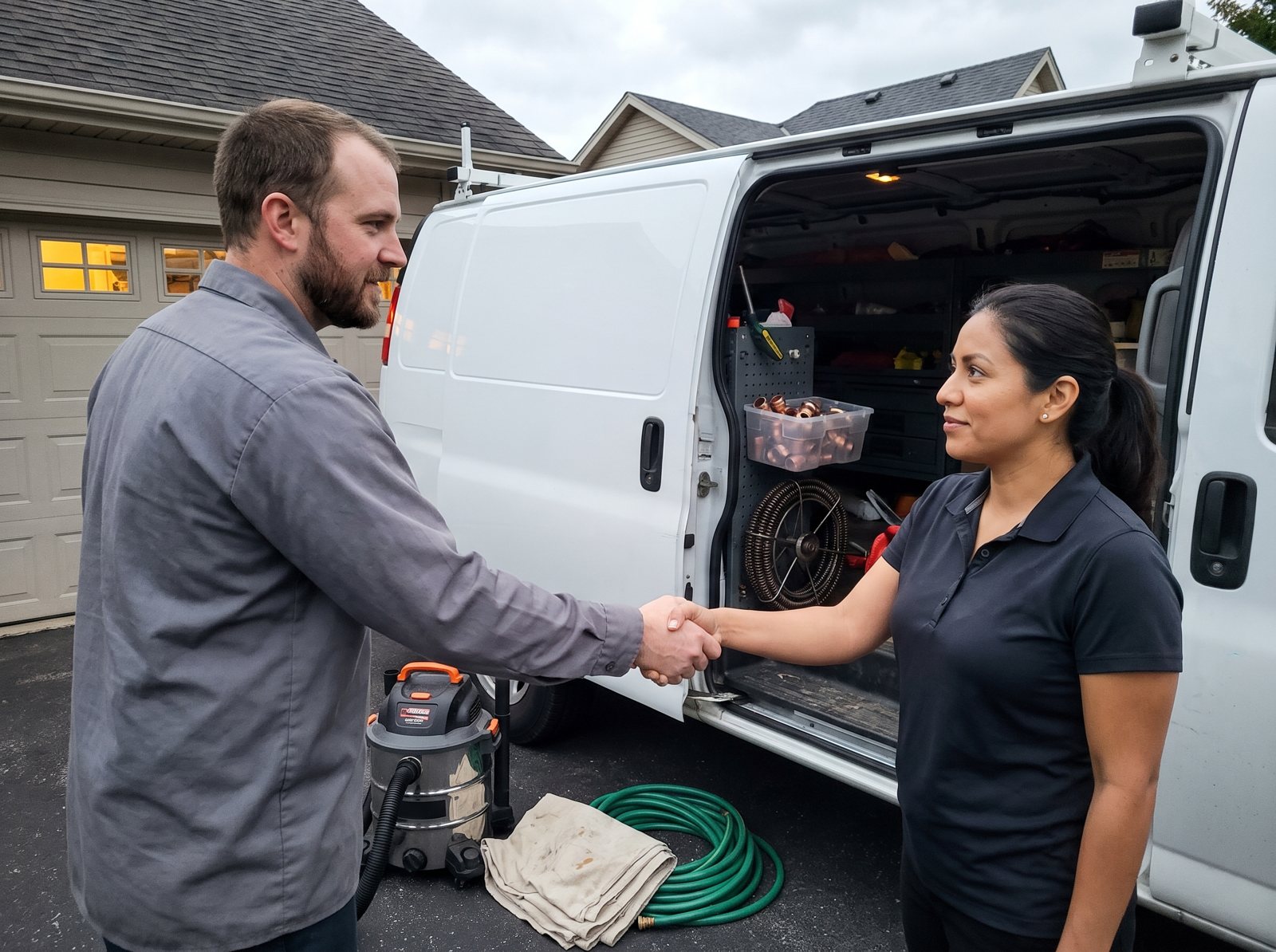
- Plumbers want to fix the leak and leave. They want you to show up fast, keep the homeowner calm and never take their plumbing work. Ask the homeowner if it’s OK to share a couple of job photos with the plumber who sent you, then send them with the outcome. It makes the plumber look good for calling you.
- Insurance agents want their client off the phone and happy. Shane O’Dazier says it in the DocuSketch guide: “Don’t ask for the claims, ask for the questions.” Be the company they send a worried customer to.
- Property managers want one number that always answers. Offer a free pre-loss plan for each building: shutoff locations, contacts and your response steps. When a pipe breaks, you’re already on file.
A text to send a plumber after a referral
A made-up example to adapt: “Hi Mike, it’s Dana from [your company]. Thanks for sending the Jensen job on Elm. We were on site in 50 minutes, extracted the kitchen and set drying equipment. Homeowner’s calm and the adjuster’s coming out Thursday. Photos attached. Anything we can do for your guys this week?”
Send it the same day. Then keep a short leave-behind in every truck: one card with your 24/7 number, your service area and what you’ll do in the first hour.
About referral fees
Referral fees are common. The magicplan guide says small plumbing shops often expect a referral bonus, and that “a few hundred bucks per job is common.” Before you pay one, check your state’s rules with your attorney.
We’d never offer an adjuster anything of value. Paying an insurance agent per referral can also run into state insurance rules, so clear it with your attorney first. Put any fee deal in writing. A fast crew and a same-day update give a plumber a reason to call you, check or no check.
TPA and program work
Third-party administrators, or TPAs, send you claims from insurance carriers. You get steady volume, and you pay for it in fees, set price lists and estimate reviews.
Restorers aren’t thrilled with them. In the Restoration Industry Association’s 2025 TPA Scorecard, 379 restoration contractors and industry pros rated the programs they had worked with in the past 12 months. The average overall score across 13 TPAs was 2.7 out of 5 stars, from 3.1 for ONCORE at the top to 2.1 for Accuserve at the bottom. The top areas for improvement were advocacy and partnership, accuracy of pricing and payment (including overhead and profit), and claims process flexibility.
On cost, a 2023 Cleanfax column put the typical TPA fee for handling a claim at around 5% to 10%, depending on the program. Ask whether it applies to mitigation only or to the full claim, rebuild included. The same column warns that a job from one of the program’s carriers can still have to run through the program, fee included, even if the job came to you directly. Read your agreement for that clause.
Run it with round numbers. On a $6,000 mitigation job, a 7% fee is $420. If you’d otherwise spend $300 in ads to sign that job, the program costs more. If your ads cost $600 per signed job, it costs less. Program pricing can also come in lower than what you’d bill direct, so compare what you keep, not just the fee.
We don’t tell owners to drop programs. We tell them to track program jobs on their own line and build direct work next to them, so a program change can’t empty the schedule. Our restoration marketing plan for program-heavy shops shows how we set that up.
Leads you own: your map pack and website
Every source above stops when you stop paying or stop calling on people. Your Google Business Profile and website don’t. Nobody bills you per call once they work.
For a water shop, owned leads come down to four jobs:
- A Google Business Profile set up for water. A water damage primary category, real hours you can staff, your service area and job photos.
- One page per loss type: water, sewage, flooded basements, mold. Each one answers what the caller is scared about, like insurance, drying time and whether they can stay home.
- A review request after every job. Reviews help you in the map, and Google counts your rating and review count in Local Services profile quality too.
- A fast mobile site with the phone number at the top, so someone standing in water can call in one tap.
Paid leads keep you busy while this builds. Our restoration SEO page has the full setup, and our guide to getting more Google reviews has request scripts you can send from the truck.
The first-call intake script
A lead isn’t a job until someone books it. The first two minutes on the phone decide that. When we listen to call recordings on restoration accounts, the lost jobs usually sound the same: a long pause, a price question nobody can answer, and no arrival time.

Give whoever answers this script. It takes about two minutes if the water’s already off. It works for your office, your on-call tech or an answering service.
- “Is the water still coming in?” If yes, tell them where the main shutoff usually is and stay on the line while they look. If water is near outlets, appliances or the electrical panel, tell them to stay out of that area and not touch anything electrical.
- “Can I get your name, the address and the best number to reach you if we get cut off?”
- “How did you find us?” If a plumber or agent sent them, write down the name so you can thank them the same day.
- “Where did the water come from?” A supply line, a toilet, a sump pump or a sewer backup. The source, and how long it has sat, tells your crew the likely water category under the IICRC S500 standard, and that changes the gear and the scope.
- “When did it start?” The answer tells the crew how long materials have been wet before they walk in.
- “Which rooms and floors are wet?”
- “Do you own the home, or rent?” A renter needs the owner or the property manager on board.
- “Are you planning to file with insurance?” Don’t promise coverage. Say you’ll document everything for the adjuster. If yes, get the carrier name and the claim number if they have one.
- “I can have a crew there between [time] and [time]. Can you text me two photos at this number?” Keep the arrival window to an hour or less, and give the earliest time you can really hit.
If they ask what it costs, try: “I can’t price it until we see and measure the wet areas. Here’s how the first visit works.” Then give your real policy, including what it costs, if anything. The arrival window matters most. The lost calls we hear usually end without one. With the next question printed in front of them, whoever answers doesn’t go quiet. The photos help too. They let the tech load the right equipment before leaving the shop.
Fix the first two minutes of the call before you buy more calls.
If nights are the weak spot, decide who answers before you turn on more leads. Some shops run an on-call rotation with a backup. Others use a live answering service or an AI receptionist like Restoral, our own system that answers calls, takes the details and books the job onto your calendar.
Whatever you pick, test it once a month at 2 a.m. Call your main business line, not your Google or vendor tracking number, which can bill you for the call. Then confirm in your call tracking tool, and with any vendor, that their numbers forward to that same line.
Track cost per signed job by source
If you can’t say what each source cost per signed job last month, you’re guessing about where to spend next month. A simple sheet fixes that. Give every source its own tracking number, so a call from the plumber card never gets counted as a Google call. On your Google Business Profile, put the tracking number as the primary number and your main line as an additional number, so your listings stay consistent.
Use one row per caller with these columns: date, time, source, caller name, loss type, answered (yes or no), amount billed, disputed or credited, booked (yes or no), signed (yes or no), invoice amount and why you lost it. At month end, add up each source. With made-up numbers, a month looks like this:
| Source (example month) | Spend | Calls | Signed jobs | Cost per signed job |
|---|---|---|---|---|
| Local Services Ads | $2,400 | 18 | 8 | $300 |
| Search ads | $3,000 | 14 | 6 | $500 |
| Pay-per-call vendor | $2,250 | 15 | 5 | $450 |
| Plumber referrals | $200 (lunches) | 6 | 5 | $40 |
In this example the vendor works out to $150 a call. Then you notice five of its 15 billed calls rang out on two busy nights. That’s $750 for nothing, and your five signed jobs came from the ten calls you answered. The vendor billed by its rules. The leak was your phones, and fixing it is worth more than a new channel. The “why you lost it” column is where you’ll find those leaks.
Give each new source at least 60 days and a few signed jobs before you judge it. Water is lumpy. One freeze can make a slow month look great.
Which mix of water damage leads fits your shop
The right mix of water mitigation leads depends on how long you’ve been open, how you answer the phone at night and how much program work you already do. This is where we’d start for four common shops, plus one that got burned.
Brand-new shop with no reviews
Start Google’s screening on day one, since it takes time. Run search ads on your core towns in the hours you can answer. Visit ten plumbers in your first month. Ask every customer for a review, because those reviews feed your map listing and your Local Services profile.
Established independent with a crew on call
Local Services Ads first, search ads for the emergency terms that pay off in your log, and a steady plumber and property manager program. Test one pay-per-call vendor only if your own call log shows you answer nearly every call live, nights included.
Franchise owner in a set territory
Check what corporate already runs before you buy anything, so you don’t bid against your own brand. Check your franchise agreement for rules on running your own ads and which ZIP codes you can target. Then put your local effort where corporate can’t: reviews on your territory’s own Google Business Profile, agent and adjuster relationships, and commercial pre-loss plans.
Shop that leans on TPA work
Keep the programs, and track them on their own line. Add one direct source at a time, starting with Local Services Ads and plumber referrals. Track your direct share of jobs each quarter. You want it rising.
If a pay-per-call vendor burned you
Pull the call recordings and count how many billed calls were missed, went to voicemail or hit your answering service. 33 Mile Radius, for one, says it has “a transparent process to resolve issues” with billing. Whoever your vendor is, get that process in writing, with the deadline. Come back to pay-per-call only once your nights are covered.
Water damage leads FAQ
How much does a water damage lead cost?
It depends on the source and your market. One lead vendor, 99 Calls, publishes what businesses paid nationwide over the last 12 months: $76 to $249 per Local Services lead and $175 to $1,123 per Google Ads lead. Judge any source by cost per signed job, not price per lead.
Are exclusive water damage leads worth it?
They can be, because nobody else is calling that homeowner. But read the billing rules first. Some vendors bill calls that ring 4 times unanswered, go to voicemail or reach an answering service. If your phones are covered day and night, exclusive calls can work well. If not, fix the phones first.
Is it legal to pay plumbers for referrals?
The rules vary by state, so ask your attorney before you pay anyone per job. Be extra careful with anyone who works in insurance, since insurance is regulated state by state. Put any fee deal in writing. Fast service and a same-day update give plumbers a reason to keep sending work, fee or not.
Do Local Services Ads still work for water damage?
On the water accounts we run, yes. They usually cost less per lead than search ads. Google is moving them into Google Ads as Performance Max campaigns with pay-per-lead goals, but you still pay per valid lead and the ads still show on Search and Maps. Save your old reports before the move, because Google says they won’t carry over.
How fast should I call back a water damage lead?
Answer live if you can, and call back within minutes if you can’t. On shared leads, other shops are calling the same person. On Local Services Ads, Google says missed calls may hurt your responsiveness, which may affect your ranking. Give callers an arrival window before you hang up.
What to do this week
- Call your main business line at night, not a tracking number, and see what happens.
- Set up the tracking sheet and give each source its own number.
- If you run Local Services Ads, save your reports now and write down your max cost per lead.
- Ask any lead vendor for its billable call list in writing.
- Print the intake script and tape it by every phone.
- Visit three plumbers with a leave-behind card.
Not showing up for “water damage restoration near me”? Our free audit checks 23 local SEO factors, from your Google Business Profile to your website, and shows what to fix first. If you do more than water, our guide to lead generation for contractors covers the other trades.


