
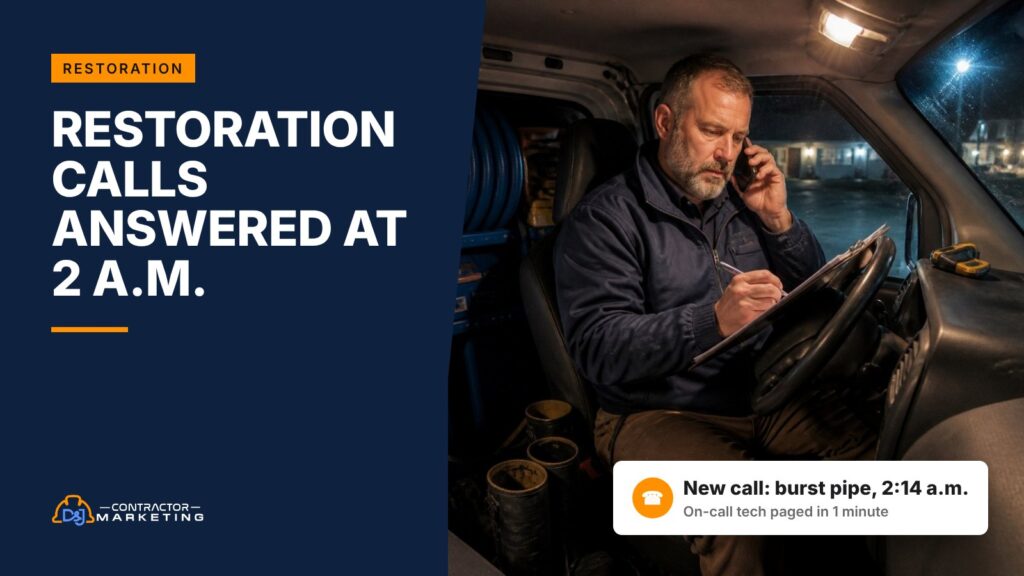
A pipe lets go at 2 a.m. The homeowner grabs a phone and calls restoration companies until somebody picks up. A restoration answering service decides whether that somebody is you.
This page is for restoration owners picking one. You’ll get the intake script we’d use word for word, who gets woken up and how fast, what it costs in a storm month, how Google bills missed calls on Local Services Ads, and ten test calls to run before you sign. It’s part of our restoration marketing playbook.
The short answer: pick the service, AI or live, that answers every call fast, takes a callback number and runs safety questions first, collects the address and loss details, promises a callback time, and pages your on-call tech with a backup if they don’t answer. Then test it at 2 a.m. with your own script before you sign. For most shops we’d use AI for the first answer and a person for transfers.
Key takeaways
- A good service does five things on every call: answer fast, keep people safe, get the facts, promise a callback time and wake the right person. The five jobs
- Speed matters because the EPA says to dry water-damaged areas within 24 to 48 hours to prevent mold. Why restoration is different
- Right after a callback number, the agent asks about fire, smoke, gas, electric and sewage, before the address. The intake script
- The page keeps moving down a ladder, tech then backup then owner, until a human says “got it.” The escalation ladder
- On Responsive’s Premium plan, our example freeze month costs nearly five times a quiet month, so budget for your worst month. Storm month cost math
- On Local Services Ads, a missed call where the caller stays on the line past 20 seconds, during your listed business hours and ad schedule, can be a charged lead. LSA missed call rules
- Judge a service on ten test calls you make yourself. The ten test calls
What a restoration answering service has to do on every call
A restoration answering service has to get a crew rolling. That takes five things on every call, in this order.
- Answer fast. A real answer in your company name within a few rings, whether it’s AI or a person. No phone tree.
- Keep people safe. Right after getting a callback number, ask if anyone is hurt, if there’s fire, smoke or a gas smell right now, if water is near outlets or the panel, and if it’s sewage. Some calls end right there with “get out and call 911.”
- Get the facts your crew needs. Address, what’s wet, where the water came from, how long ago, and whether it’s still running.
- Promise a callback time and keep it. “Our on-call tech will call you within 15 minutes” beats “someone will be in touch.”
- Wake the right person. Page the on-call tech with the whole story, and move to the backup if they don’t answer.
Most vendor pages promise step one and wave at the rest. Steps two through five decide whether a tech is in the truck in 20 minutes or reading a voicemail at 7 a.m.
The 15-minute number is our pick, not an industry rule. Use whatever your crew can hit every night.
Why restoration calls break normal answering services
A lot of general answering services are built to take a message and pass it on. A restoration caller isn’t waiting for that. They’re standing in water. If you don’t pick up, they call the next name on the list.
The EPA’s guide to mold and moisture says it’s important to dry water-damaged areas and items within 24 to 48 hours to prevent mold growth. A loss that waits until Monday morning can turn into a bigger, messier job, or into somebody else’s job.
Triple-I’s homeowners insurance data puts the average paid claim from 2019 to 2023 at $15,400 for water damage and freezing (which includes mold, where covered) and $88,170 for fire and lightning. Those are average insurer payouts per claim. They’re not your invoice.
Three more things make restoration harder than plumbing or HVAC:
- Spikes. A hard freeze or a big storm can stack calls faster than one on-call tech can return them. Ask any service how many agents are on at 2 a.m. in January.
- Noise on the line. Adjusters, program coordinators, vendors and customers on open jobs all call the same number as new losses.
- Safety. Water near a live panel or sewage in a basement isn’t a scheduling question. The agent has to know what to say first.
The intake script we’d hand any restoration answering service
Here’s the script we’d give any service, AI or live, before it takes a single call for a restoration shop. Copy it, change the names, and make the vendor show you it’s loaded word for word.
The opening
“Thanks for calling [your company], this is the emergency line. Is this about new damage, or a job we’re already working on?”
That one question splits the call. New damage goes down this script, and the very next line is: “In case we get cut off, what’s the best number to reach you tonight?” Flooded basements drop calls. Everything else follows the routing for adjusters, vendors and open jobs further down.
Safety first, before the address
- “Is anyone hurt, or is anyone in danger right now?” If yes: “Please hang up and call 911. We’ll be here after.”
- “Is anything burning, or is smoke still coming from somewhere right now? Do you smell gas?” If yes: “Please get out and call 911 or your gas company from outside.”
- If the fire is out and it just smells like smoke: “Has the fire department cleared the house for you to go back in?”
- “Is any ceiling bulging or sagging?” If yes: “Please stay out from under it.”
- “Is the water near outlets, cords or your electrical panel?” If yes: “Please stay out of that room. Don’t touch anything electrical.”
- “Does it look or smell like sewage?” If yes: “Keep everyone out of that area, especially kids and pets, and try not to touch the water.”
- “Is water still coming in? If you know where your main shutoff is and you can reach it without walking through standing water, turning it off will help.”
Notice what the agent never does: tell anyone to wade in, pull a breaker or start cleaning. Those calls belong to your crew lead, who can talk the caller through it.
The loss questions
- Your name? (The callback number is already taken.)
- The address of the damage? (Read it back. Ask for the cross street.)
- Is this a home or a business? Do you own it, rent it, or manage the building?
- If you rent: do you have the owner’s or property manager’s number? (Your crew needs the owner’s OK before work starts.)
- What happened: pipe, appliance, roof, toilet or drain backup, outside water, fire or smoke?
- About when did it start?
- Which rooms and floors are wet? Is there a finished basement?
- In a freeze: is your heat still on? (Our pick. Other pipes may be next.)
- If this line takes texts: “Can you text us a couple of photos to this number?” If not, give the tech’s cell in the close.
Insurance: ask, don’t advise
“Have you called your insurance company yet? Who’s your carrier? If you have a claim number, we’ll take it, and if not, that’s fine.”
The agent should never say a loss is covered. That’s the adjuster’s call. And no caller should get turned away because they don’t have a claim number at 2 a.m.
The close
“Thanks, [name]. I’m sending this to our on-call tech now. You’ll get a call from [number] within 15 minutes. If you don’t hear from us, call this line back and say ‘callback missed’ and we’ll go to the next person.”
For a calm, small loss where the water has stopped, swap in “within 30 minutes” so the promise matches the ladder below.
The “callback missed” line gives the caller a reason to ring you again instead of the next company. The callback still has to happen on time.
Who gets woken up, and how fast
The script doesn’t matter if the page goes to a tech whose phone is on silent. You need a ladder: who gets the first page, how long they have, and who’s next.
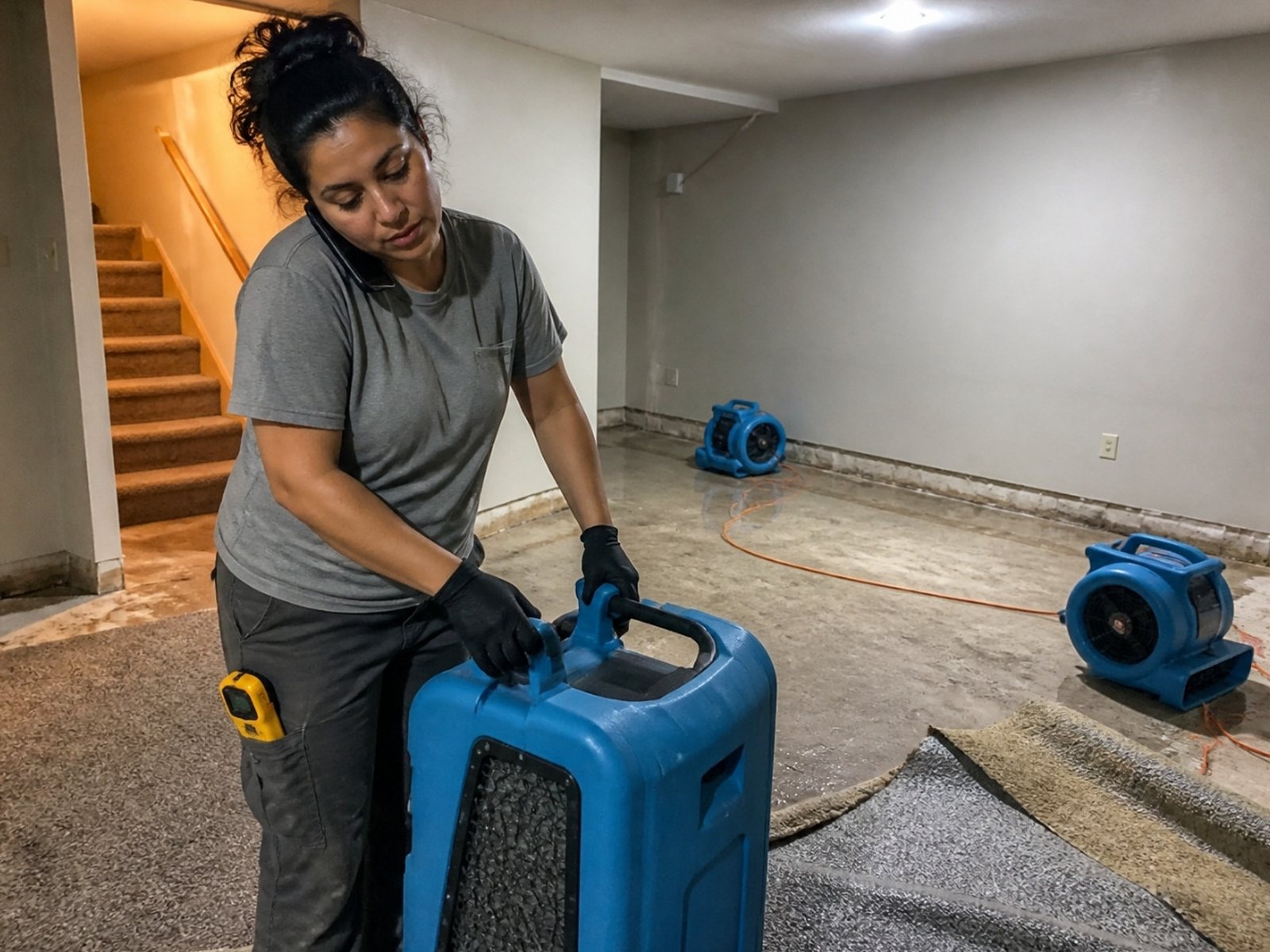
Here’s the one we’d start with. The time limits are our starting points, so tune them to your crew.
| Call type | What the service does | Time limit |
|---|---|---|
| Active water, sewage, fire or smoke, roof open to weather | Call and text the on-call tech with the full intake | Tech calls the customer within 15 minutes |
| No reply from the on-call tech | Call the backup tech, then the owner or ops manager | Next rung after 5 minutes each |
| No reply from anyone on the ladder | Call the customer back, say a tech is being reached, and keep paging | Before the 15-minute promise runs out |
| Water stopped, small area, caller is calm | Page the tech, who decides tonight or first thing | Callback within 30 minutes |
| Mold, odor or “old stain” questions | Book an inspection or put it on the morning list | Office calls by 9 a.m. |
| Contents, estimates, general questions | Morning list | Next business day |
Two rules make the ladder work. First, the page goes by call and text, not email. Second, the service keeps calling down the ladder until someone replies “got it” by text or on the phone. A voicemail pickup doesn’t count.
Why 5 minutes? Because the caller heard “15 minutes.” If the first tech doesn’t answer within 5, the backup still has time to keep that promise. Before you blame an answering service for lost night jobs, check whether you even have a backup. One on-call phone with no rule for a missed page is a weak link, no matter who answers the line.
Adjusters, TPAs, vendors and existing jobs
Your emergency line rings for a lot more than new losses. Adjusters, program coordinators, equipment vendors and customers on active jobs all call the same number, and none of them should wake up your on-call tech at 1 a.m.
The opening question (“new damage, or a job we’re already working on?”) does most of the sorting. Then give the service a short rule for each caller type:
- Adjusters and program coordinators (including TPAs, the third-party administrators that hand out work for insurance programs). Take the claim or file number and the question, and send it to whoever owns that file. If your programs set contact time rules, give the service those rules so a program assignment gets paged like a new loss.
- Customers on open jobs. “Is anything new wrong, like water coming back or equipment that stopped?” If water is coming back, page the tech. For equipment that stopped, follow your own rule: some owners page, some put it first on the morning list. If it’s “when are you coming back,” it goes on the morning list.
- Vendors and subs. Message only, unless it’s a crew lead who can’t get into a job site.
- Sales calls. Polite no, no message.
Ask every vendor how they’d handle a commercial property manager with three floors wet. That caller wants a person, and fast. We’d page that one straight to the owner.
AI receptionist, live service or both for restoration
You don’t have to pick one. For most restoration shops we’d let AI answer first and keep a person in the loop for the calls that need judgment.
| Task | AI receptionist | Live answering service |
|---|---|---|
| Answering at 2 a.m. on the first ring | Strong (our view; time the answer on every test call) | Good, if staffed that night |
| Reading the safety script the same way every time | Strong, if your test calls prove it | Good, depends on the agent |
| Ten calls in the same hour after a freeze | Ask how many it takes at once | Ask about hold times on storm nights |
| Booking straight into your calendar or CRM | Strong when it’s connected | Depends on the service |
| A crying caller or a big commercial loss | Should hand off to a person | Strong |
| Spanish-speaking callers | Ask which languages it handles | Some services list English and Spanish agents |
| Cost when call volume jumps | Varies: per customer, per call or per minute | Usually priced per minute or per call |
Our take: the AI or live debate matters less than the script and the ladder. A live agent reading a bad script loses the job. So does a bot that takes a message and stops.
The hybrid we like is simple. AI answers every call, runs the safety and intake script, books what it can and pages the on-call tech. If the caller asks for a person, or the loss is commercial, it transfers to your on-call phone or to a live service as a backup. Responsive Answering’s restoration page, for one, says its agents are fluent in Spanish and English, which matters if a lot of your night calls come in Spanish.
Want the bigger comparison across trades? Our guide to answering services for every trade covers plan types and fine print in more depth.
What a restoration answering service costs in a storm month
Most price pages show you a quiet month. Your phones don’t ring the same every month, so run the math on your worst month, because that’s when the bill and the jobs both pile up.
Here’s what three providers published when we checked on November 5, 2026:
- Responsive Answering (live, per minute). Its pricing page lists $29 a month with no minutes included and $1.25 a minute, up to $549 a month for 500 minutes and $1.15 a minute after that. There’s a one-time $75 setup fee. It also says all activity is rounded up to the next whole minute.
- Ruby (live, per minute). Its pricing page starts at 50 minutes for $250 a month and 100 minutes for $395.
- Goodcall (AI, per caller). Its pricing page starts at $79 a month for 100 unique customers, then 79 cents each, and says “We never meter minutes.” A unique customer is one phone number, once a month. Check which plan includes the booking and calendar tools you’d need.
Now an example calculation. Say a hard freeze brings your shop 300 calls in one month, at about 4 minutes each once you count the safety script and the read-back. That’s 1,200 billed minutes. A quiet month for the same shop might be 60 calls, or 240 minutes.
| Plan (published price) | Quiet month: 240 minutes | Freeze month: 1,200 minutes |
|---|---|---|
| Responsive Premium: $299 for 250 minutes, then $1.18 | $299 | $1,420 |
| Responsive Elite: $549 for 500 minutes, then $1.15 | $549 | $1,354 |
| Goodcall Starter: $79 for 100 callers, then 79 cents | $79 | $197.50 |
| Goodcall Growth: $129 for 500 callers | $129 | $129 |

Goodcall counts one phone number once a month, so we assumed some people call more than once: 50 unique callers in the quiet month, 250 in the freeze month. Goodcall’s plans are for an AI agent, so add the cost of whoever takes your transfers before you compare it with a live service.
On Responsive’s Premium plan, the freeze month costs nearly five times the quiet month. On Elite it’s about 2.5 times, so the plan you pick matters as much as the volume. On Goodcall, the freeze month is cheaper on Growth than on Starter, so switch plans before winter.
Rounding matters too. Responsive rounds all activity up to the next whole minute, so a 1 minute 5 second call bills as 2 minutes. Fifty of those bill 100 minutes for about 54 minutes of talk. That’s why we used billed minutes, not talk time, in the example above. Also ask whether outbound pages, ladder calls and callbacks to the customer count as billed activity. With a three-rung ladder, that can add minutes to every night call.
We left Ruby out of the freeze math because the plans we checked are sold in much smaller blocks, so ask Ruby for a quote at your winter volume.
Before you sign anything, ask for the overage rate, the rounding rule, any setup fee, whether booking or transfers cost extra, and whether you keep your own number (call forwarding) or have to move it. Then put one water job against the bill. Compare the gap between two plans with what one booked water job is worth to you. If one job covers it, choose on test calls, not price.
If you run Local Services Ads, a missed call can cost you twice
If you’re on Google’s Local Services Ads, a missed call costs more than the job. Google can charge you for the lead, and Google says missed calls may hurt your responsiveness, which feeds ad ranking.
Google’s help page on how leads work counts a missed call as a valid lead when it happens during your business hours and the caller stays on the line for more than 20 seconds. A call that hits voicemail or an automated greeting during business hours is charged the same way if the caller stays on past 20 seconds, message or not. “Business hours” means the hours on your Google Business Profile, and missed calls only count during your ad schedule too.
A lot of water damage shops list themselves as open 24 hours, because they are. If your profile says 24 hours and your ads run all night, a 3 a.m. call that rings out for more than 20 seconds can be a charged lead.
Then there’s ranking. Google’s page on ad rankings lists your responsiveness as a factor and says “Missed calls may negatively affect your responsiveness.” Average response time also counts toward profile quality.
So if you say you’re open 24 hours, answer like it. If you can’t yet, cut your ad schedule to the hours you can cover until the service is live. You’ll lose night leads that way, so keep it to a week or two. Our Local Services Ads guide walks through the rest of the setup.
Ten test calls to make before you sign
Make the ten calls below yourself, some after midnight. Ask for a trial or a test line with your own script loaded, because a demo built on the vendor’s generic script tells you almost nothing about how your calls will go.
- 2 a.m. burst pipe, water still running. Did it ask about the shutoff and safety before the address?
- Water near the electrical panel. Did it tell you to stay out of the room?
- Sewage in the basement. Did it tell you to keep everyone out and not touch the water?
- “The fire’s out, but the house still smells like smoke.” Did it ask whether the fire department cleared the house, instead of telling you to call 911?
- Panicked caller who talks over the agent. Did it stay calm and still get the address right?
- A hard address. An apartment number, a rural route or a new street. Did it read it back?
- An adjuster asking about a file. Did it route the call without paging your tech?
- A customer on an open job saying the dehumidifier stopped. Did it follow your rule for equipment failures (page now or morning list)?
- A caller who wants a person. Did the transfer work, and how long did it take?
- Two calls at the same time. Have a friend call while you’re on the line. Did the second one get answered or sit on hold?
After each call, check the page your on-call phone got. Was the address right? Was the story clear enough to dispatch from? Did the text arrive in under a minute? Could the caller text photos to the number they called? When your tech called back, did your business number show up, or a number the homeowner won’t pick up?
How to tell if your answering service is working
Check five numbers every week. They’ll tell you if the service is booking jobs or just answering phones.
| Number | Where to find it | What we look for |
|---|---|---|
| Missed or abandoned calls | Your phone system or call tracking | Close to zero, and none in a row at night |
| Time from page to callback | Page time vs. your tech’s outgoing call | Inside the promise you made on the call |
| New losses booked | Your CRM or job board | Every active loss has a job or a reason why not |
| Wrong or missing details | Ask the techs | Addresses and phone numbers right every time |
| Cost per booked job | Service bill divided by booked jobs | Compare months with similar call volume; it should drop as the script improves |
Then listen to three recorded calls a week, picked at random, not the ones the vendor sends you. If you record calls, check your state’s consent rules first and add a short notice to the greeting.
Want to see what your missed calls are costing right now? Plug your numbers into our free missed call calculator.
What we’d set up at three shop sizes
Whichever way you go, ask every vendor for the minimum term and the cancellation notice before you sign.
One or two trucks, owner on call
Keep answering yourself when you can, but forward anything you don’t pick up by the third ring to an AI receptionist with the safety script, and have it page you by call and text.
Set your carrier’s no-answer forward to about 15 seconds. On LSA, once a caller stays on past 20 seconds, Google can charge you for the lead whether you answer or not, so make sure the forward lands on something that books the job, not a dead ring. You’d still sleep through some pages, so name a backup, like a family member or a trusted tech who gets paid per callout.
Office manager plus an on-call rotation
The office answers during the day. After hours and on overflow, AI answers first and books into the same calendar or CRM the office uses. Put the ladder from above in writing, with a backup tech and the owner as the last rung. Review the five numbers every Monday.
Multi-crew shop with storm and freeze spikes
AI answers every call first, as long as it passed the two-calls-at-once test, so fewer callers sit on hold during a surge. A live person, yours or a service’s, takes transfers for commercial losses and upset callers. Write a separate storm-night script that sets honest arrival windows, because promising a 2-hour arrival you can’t hit turns into a bad review.
Where Restoral fits
Restoral is our own AI system for this job. It answers calls and chats and books jobs onto your calendar. It works with Google Calendar, Calendly, Cal.com, Jobber and most trade CRMs, and our team sets up the integration. Ask us for a walkthrough, then run the ten test calls on it like any other vendor. As an agency, D&J has worked with 30+ SERVPRO franchises and has never lost a SERVPRO client.
Restoration answering service FAQ
How much does a restoration answering service cost?
It depends on how you’re billed. On November 5, 2026, Responsive Answering listed live plans from $29 a month plus $1.25 a minute, Ruby started at $250 for 50 minutes, and Goodcall’s AI plan started at $79 for 100 unique callers. Price your busiest month, not your average one, since that’s when per-minute bills jump.
Should an AI or a live person answer water damage calls?
For most shops, both. Let AI answer first, run the safety and intake script the same way every time, book the job and page your on-call tech. Have it transfer to a person for commercial losses, very upset callers and anyone who asks for a human.
What should the answering service ask on a water loss call?
First a callback number, in case the call drops. Then safety: anyone hurt, fire or smoke right now, a gas smell, water near outlets or the panel, sewage. Then name, the address read back, own or rent, where the water came from, when it started, which rooms are wet, and the insurance carrier if they have it. End with a callback time.
How fast should the on-call tech call back?
We start restoration shops at 15 minutes for active losses, with the page moving to a backup tech after 5 minutes of no reply. Pick a number your crew can hit every night, tell the caller that number, and check it each week.
Do missed calls cost money on Local Services Ads?
They can. Google counts a missed call as a valid lead when it comes during your business hours and ad schedule and the caller stays on the line for more than 20 seconds. Voicemail or an automated greeting during business hours counts too, on the same 20-second rule. Google also says missed calls may hurt your responsiveness, which affects ad ranking.
Can the answering service book jobs into my CRM?
Some can, but ask for the exact system and watch a test booking land. Our own AI system, Restoral, works with Google Calendar, Calendly, Cal.com, Jobber and most trade CRMs, and our team sets up the integration. Whatever you use, the booking should show up where your office already looks.
What to do this week
- Call your own emergency line at 11 p.m. tonight and see what happens.
- Copy the intake script above and change it to fit your shop.
- Write down your ladder: first page, backup, owner, and the time limit for each.
- Pull last winter’s busiest month of calls and price it on two or three plans.
- If you run Local Services Ads, check that your profile hours and ad schedule match the hours you can really answer.
Answering only helps if the phone rings. Getting more calls in the first place is where restoration SEO and the tactics in our guide to water damage leads come in. If you want a second set of eyes on your call flow or your local rankings, start with a free audit.


