
Roofing SEO for companies that want booked inspections, not a ranking report.
When a homeowner finds a water stain on the ceiling, they grab their phone and search. If your roofing company isn’t in the map pack or the first few results, that call goes to someone else. Usually the roofer with more reviews, a sharper profile and a page about the exact job they need.
The short answer: roofing SEO means showing up on Google when local homeowners search for roof repair, replacement or storm damage help. Most of those calls start in the map pack, so the work starts with your Google Business Profile and reviews. Then come one strong page per roofing service, storm pages built before storm season, and tracking that counts booked inspections.
Key takeaways
- Google says local results mainly come down to relevance, distance and prominence, and you can’t pay for a better map ranking. How it works
- The biggest roofing buying searches, like “roof repair near me” at about 82,000 a month, are map pack searches. Roofing search terms
- Use “Roofing contractor” as your main profile category, list each service you want calls for, and keep keywords out of your business name. What we do
- Hail searches in 2025 ran about four and a half times higher in March and April than in December, so storm pages go up in winter. Storm season timing
- In Texas, a roofer’s website can’t offer to handle or negotiate the insurance claim. Insurance page rules
- Near-copy city pages that all funnel to one contact form can count as doorway abuse under Google’s spam policies. City pages
- We measure SEO by booked inspections and cost per inspection, not rankings. How we measure
How roofing SEO actually gets your phone to ring
Roofing SEO is the work that puts your company in front of homeowners when they search for a roofer on Google. For most roofers, that means two spots: the map pack (the three businesses under the map) and the regular results below it.
Win those for the right searches and you get calls for inspections. Lose them and you’re paying for leads: ads, lead sites or a canvassing crew knocking doors after a storm.
Google tells you how the map side works. Its help page says local results are mainly based on relevance, distance, and popularity, and it describes the third one under the name prominence. In plain words:
- Relevance: does your profile and site clearly say you do the job they searched for? A profile that just says “roofing” is weaker on relevance than one that lists leak repair, replacement and storm work.
- Distance: how close you are to the person searching. You can’t change where you’re based, so you work the other two.
- Prominence: how well known you are. Google says this is based partly on how many websites link to you and how many reviews you have.
The same page says there’s no way to pay Google for a better map ranking. So any agency that guarantees a top 3 spot is promising something Google says can’t be bought.
The regular results are different. Your website carries more weight there, so SEO for roofers is profile work plus website work: service pages, project photos and storm pages.
Which roofing searches go to the map, ads or AI answers
Roofing searches don’t all work the same way, and the page that wins one can be useless for the next. “Roofers near me” is a map pack fight. “Roof replacement cost” isn’t, because Google answers it with an AI summary and articles.
We pulled these numbers from Ahrefs Keywords Explorer in October 2026. They’re US estimates of average monthly searches, plus what Ahrefs saw on the results page. Use them to compare sizes, not as exact counts. They’re 12-month averages, so the hail chart further down, which shows each month of 2025, runs higher.
| Search | Monthly US searches | What Google shows | The page that wins it |
|---|---|---|---|
| roof repair near me | 82,000 | Map pack | Your Business Profile |
| roofers near me | 67,000 | Map pack | Your Business Profile |
| roof repair | 63,000 | Map pack | Profile plus a repair page |
| roofing contractors near me | 26,000 | Map pack | Your Business Profile |
| roof leak repair | 26,000 | Map pack | Profile plus a leak repair page |
| roof replacement cost | 19,000 | AI summary, no map | A real cost guide |
| storm damage roof repair | 14,000 | AI summary and map pack | A storm damage page |
| flat roof repair | 12,000 | AI summary and map pack | A flat or commercial roof page |
| emergency roof repair | 10,000 | Ads on top, then map pack | Profile plus an emergency page |
| commercial roofing contractors | 4,900 | Map pack | A commercial page |
| metal roofing contractors | 3,500 | Map pack | A metal roofing page |
| hail damage roof | 3,500 | AI summary, no map | A hail guide |
| roof insurance claim | 1,400 | AI summary and forum threads | An insurance guide |
The biggest buying searches are all map pack searches. That’s why we start almost every roofer on the Google Business Profile before anything else.
The research searches (cost, hail, insurance) don’t show a map at all. They still matter. A homeowner reading about hail damage today may be booking an inspection next week. You only reach them with a page that answers the question better than the AI summary does.
Commercial roofers have a different buyer. Property managers and building owners search terms like “commercial roofing contractors” (about 4,900 a month, with a map pack) and “flat roof repair.” They want roof systems, maintenance plans and proof you’ve worked on buildings like theirs. That needs its own commercial page: the roof systems you install (TPO, EPDM, metal), what your maintenance plans cover, the building types you’ve worked on, and a contact path built for a property manager, not a homeowner.
For the research searches with AI summaries, plain question and answer sections help. So do your own photos and stated facts: materials, timelines, what an inspection checks. That gives Google something specific to pull from. Cost and hail guides should get a fresh look at least once a year, so the facts on them stay current.
Emergency searches are the odd one out. When water is coming through the ceiling, Google puts paid ads on top, so SEO alone won’t own that moment. For those, we usually pair your profile with Local Services Ads and an AI receptionist, so the 11 p.m. leak call gets answered instead of going to voicemail.
What our roofing SEO work covers
Here’s the actual work, in the order we usually do it. Most of it is work you could do yourself if you had a free week in May.
A Google Business Profile set up like a roofer’s
Your primary category should almost always be “Roofing contractor.” Google’s own guidelines say to choose the fewest number of categories it takes to describe your overall core business. So we only add a second category, like “Siding contractor” or “Gutter cleaning service,” when it’s real work your crews do every week. Check the exact names in your own category picker, since Google changes the list.
The services list is the next fix. We add each job you want calls for: leak repair, full replacement, storm and hail repair, inspections, metal, flat roofs, gutters. Each one gets a plain description.
Two rules matter here. If you work out of a shop or home that customers don’t visit, Google says you should hide your business address and show a service area. And don’t stuff “Best Roof Repair Dallas” into your business name. Google says unnecessary info in the name isn’t permitted and could get the profile suspended.
One strong page for each roofing service
One “Services” page that lists eight things in bullet points rarely ranks well for any of them. We build a page per service you want to sell: replacement, repair, leak repair, storm and hail damage, metal, and flat or commercial if you do it.
A good roofing service page shows your own job photos, names the materials you install, walks through what happens at the inspection, and ends with one clear way to book. It answers what a homeowner asks on the phone. How long does a tear-off take? Will you protect the landscaping? Do you haul away the old shingles?
Under the hood, the site has to load fast and read well on a phone. We also add business details in code (called schema) so Google reads your name, phone and services the same way your profile shows them.
A review system your crew will actually use
Reviews count twice for a roofer. They help your map ranking, and they’re what a homeowner reads before letting a stranger on the roof.

The best time to ask is at the final walk-through, when the yard’s clean and the customer is happy. We set up a short text with your review link (our free review link generator makes one in a minute) and a follow-up a couple of days later.
Keep it clean. Google’s review policy doesn’t allow discounts or gifts for reviews, asking only happy customers, or telling staff to get a set number of reviews. The FTC’s 2024 rule also bans rewards that depend on the review saying something positive or negative. Ask every customer, the same way. More on that in our guide to getting more Google reviews.
Local links that make sense for a roofer
Google says prominence is based partly on how many websites link to your business. For roofers, the useful links are close to home:
- The contractor locator on a shingle maker’s site, if you hold their certification.
- Your local home builders association and chamber of commerce.
- Local news or a neighborhood site covering a job or a roof you donated.
- Suppliers and real estate agents you already work with.
Listings count too. We make sure your name, address and phone match everywhere they show up: Bing Places, Apple Business Connect, Yelp, the BBB and the big home service directories. Each one has a free basic listing. You don’t need the paid upgrades for SEO. A mismatched phone number on an old listing is a common mess we clean up.
We don’t buy links. Google’s spam policies list buying links for ranking purposes as link spam. Paid sponsorships are fine for getting your name around town, but Google wants those links marked as sponsored, so don’t count on them for rankings.
Call and form tracking
Every SEO lead gets tagged: which page or profile it came from and which service it’s about. Calls from the profile and calls from the website are tracked separately. Without this, nobody can tell you if SEO is working, including us.
Storm season: build the hail pages before the hail
Hail searches aren’t steady. In 2025, US searches for “hail damage roof” hit about 7,700 a month in March and April, then fell to about 1,700 in December, according to Ahrefs estimates. That’s roughly four and a half times more people asking in spring.

A new page rarely ranks the week you post it. If your storm and hail pages go up after the first big storm, you’ve missed the peak and handed those homeowners to whoever planned ahead.
So we build or refresh storm pages in the slow months, usually December through February. Each one covers what hail damage looks like on your local roof types, what a free inspection includes, and photos from your own storm jobs.
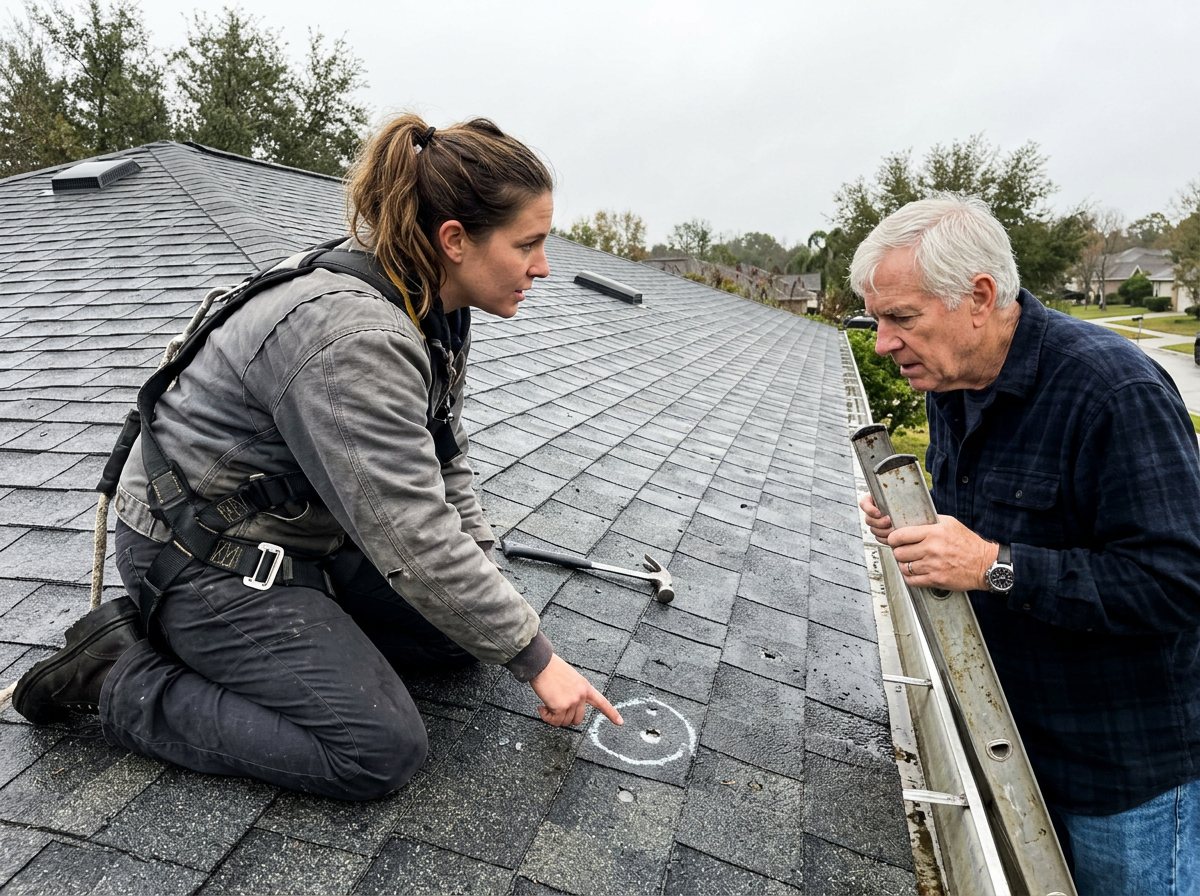
Leak repair is the opposite. Ahrefs shows “roof leak repair” at about 25,000 to 27,500 searches a month for the past year, with no storm season spike. Leaks happen all year, so your repair page has to be ready all year too.
Your storm season may not match the national curve, because storms don’t hit every region in the same months. We check the search trend for your own area before we set the calendar.
Insurance claim pages: what not to say
A lot of roofing work runs through insurance, so a lot of roofing websites talk about claims. Some of that talk can get you in trouble. Texas is a good example, because its insurance department spells it out.
The Texas Department of Insurance says a roofer can’t act as a public adjuster on a claim for a job they’re doing, and can’t advertise that they would. It also notes that state code defines advertisement to include a website. So your site copy counts.
Things TDI says your site shouldn’t offer or promise:
- Offering to negotiate claim settlements or file a claim for the policyholder.
- Promising to recover “every dime you are owed” from an insurer.
- Offering to waive, rebate or absorb the homeowner’s deductible (illegal in Texas).
What can you say? A 2024 TDI bulletin says contractors may provide estimates and discuss them, plus other technical details, with the insurer or its adjuster.
So our insurance pages stick to what you actually do. What the inspection covers. How you photograph and document damage. How your estimate is built. What the homeowner should expect from their own insurer. All of it is useful, and none of it promises you’ll fight their claim.
Every state is different, and this isn’t legal advice. If you work outside Texas, check your own state’s insurance department or ask your attorney before we publish claim copy.
Why we won’t build 40 city pages for you
Some agencies sell roofers a page for every town within 50 miles. Same text, new city name, swap the photo. We don’t do that.
Pages like that can count as doorway abuse under Google’s spam policies. One of the examples Google gives is “pages targeted at specific regions or cities that funnel users to one page.” Forty near-copies that all push people to the same contact form fit that description.
Storm chasing makes this worse. After hail hits a town far away, it’s tempting to spin up a page for it overnight. A page for a town you’ve never worked in won’t help much. Your Business Profile has its own limit too: Google says a service area shouldn’t extend farther than about 2 hours of driving time from where you’re based, with some exceptions.
Here’s what we do instead:
- Build strong service pages first. They can rank across your whole area.
- Add a town page only where you have real work there: jobs, photos, local roof styles, HOA or permit quirks you’ve dealt with.
- Post project pages as you finish jobs. A short write-up with photos of a real tear-off in a real town gives Google and homeowners proof you work there.
How we measure roofing SEO: booked inspections
Rankings are nice, but they don’t pay for shingles. We judge roofing SEO by the calls and forms it brings in and how many turn into booked inspections.
The monthly report tracks these lines:
| What we track | Why it matters |
|---|---|
| Calls from your Business Profile | The map pack is where most roofing buyers start |
| Calls and forms from your website, by page | Shows which service pages pull their weight |
| Booked inspections from SEO | The number your sales team actually works |
| Jobs sold from those inspections | Needs your CRM or a quick weekly update from the office |
| Cost per booked inspection | Lets you compare SEO with ads and lead sites |
| Reviews gained | Feeds rankings and close rate |
Divide what you spent on SEO last month by the inspections it booked. That’s your cost per inspection. Do the same for ads and lead sites, then put the numbers next to each other. If you’ve been renting leads instead of owning them, this is where you’ll see it.
Those numbers come from your tracking. That’s why we set it up in month one.
What the first three months of roofing SEO look like
SEO is slower than ads, and anyone who promises page one in 30 days is guessing. Here’s how the first three months usually go when we start with a roofer.
Month 1: fix the foundation
- Audit your profile, website and the top map results in your area.
- Clean up categories, services, service area, hours and photos.
- Set up call tracking and form tracking so we have a baseline.
- Start the review text at every final walk-through.
Month 2: build the pages that sell
- Write or rebuild your main service pages: replacement, repair, leak repair.
- Add storm and hail pages if storm work is part of your business.
- Set up one shared photo album or one number the crew texts job photos to, so the profile and site get new photos every week.
Month 3 and on: grow what’s working
- Go after local links and listings.
- Add project pages and answer the questions homeowners keep asking on calls.
- Check which pages bring booked inspections and put more into those.
How fast it moves depends on your market. A roofer in a small town with five competitors moves quicker than one in a metro area with fifty. We’d rather tell you that up front than sell you a timeline.
Why D&J for roofing company SEO
We’re a marketing agency for contractors and home service companies, based in Stamford, Connecticut. We’ve worked with more than 30 SERVPRO franchises and have never lost a SERVPRO client. Restoration runs on the same things roofing does: storm spikes, insurance jobs and 2 a.m. calls.
We’re a Google Partner and a Meta Business Partner. SEO is one piece of what we do. We also run Google Ads and Local Services Ads management, build websites, and handle reviews, so the pieces work together. If you want the bigger picture on roofing lead generation, start there.
Comparing quotes? Ask every roofing SEO company these questions, including us:
- Will you report booked inspections, or just rankings and traffic?
- How many city pages do you plan, and what will make each one different?
- Where will our links come from? Do you buy any?
- What will you change on our profile in the first 30 days?
- What will you change on our service pages in month two?
If a company can’t answer the first one, keep shopping.
Roofing SEO FAQ
How long does roofing SEO take to work?
It depends on your market and where you’re starting. Profile fixes and steady reviews can move you in the map pack sooner than new pages move in the regular results. In a crowded metro, expect several months before new service pages bring steady calls. Anyone who guarantees a date or a spot is guessing.
Is SEO or Google Ads better for a roofing company?
They do different jobs. Ads can put you on top today, which matters for emergency searches where paid ads sit above the map. SEO builds calls you don’t pay for per click, but it takes longer. For most roofers, we’d run ads while SEO grows, then shift budget as organic calls pick up.
Should I make a page for every city I serve?
No. Google’s spam policies list pages targeted at specific cities that funnel users to one page as doorway abuse. Build strong service pages first. Add a town page only where you have real jobs, photos and something specific to say about roofing there. Project pages for finished jobs do the rest.
Can I ask every customer for a Google review?
Yes, and you should. Google allows asking for honest reviews. What it doesn’t allow is offering discounts or gifts for reviews, only asking happy customers, or telling staff to hit a review count. Send the same short text with your review link to every customer after the final walk-through.
Do I need a separate page for insurance claims?
If insurance work is a big part of your business, yes. Keep it to what you do: the inspection, how you document damage, and how your estimate is built. Don’t promise to negotiate or file the claim. Texas, for one, doesn’t allow a roofer to advertise acting as the adjuster. Check your state’s rules.
What does roofing SEO cost?
It depends on how many services you sell, how big your area is and how hard your local competition is. That’s why we start with a free audit instead of a price list. Whatever you pay, compare it by cost per booked inspection, the same way you’d judge ads or a lead site.
What to do this week
You don’t need an agency to start. Here’s what you can do before Friday:
- Search “roof repair near me” from a job site in your area and note who shows up in the map pack.
- Open your Business Profile. Check your main category, your services list and your business name.
- Text a review link to every customer you finished a job for this month.
- Read your insurance and storm page out loud. Cut anything that promises to handle the claim.
Want a second set of eyes? We’ll look at your profile, your site and the roofers beating you in the map pack, and tell you what we’d fix first. Want to work on reviews now? Read our guide to answering Google reviews.


