
A no-cool call, a $9,000 replacement and a $150 tune-up don’t come from the same place. Each one needs its own budget.
A lot of agency reports stop at leads. Leads don’t tell you if you booked a $9,000 install or an $89 service call. That’s how a shop ends up paying install prices for tune-up clicks, missing calls in July and going quiet in October. We report on booked jobs instead. A lead that never books is just a cost.
The short answer: HVAC marketing works when each job type has its own channel and budget. Local Services Ads and fast phones win emergency repairs, the calls that can’t wait until tomorrow. Search ads, strong pages and quote follow-up win replacements. Your customer list wins tune-ups and maintenance plans, because those people already know you and already have your number. Then you track all of it by jobs on the schedule, not leads.
Key takeaways
- Emergency repairs, replacements and tune-ups each book through different channels, so each gets its own budget. Channel by job type
- In LocaliQ’s 2025 sample, median search ad leads cost $127.74 for AC and $129.02 for heating, so judge each channel by what it costs to book a job, not a lead. What HVAC leads cost
- ENERGY STAR tells homeowners to check cooling in spring and heating in fall, which sets your two tune-up pushes. Budget by season
- At about $1,500 a month we’d skip broad search ads and put the money into your profile, reviews, Local Services Ads and your customer list. Three budget levels
- A missed Local Services Ads call during business hours can be a paid lead if the caller stays on more than 20 seconds. Missed calls
- Your report should show sold work and its cost by channel, not just impressions. How we measure
- Before signing with any agency, make sure your ad, Local Services Ads and Google Business Profile accounts stay in your name. Questions to ask
Good HVAC marketing books three different kinds of jobs
Each one books a different way, and repairs come in two speeds. Lump them into one “HVAC lead” bucket and you overpay for some and miss the rest.
We split them like this:
- Repairs. Some can’t wait: the house is 88 degrees or the furnace quit at night, and the homeowner calls whoever shows up first with good reviews. Others, like a noisy heat pump, can wait a day. Speed and phone coverage win both.
- Replacements. A big ticket and a slow decision. Many people get more than one quote and pick the company they trust. Fast follow-up on the estimate decides a lot of these.
- Tune-ups and maintenance plans. Small tickets, but steady, and they fill the weeks when nothing is breaking. Your own customer list wins these.
The calendar matters too. ENERGY STAR tells homeowners that contractors get busy once summer and winter hit, so it’s best to check the cooling system in the spring and the heating system in the fall. That gives you two times a year to sell tune-ups before the rush.
When we build an HVAC marketing plan, the first question is which of those three jobs you want more of, and in which months.
HVAC marketing services we offer
A one-truck shop doesn’t need retargeting ads. We turn on what fits your crew and the jobs you want more of.
Google Business Profile and local SEO
This is how you show up in the map pack when someone searches “ac repair near me.” We set the right categories and services, add real job photos, and link your profile to the right service pages. It takes months to build. Once it’s built, the calls it brings don’t cost you per click. That’s why we start it first. The full playbook is on our HVAC SEO services page.
Local Services Ads
Once you pass Google’s screening and checks, your ad can show the Google Verified badge. Google says the Local Services unit is shown prominently in Google Search results when people search for your services in your areas. You don’t pay per click. Google says you’re charged for each valid lead, and the price can change with your location, the job type and the type of lead.
Getting in takes some work. Google lists HVAC as an urgent category, so HVAC pros go through an extra level of screening that includes background checks. We handle the setup, the job types and the service area, and we keep an eye on lead quality. Our Local Services Ads guide and our page on the Google Verified badge go deeper.
Google Ads (search)
Search ads let you pick the exact jobs you pay for. We run repair, replacement and maintenance as separate campaigns with their own budgets, so a cheap tune-up search never eats the money meant for installs. We block the junk too: “hvac jobs,” “hvac school,” “how to fix my own ac.” Calls from ads go to a tracked number, so we can match each one to a booked job.
Website pages built to book
Every ad and listing should land on a page that gets the call. That means one page per job, a phone number you can tap, real photos and a short line on financing for replacements. We also take down old tax credit claims. The IRS says the 25C home improvement credit will not be allowed for any property placed in service after December 31, 2025, so any page still promising it has to change.
Reviews
In BrightLocal’s 2026 survey of 1,002 US consumers about local businesses in general, 47% said they won’t use a business with fewer than 20 reviews, and 74% only care about reviews from the last three months.
So we set up a review ask after every finished job, tune-ups included, with a direct link to your Google review form. You can make that link with our free Google review link generator. More on that in our guide to getting more Google reviews.
Facebook and Instagram
Social ads rarely bring in a no-cool call. They work better for tune-up offers, maintenance plan sign-ups and reminding past site visitors you exist. We also run regular posting through BuilderBase, our social media service.
Email and text to your own customers
Past customers are often the cheapest jobs to book, because you already have their number. We send seasonal tune-up reminders and maintenance plan renewals, plus follow-ups on open replacement quotes. Marketing emails have to follow the FTC’s CAN-SPAM rules, which include a valid physical postal address in every message and honoring opt-outs within 10 business days. We build that in. Texts have their own federal and state consent rules, so we only text customers who agreed to get texts.
Phone answering
If nobody answers, you paid for that call and got nothing. Frontline, our AI receptionist, answers the phone when your office can’t, so the caller gets an answer instead of a voicemail box.
Which channel books which HVAC job
We start an HVAC plan with this table. It shows which channel tends to bring which kind of job, so you can see where the next dollar should go.
| Job type | What people search or do | Channels that usually book it | What we track |
|---|---|---|---|
| Repair that can’t wait | “ac not cooling,” “furnace repair near me,” “emergency hvac” | Local Services Ads, map pack, Google search ads with a call button, live phone answering | Answered calls, booked calls, time to answer |
| Repair that can wait a day | “heat pump making noise,” “ac short cycling” | Google Ads, service pages, map pack | Booked diagnostics, average ticket |
| System replacement | “new ac unit cost,” “furnace replacement,” “heat pump installation” | Google Ads, replacement pages, reviews, follow-up texts and emails | Estimates run, close rate, revenue per sold job |
| Tune-ups and maintenance plans | “ac tune up,” past customers due for a visit | Your customer list, Facebook and Instagram, Google Business Profile posts | Plans sold, renewals, tune-ups that turn into repairs |
If calls roll to voicemail at 6 p.m., more ad spend just buys more missed jobs.
Replacements need two things a lot of shops skip. The first is the page that sells the job before the estimate, with real photos, a line on financing and a clear way to book the visit. The second is the follow-up after it. When we audit a contractor’s account, open quotes with no follow-up are one of the first leaks we look for.
Some people search for tune-ups, but your best tune-up buyers are past customers who already know you. A reminder to that list costs far less than a stranger’s click.
What HVAC leads cost, and what a booked job costs
Search leads for HVAC aren’t cheap. LocaliQ studied 3,211 home services search ad campaigns run by its customers from April 2024 to March 2025. In that sample, the median cost per lead was $127.74 for air conditioning and $129.02 for heating.
| Search ads, 2025 benchmarks | Cost per click | Conversion rate | Cost per lead |
|---|---|---|---|
| Air conditioning installation and repair | $9.68 | 6.56% | $127.74 |
| Heating and furnaces | $9.30 | 7.48% | $129.02 |
| All home services | $7.85 | 7.33% | $90.92 |

Facebook looks cheaper on paper. LocaliQ’s 2026 Facebook benchmarks put the average cost per lead for lead campaigns in the broad “home and home improvement” group at $42.95. That group isn’t HVAC only, and a form fill from a scroller isn’t the same as a call from someone whose AC just died. A form fill still needs a callback before it turns into a booking, so plan for that follow-up.
So we look past cost per lead to cost per booked job, by job type.
Say a search lead costs about $128 and your office books 1 in 3. That’s about $384 per booked call. A booked call isn’t a sale, though. If you close 1 in 3 replacement estimates, a sold replacement costs about $1,150 in ads. That can still pay on a $9,000 job. On a $150 tune-up, it’s a loss.
That’s why we split campaigns by job type. Our post on how to get HVAC leads without overpaying walks through more of this math.
How we split an HVAC marketing budget across the year
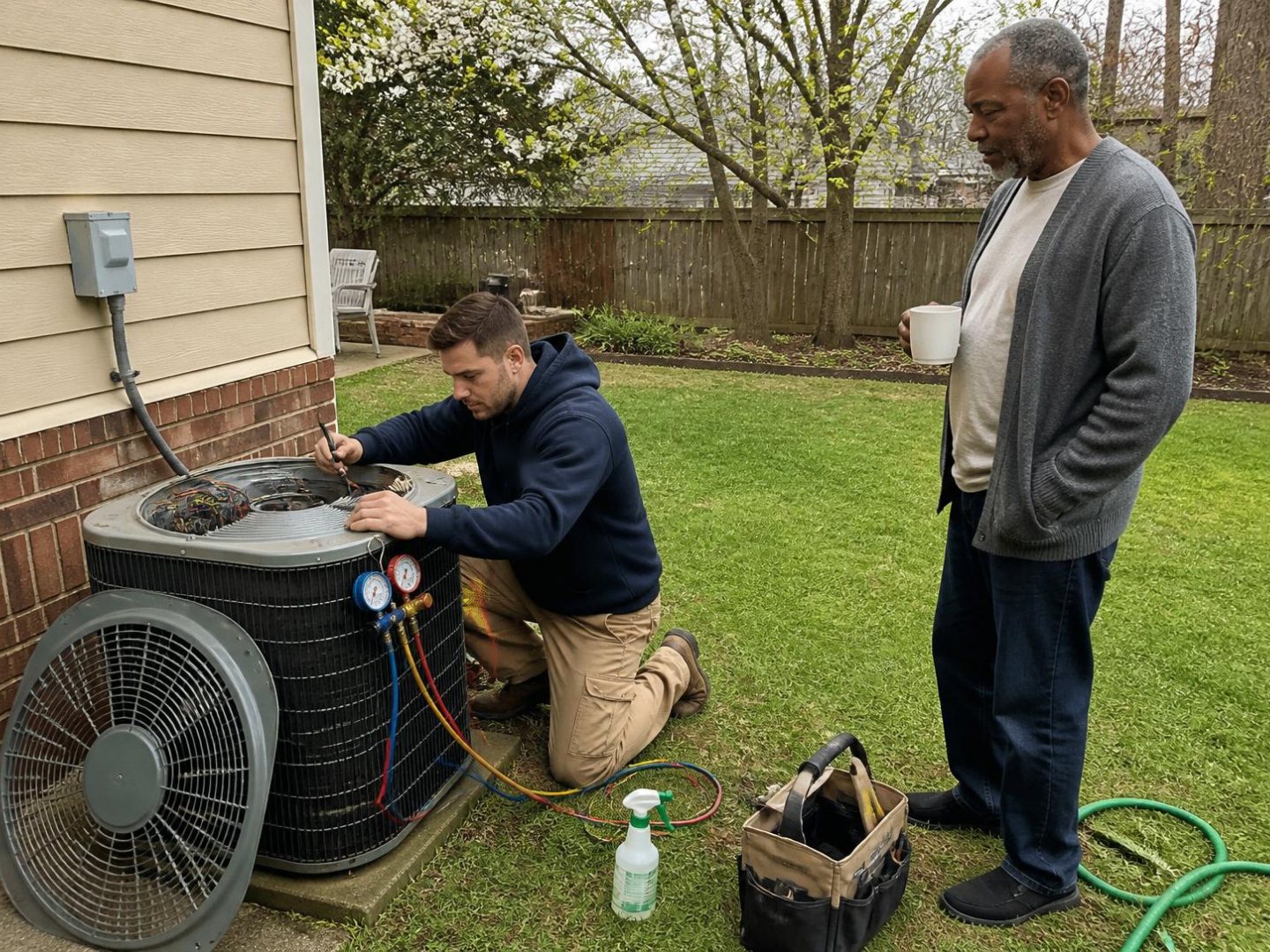
In most markets your phone rings more in July than in March, so your budget should too. We move money with the seasons instead of switching channels off. This is a rough split for a shop that does both heating and cooling. The percentages are an example for a mixed climate, not a rule. A Phoenix shop and a Buffalo shop will tilt it in opposite directions. If January is your busiest heating month, move money from November into it.
| Months | What’s happening | Where the money goes | Share of yearly paid budget (example) |
|---|---|---|---|
| January and February | Heating peak in cold areas, slower in warm areas | Heating repair ads in cold markets. Replacement follow-ups. Build or fix pages for the coming cooling season. | 10% |
| March and April | Before the cooling rush | Cooling tune-up push to your customer list. Maintenance plan sign-ups. Light spend on social tune-up offers. | 15% |
| May through August | Cooling peak | Most of the paid budget. Local Services Ads and repair search ads at full budget. Extra phone coverage. | 45% |
| September and October | Before the heating rush | Heating tune-up push. Furnace and heat pump replacement pages. Review asks on every tune-up. | 15% |
| November and December | Heating calls, holiday slowdown | Heating repair ads. Plan renewals. Year-end follow-up on open replacement quotes. | 15% |
The tune-up windows line up with what ENERGY STAR tells homeowners: check cooling in the spring and heating in the fall, and it suggests planning those check-ups around the time changes. That gives your reminder a real reason to go out on that date. Most of the US changes clocks in March and November, so “clocks change, check your system” is an easy reminder. Hawaii and most of Arizona don’t change clocks, so shops there should pick a date instead.
One common mistake: shutting everything off in the slow months. Your map rankings and review flow don’t pause, and the customer list still needs a reason to call. Cut the paid search budget in the shoulder months if you need to. Keep the reviews, the reminders and the pages going.
What we’d do with $1,500, $5,000 or $15,000 a month
Our starting point at three levels of total monthly spend. These are rough totals for your whole monthly marketing spend. They’re starting points, not packages. The split changes once tracking shows what actually books.
About $1,500 a month: one or two trucks
At this level, every dollar has to be close to a booked job. We’d put it into three things:
- A fully built Google Business Profile, a review ask after every job, and call tracking so every job has a source.
- Local Services Ads with a tight service area and only the job types you want.
- Spring and fall tune-up reminders to your past customers.
We’d skip broad search ads for now. Even if every dollar went to search ads at the $127.74 median cost per lead in the table above, you’d get 11 or 12 leads a month, and fewer once other costs come out. That’s thin.
Local Services Ads charge per valid lead, not per click. Prices vary by market and job type, so we run them for 60 days, then check the cost per booked job.
About $5,000 a month: a growing shop with an office
Now there’s room to go after replacements on purpose. We’d keep everything from the first level, then add:
- Google search ads split into repair and replacement campaigns, with their own budgets
- Replacement and heat pump pages built to sell the estimate
- Tracking tied to your field software, so booked jobs flow back into the ad account
- A follow-up sequence for every open quote
Facebook comes in small, only for tune-up and maintenance plan offers.
About $15,000 a month: multiple crews and a sales team
At this size, the bigger risk is two channels paying for the same customer and no one knowing which one booked the job. We’d run every channel on this page, plus:
- Separate budgets by season and job type, reviewed every week in peak months
- Revenue from sold jobs sent back into Google Ads, not just booked calls, so bidding learns from real sales
- Retargeting for people who visited a replacement page but didn’t call
- Short job-site videos for social and the website
- Extra phone coverage for peak-season nights and weekends
At every level we keep three things: reviews, phone coverage and your customer list. They’re cheaper to keep running than ads, and without them, fewer of the calls you pay for turn into jobs.
Missed calls cost you twice with Local Services Ads
With Local Services Ads, a missed call can still be a paid lead. Google’s help page lists the cases that count as valid leads. One of them is a missed call during your business hours when the caller stays on the line for more than 20 seconds. A voicemail counts too.
So you pay for the lead and the job goes to whoever answers next. In July, when the office is buried, that adds up fast.
Google does credit some low-quality leads on its own. But it no longer supports credits for “job type not serviced” and “geo not serviced” leads. So your job types and service area have to be set right from the start.
Here’s what we set up on the phone side:
- Business hours in Local Services Ads that match when someone can really pick up
- A rollover so a busy line rings a second person, not voicemail
- A callback rule for every missed lead, with a target time your office agrees to
- Frontline for nights, weekends and overflow
Google also says message leads are usually priced lower than phone leads, though not always. If your office is better at texting back than picking up, that’s worth a look.
How we measure HVAC marketing
We judge every channel by the work it puts on your schedule and the revenue behind it, split by job type.
Phone calls are where HVAC tracking often goes wrong. Google Ads can count a call as a conversion in two ways: by call length, using a minimum duration you set, or by using Google’s AI to review call recordings. Both help filter out short or junk calls. Neither tells you if the job was booked.
So we match calls to jobs. Calls and forms get matched to jobs in your field software, and once there’s search spend to learn from, booked jobs go back into the ad account. That way Google’s bidding learns from sold work, not from talk time.
Your monthly report from us shows:
- Booked jobs by channel and by job type (repair, replacement, maintenance)
- Cost per booked job for each channel
- Revenue from sold replacements and where each one started
- Missed calls and how fast they were called back
- New reviews and your current rating
- What we’re changing next month, and why
If a paid channel can’t show booked jobs after 60 to 90 days, we cut it and move the money. SEO gets longer, and we tell you where it stands each month.
The first 90 days of HVAC marketing with us
This is how we’d run the first three months for a shop that already has ads running and no clear idea which ones book jobs. Ads can ring the phone in the first weeks. SEO and reviews take longer, so we start them in month one too.
Month 1: tracking and the leaks
We audit your Google Business Profile, ad accounts and website. We set up call and form tracking and connect it to your field software. Then we fix the leaks: wrong job types in Local Services Ads, junk search terms, dead tax credit lines and phone gaps.
Month 2: campaigns by job type
Repair, replacement and maintenance get their own campaigns and pages. The review ask goes live after every job. Before tune-up season, we email and text your customer list.
Month 3: move the money
By month 3 there’s often enough data to see cost per booked job for the bigger channels. On a small budget it can take longer, and we’ll say so. We shift budget toward what books. Then we plan the next season. SEO is usually still building at this point.
What to ask any HVAC marketing agency before you sign
Whether you hire us or someone else, ask these before you sign anything.
- Who owns the accounts? Your Google Ads, Local Services Ads, Google Business Profile, analytics and domain should be in your name, with the agency added as a user. If you leave, you keep your history.
- How long is the contract, and how do I get out? Get the term, the notice period and what happens to your website in writing.
- Will the report show booked jobs or just leads? Ask to see a sample report. If it’s all impressions and rankings, that’s what you’ll get.
- How do you split repair, replacement and maintenance? If the answer is one campaign called “HVAC,” your install budget is paying for tune-up clicks.
- What’s the plan for my slow months? You want a real answer about tune-ups, plan renewals and quote follow-up. “We’ll keep optimizing” isn’t one.
- Who actually does the work? Ask who touches your account each week and how you reach them.
- What will you fix on my site first? A good answer is specific, like “your phone number isn’t tappable on mobile” or “your heat pump page still promises the old tax credit.”
If they dodge any of these, keep looking. Get the account ownership answer in writing.
Who we are
We’re a marketing agency for contractors and home service businesses, based in Stamford, Connecticut. We’re a Google Partner and a Meta Business Partner.
Every channel on this page is a service we offer: local SEO, Google Ads, Local Services Ads management, websites, reviews and reputation, social media through BuilderBase, video, and Frontline. One team runs every channel, so you don’t have to chase three vendors.
We’ve also worked with more than 30 SERVPRO franchises and have never lost a SERVPRO client. Restoration is emergency work too, so we plan phone coverage before we turn on ads. Here is how we handle marketing for restoration companies.
HVAC marketing FAQ
How much should an HVAC company spend on marketing?
There’s no single right percentage. Start from the jobs you want. Work out what a booked job is worth to you, then what you can afford to pay to book one. The lead cost section above walks through the math. A price that works for replacements usually fails for tune-ups. Spend more in peak months and less in the shoulder months.
What does an HVAC marketing agency do?
A good one runs the channels that bring you booked jobs and shows you which ones work. For us that means your Google Business Profile and SEO, Local Services Ads, Google Ads, website pages, reviews, social ads and email to your customers. It should also mean call tracking, so every job has a source, and a monthly report built on booked jobs.
Are Local Services Ads worth it for HVAC?
Often, yes, if someone can answer the phone. You pay per valid lead instead of per click, which suits emergency calls. But a missed call during business hours can count as a lead if the caller stays on the line more than 20 seconds. Set your job types and service area carefully, too. Google no longer gives credits just because a lead was for a job type or area you don’t serve.
How long does HVAC marketing take to work?
Paid channels can bring calls soon after they’re approved and live. Local Services Ads can’t run until you pass Google’s screening, and HVAC pros get an extra level of it, including background checks. SEO and reviews build over months, not weeks. That’s why we start them right away while the ads carry the early load.
Should HVAC companies advertise on Facebook?
Yes, but not for emergencies. When the AC dies, people search Google or call someone they know. That’s why we don’t count on Facebook for emergency calls. Facebook and Instagram work for tune-up offers, maintenance plan sign-ups and reminding past website visitors about a replacement. LocaliQ’s 2026 benchmarks put the average Facebook lead in the broad home and home improvement group at $42.95, and most of those are form fills, not phone calls.
What to do this week
You don’t need a new agency to start. Here are four things you can do this week without hiring anyone.
- Pull last month’s booked jobs and write the source next to each one. Leave “don’t know” where you don’t.
- Call your own number at 5:30 p.m. and on Saturday morning. See who answers.
- Search your website for “tax credit” and “25C” and fix any page that still promises it.
- Write down every open replacement quote from the last 60 days and call each one.
If you’d rather have us look first, start with a free local SEO audit, or talk to us about your whole HVAC marketing plan. For more ways to fill the schedule, our 15 HVAC marketing ideas and broader contractor marketing ideas are good next reads.


