
Most electrician marketing gets sold as “more leads.” But a dead outlet call and a 200-amp panel call aren’t worth the same, and they come from different places. And six career searches, led by “electrician salary,” add up to about 96,000 a month in the US. Some of those people will click your ads and never hire you. So we plan around the jobs you want and count booked jobs, not clicks.
The short version: electrician marketing works when service calls, planned upgrades and commercial work each get their own plan. Local Services Ads, your map listing and a phone someone answers bring in service calls. Search ads, job pages and quick follow-up book the bigger upgrades. Block job seeker searches, ask every customer for a review, and track cost per booked job by job type.
Key takeaways
- Service calls, upgrades and commercial jobs are searched for differently, so each one gets its own plan and budget. Plan by job type
- Six career searches like “electrician salary” add up to about 96,000 US searches a month, so a long negative list comes first. The job seeker searches
- LocaliQ’s median electrician search ad cost $12.18 a click and $93.69 a lead, so we judge campaigns on cost per booked job. What ads cost
- Local Services Ads screening takes 3 to 4 weeks on average, and a missed call in business hours can be billed if the caller stays on more than 20 seconds. Local Services Ads rules
- Whole house generator searches ran about 12 times higher in January 2026, a big winter storm month, than in April, so generator ads need to be ready before your storm season. Search seasons
- The federal credits that covered some panel upgrades and home EV chargers have ended, so old “30% back” lines should come out of your ads. Selling big jobs
- At about $1,500 a month, regular search ads wait while Local Services Ads, reviews and one strong job page come first. Three budgets
Start with the job, not the lead
A no-power call at 7 p.m. A panel swap in a 1960s ranch. A builder’s next 40 houses. Those are three different sales, and people look for each one in a different way.
| Job type | How people search | Where it comes from | What makes them call |
|---|---|---|---|
| Service and repair (dead outlets, tripping breakers, no power) | “electrician near me,” “emergency electrician” | The map pack, Local Services Ads, a phone that gets answered | Open now, close by, good recent reviews |
| Planned upgrades (panels, EV chargers, generators, lighting) | “ev charger installation,” “generator installation,” “electrical panel upgrade” | Search ads that land on a page for that job, SEO pages, past customers | A clear process, permit help, real photos, quick follow-up |
| Commercial and builder work | “electrical contractors near me,” plus referrals | Relationships first, plus a commercial page and a small, separate ad campaign | A certificate of insurance and license number ready to send, project photos, fast bids |
The setup we find most often is one campaign called “Electrician” pointed at the homepage. A homeowner wants a Level 2 charger in the garage. She clicks the ad and lands on a page about outlets and ceiling fans. There’s not one word about chargers, so she hits back and calls the next shop.
The fix is cheap. Keep the website. Add a charger ad group and a charger page that answers what she was wondering when she searched.
Builder work runs on relationships, not search. If that’s where your best jobs come from, Google won’t be your main channel. Keep a commercial page and a small campaign. Spend your real effort on the people who hand out the work. When they check you out, search just has to show them your license, your insurance and some clean project photos.
Electrician marketing services we run
This is the full menu for electrical contractors. Almost nobody needs all of it on day one, and part of our job is telling you what to leave alone for now.
Local Services Ads come first for most residential shops. You send Google your license and insurance papers and finish its background check. We handle the setup, pick the job types you want and switch off the ones you don’t. The rules that trip people up are further down.
Google Ads come next, split by job, each with its own budget and landing page. A long negative keyword list keeps out the people who want your job instead of your help.
Then the free side of Google. That means your Business Profile: “Electrician” as the primary category, only the few extra categories that match real work (Google’s guidelines say to use the fewest that describe your core business), services, photos from real jobs, and a page on your site for each job you want more of. Our electrician SEO page goes deep on that part.
Then the pieces that stop paid calls from leaking:
- Website fixes: a call button that stays on screen, your license number where people can see it, a short quote form. We don’t rebuild a site that already works.
- A review text after every job, and help replying to what comes in.
- Call tracking on every channel, plus Restoral, our AI system that picks up calls and chats when your team can’t and books the job onto your calendar. It works with Google Calendar, Calendly, Cal.com, Jobber and most trade CRMs, and our team sets up the connection.
- Job photos posted through BuilderBase, our own social media tool, so your pages show recent work when people check you out.
If you’d rather try a few cheap things yourself before hiring anyone, our list of electrician marketing ideas is a good place to start.
Lots of people searching “electrician” want to become one
Plenty of people typing “electrician” into Google want the job, not the service call. Apprentices, students and career changers aren’t going to hire you, and every click from them costs money.
Look at the career searches next to the buying ones. These are Ahrefs monthly US estimates from a snapshot we pulled on October 17, 2026.
| Search | About how many a month | What they want |
|---|---|---|
| electrician salary | 40,000 | Pay info |
| electrician school | 19,000 | Training |
| how to become an electrician | 14,000 | A career |
| electrician jobs near me | 11,000 | A job |
| electrician jobs | 10,000 | A job |
| electrician apprentice | 2,200 | An apprenticeship |
| electrician near me | 216,000 | Mostly people who need an electrician |
The six career searches add up to about 96,000 a month. On broad or phrase match, Google can show your ads to some of them unless you tell it not to.
This is the starting negative list we work from before tuning it to your area. Single words without quotes are broad match negatives. They block any search that contains that word. Phrases in quotes are phrase match negatives, which block searches containing those words in that order.
- job, jobs, hiring, career, careers, employment
- salary, salaries, wage, wages, earn, “electrician pay”, “how much do electricians make”
- apprentice, apprentices, apprenticeship, school, schools, class, classes, course, courses, training, degree, internship, internships, “apprenticeship program”, “training program”, “electrician requirements”
- exam, exams, certification, certifications, journeyman, IBEW, “how to become”
- resume, indeed, DIY, diagram, “how to wire”
See the singular and plural pairs? Google’s negative keyword help page says you have to add synonyms and singular or plural versions yourself. “Job” alone won’t stop “jobs.”
If you chase union or commercial work, drop IBEW and journeyman, since some buyers search for union contractors by name. If you bid school projects or your shop sits on School Street, drop “school.” And we never block “hourly” or “license,” since real customers type those when they’re checking rates or looking you up. Same for “program” and “requirements” on their own, because people looking up charger rebates and install rules use them.
Put the list in a shared negative list and apply it to every search campaign. Local Services Ads don’t use keywords, so it only protects your regular search ads. Then read the search terms report every week for the first two months. Expect to add new negatives every week at first, things like “electrical supply near me.”
Searches we bid on and pages we build
With the job seekers fenced out, this is where the money goes. Same source: monthly US estimates from Ahrefs Keywords Explorer, pulled October 17, 2026. Each one gets a matching destination, usually its own page.
| Search | About how many in an average month (US) | What the person wants | Where we send it |
|---|---|---|---|
| electrician near me | 216,000 | Someone local, often today | Local Services Ads, map listing, service call page |
| emergency electrician | 27,000 | Help right now | Ads with a call button, run only when you can answer |
| ev charger installation | 81,000 | A charger quote | EV charger page with permit and panel questions answered |
| generator installation | 30,000 | Backup power | Generator page, storm season budget |
| whole house generator installation | 3,900 | A bigger standby system | Same page, with a site visit offer |
| electrical panel upgrade | 12,000 | Research, then a quote | Panel page with photos and a clear process |
| electrical contractors near me | 8,500 | Homeowners, businesses and builders mixed | Commercial page, small separate campaign |
Keep in mind these are national numbers, and your town is a thin slice of each. That’s why we’d rather own three job types in your county than chase every electrical search there is.
Some searches look great and book badly. “Electrician cost” and “how much does an electrician charge” mostly bring in price checkers, in our experience. They get a small test budget and a short leash, and if they don’t book in a month or two, we cut them.
What electrician ads cost, and the number to watch
Electrical clicks are some of the priciest in home services, so every wasted one costs real money.
LocaliQ studied 3,211 US home services search campaigns that ran from April 2024 to March 2025. Its benchmark report lists these for electricians and electrical contractors. LocaliQ calls them averages, but its notes say they’re medians.
- Cost per click: $12.18, second only to painting among the groups it tracked
- Click rate: 5.15%
- Conversion rate: 9.08% of clicks became a lead
- Cost per lead: $93.69
And a lead isn’t a job. Some are price checks. Some live two counties over. Some never pick up when you call back. The number we manage is cost per booked job, split by job type.
Here’s an example calculation. The ticket sizes and booking rates are made up to show the math. They aren’t from any shop. At LocaliQ’s median cost per lead, $1,500 buys about 16 search leads. LocaliQ doesn’t break costs out by job type, so both rows use the same median, and your real charger and service leads won’t cost the same.
| Example campaign | Monthly spend | Leads | Booked jobs | Cost per booked job | Example ticket |
|---|---|---|---|---|---|
| Service calls (search ads) | $1,500 | 16 | 6 | $250 | $400 |
| EV chargers (search ads) | $1,500 | 16 | 4 | $375 | $2,000 |
Think of these as two campaigns inside a bigger budget, like the $15,000 plan below, not a $1,500 total plan.
The service campaign books more jobs, but marketing eats more than half of each $400 ticket. The charger campaign books fewer, and marketing is under a fifth of the ticket.
With numbers like that, we’d move money toward chargers. On the service side we’d tighten the map radius, trim the ad hours and cut the price shopper searches, or let Local Services Ads carry those calls. One caution before you write service calls off. The guy with the dead outlet in a 1950s house might be your panel job next spring, so don’t judge service calls on the first ticket alone.
Local Services Ads for electricians
For most residential shops, this is where paid spend starts. You pay per lead, not per click, and Google screens your business before your ads go live. Two catches, though. The screening takes weeks. And a call you don’t pick up can still land on your bill.

The screening
Google’s US screening page lists four checks for electricians: background, business registration, insurance and license. You also need a verified Business Profile. Google says it takes 3 to 4 weeks on average after you send in your documents. Pass it and you get the Google Verified badge, now the one badge for all Local Services advertisers. Google also ended the money back guarantee tied to the old Google Guarantee badge, so take that out of your sales pitch.
Before you upload anything, make sure your license, your insurance papers and your Business Profile all show the same business name. In our experience, if the license is in your personal name, it helps to have a document handy that ties you to the business, like your state registration listing you as owner.
How the billing works
Google’s How leads work page says you’re charged for each valid lead. One type catches people off guard: a call you missed during business hours, where the caller stayed on the line for more than 20 seconds.
If you’re in an attic all day, that rule matters. There’s one exception on the same page. If your phone menu asks callers to press a key and they hang up without pressing one, you aren’t charged. Still, the real fix is a person or a system on the other end. That can be someone in the office, a forward to a tech who’s free to talk, or Restoral picking up and booking the job.
We also set your ad hours to the hours someone can really answer, not the hours painted on the truck. You’ll show up a little less, which beats paying for calls nobody picks up.
Google says its systems credit some low-quality leads on their own, and you can give feedback on each lead in the survey on the Leads page. It won’t always get you a credit, but it tells Google what you don’t want. We do that every week for junk and out-of-area calls.
If unwanted leads keep coming, Google’s page says to refine your service areas, categories and service types. For most shops we start tight on all three and widen later. Our Local Services Ads guide walks through the whole setup.
When electrical searches rise and fall
Some electrical searches swing 9 to 12 times between a busy month and a slow one, and some of that swing follows storms rather than the calendar. If your page and budget show up after the rush starts, those calls go to the shop that was ready.
- Standby generators follow outages. In Ahrefs’ estimates, “whole house generator installation” hit about 15,800 searches in January 2026, the month Winter Storm Fern left more than a million customers without power, then fell to about 1,300 in April. In hurricane country, we’d expect the busy months in late summer and fall instead.
- If you hang holiday lighting (plenty of electricians don’t), it runs on the calendar. “Christmas light installation” hit about 82,900 in November 2025 and was down to about 8,900 by April.
- EV chargers grew. “EV charger installation” went from about 17,700 searches in September 2024 to about 85,100 in September 2026. Some of that jump may come from changes in how Ahrefs estimates volume, so don’t lean on the exact size. The direction is clear enough.
- Panel upgrades stay steadier. “Electrical panel upgrade” hit about 16,100 in July 2025 and about 9,500 that December.

Here’s how we plan around that. Standby installs need a site visit, a permit and usually a gas or propane line, so the generator page and ads go live a couple of months before your storm season: late spring in hurricane country, early fall where ice and snow take the lines down.
In our experience, once a storm is in the forecast, most new calls are emergencies and portable generator hookups, not standby sales. That’s a staffing problem more than an ad problem, so make sure someone can answer.
If you do holiday lighting, that page goes up in summer, because those searches start climbing in June. Ads ramp in the fall and wind down by mid-December. Panels and chargers run all year.
Selling panels, EV chargers and generators
These are your biggest tickets, and in our experience most homeowners get two or three quotes. The shop that answers the permit and power-off questions and follows up is usually the one they pick.
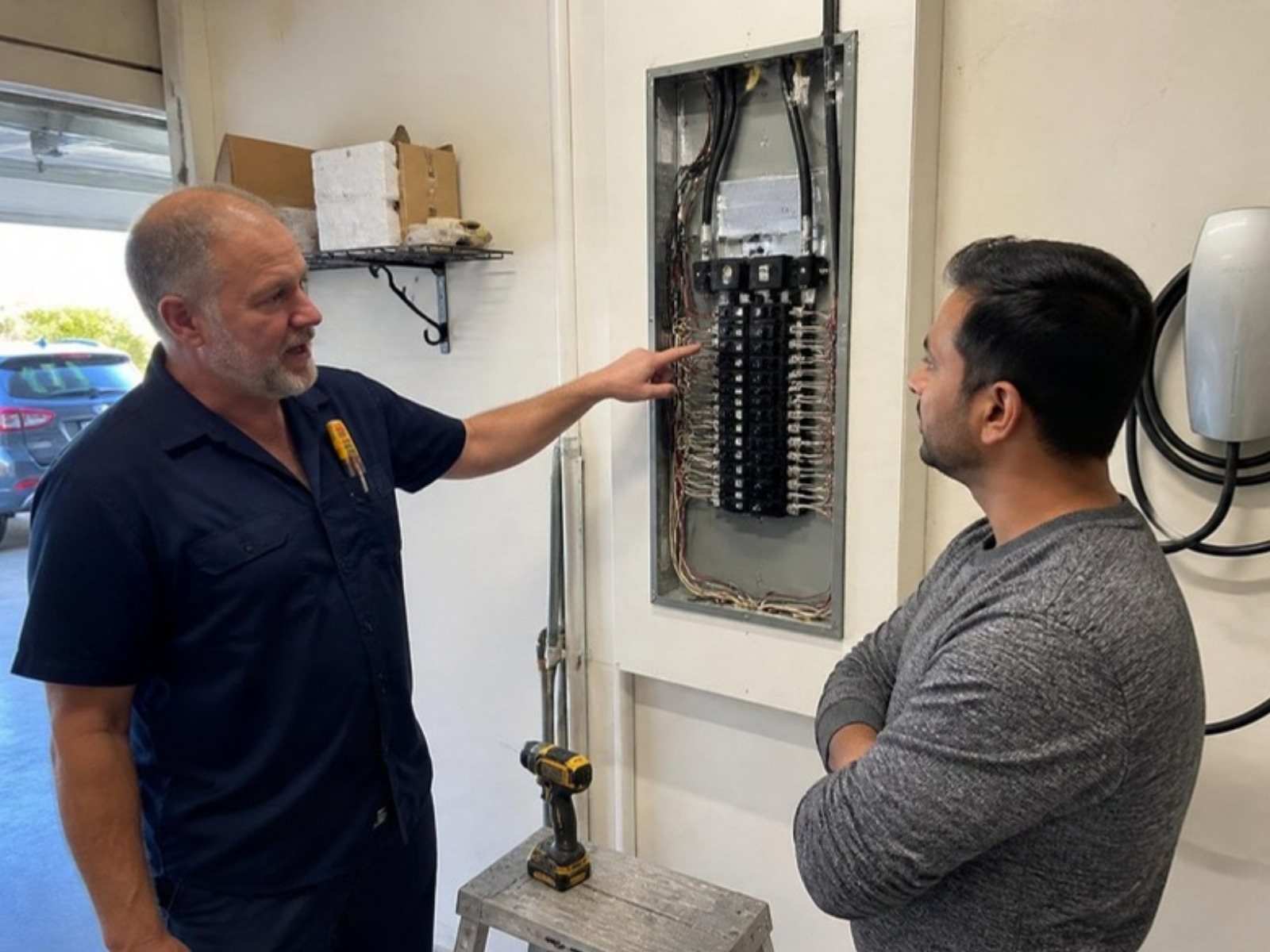
Give each job its own ad group, its own page and its own follow-up. The page should answer what people actually worry about. Does my panel need an upgrade before a charger? Who pulls the permit? How long will the power be off? What does the site visit cost? Use photos of your own installs, with the neat wire runs and labeled breakers in plain view.
Take the old tax credit lines out
If your ads or estimate emails still say “get 30% back with the federal tax credit,” that’s out of date. The IRS says the energy efficient home improvement credit (25C) isn’t allowed for anything placed in service after December 31, 2025. For panels, it was always narrow anyway. The IRS credit page limited it to 30% of the cost of panels and circuits rated 200 amps or more that were needed for qualifying energy equipment, up to $600 per item.
The home EV charger credit (30C) isn’t allowed for chargers placed in service after June 30, 2026. Before that, it only applied in certain low-income or non-urban census tracts and topped out at $1,000 per charging port, so it was never a safe blanket promise. The business version of the same credit ended on the same date, so pull it from commercial bids too.
A customer whose charger went in between January 1 and June 30, 2026, in an eligible census tract, may still be able to claim it on their 2026 return. Tell them to ask their tax preparer. For new jobs, take the line out.
Swap in what’s true where you work. Some utilities and states still run rebates, and DSIRE, a database of state and utility incentives, is a good place to check. If there’s nothing local, sell the job on speed and a clean, safe install.
The two-day estimate follow-up
A quote nobody follows up on gets forgotten under the fridge magnet. So set up a text that goes out two days after every estimate. Send it only to customers who agreed to get texts from you, from a registered business texting number. Copy it and change the details:
“Hi [first name], it’s [your name] from [shop name]. Just checking on the panel quote from Tuesday. Any questions about the permit or how long the power will be off? Happy to walk through it. Reply here or call [number]. Reply STOP to opt out.”
Send one more a week later, then stop. Two texts feel helpful. Five feel like a collections agency.
Your old customer list is the next place to look. Everyone you fixed a breaker for in an older house is a possible panel job. Everyone who asked about a generator and didn’t buy deserves a text before the next storm season, as long as they opted in.
Reviews that name the job
Reviews help you win the map and the phone call. The best ones say what you did, like “swapped our old panel” or “put in our charger in one day,” because that’s exactly what the next homeowner is scanning for.
But you can’t script them. Google’s Maps content policy says businesses shouldn’t ask for specific content in a review. It also bans incentives like discounts or free service, and it bans asking only the happy customers.
Ask every customer the same way and let them write what they want. A good walkthrough before you leave does more for the details than any script.
Here’s the text we set up to go out the evening of the job, again only to customers who opted in to texts:
“Thanks for having us out today, [first name]. If you have a minute, a Google review helps other homeowners find us: [review link]. Thanks, [your name]. Reply STOP to opt out.”
Before you leave, show them what you did. “Here’s your new 200-amp panel, here’s the breaker for the charger.” People write about what they remember. Our free review link generator makes the link, and our guide to getting more Google reviews covers the rest of the system.
Electrician marketing budgets at $1,500, $5,000 and $15,000
Each number below is monthly ad spend, the money that goes to Google. The bullets under it are the work we’d do at that level. Any agency fee is on top.
About $1,500 a month
Nearly all of the spend goes to Local Services Ads for the job types you want. The rest of the effort goes into things that cost time, not ad money:
- A plan for answering every call in business hours
- A cleaned-up Business Profile with fresh job photos each week
- A review text after every job
- Call tracking from day one
- One strong page for your best upgrade job, usually panels or chargers
We’d skip regular search ads here. Say you carved out $500 for them. At about $12 a click (LocaliQ’s median for electricians), that’s roughly 40 clicks a month. You can’t learn much from 40 clicks.
About $5,000 a month
A starting split might be $3,000 for Local Services Ads and $2,000 for search, then adjusted after 60 days once booked-job numbers come in. Search starts with two campaigns, service calls and your best upgrade job, both behind the full negative list. Pages for panels, chargers and generators go up, and tracking covers each new campaign so you can see what each booked job cost.
About $15,000 a month
Now each upgrade job gets its own campaign, and storm season and holiday lighting campaigns get added if they fit your market. A small commercial campaign can run if you want builder and business work. SEO pages keep going up, and after-hours answering plugs the night and weekend leaks.
How we track booked jobs
You only need to know two things about every call: where it came from, and what job it was.
Every channel gets its own tracking number or tag. That way an ad call never gets mixed up with a truck wrap call. Each call or form then gets a job tag: service call, panel, charger, generator, commercial or junk. Once a week, someone in your office spends 10 to 20 minutes going down the list and marking which calls turned into a job on the schedule and which ones went nowhere.
That’s enough for a monthly report that answers four plain questions:
- How many jobs of each type did each channel book?
- What did each booked job cost to get?
- How many calls were missed, and when?
- What are we changing next month, and why?
If your current report can’t answer number two, it can’t tell you whether the marketing pays.
Your first 90 days
Some of this pays off in weeks. SEO takes months, and you should hear that now, not in month four.
Month 1: fix the leaks
We audit your accounts, set up call tracking, add the job seeker negatives and clean up your Business Profile. If you’re not on Local Services Ads yet, the screening paperwork goes in during week one, since that part alone can take most of the month.
Month 2: split by job type
Search gets split into service calls and your main upgrade job. The first job pages go live. The review text and the estimate follow-up start running.
Month 3 and on: start moving the money
Small shifts start in month 3. Bigger moves wait until there are two or three months of booked-job data (less at bigger budgets), then money moves toward what books well and away from what doesn’t. More pages go up, and seasonal campaigns get built before their months arrive, not during.
Why D&J
We’re a contractor marketing agency in Stamford, Connecticut, and our whole business is marketing for contractors and home service companies. One team runs your ads, your map listing and your call tracking. So when a call gets missed, we can see where it came from instead of pointing at another vendor.
- Google Partner, Meta Business Partner and Yelp Partner
- Our own tools for phones (Restoral) and social posts (BuilderBase)
Our case studies page shows work for other home service businesses. If you do more than electrical, we also run HVAC marketing and plumbing marketing, so one team can cover the whole shop.
If you hire us, the first thing we open is your Google Ads search terms report and your Local Services Ads lead list from the last 90 days. Between them, they usually show where the money is leaking: job seeker clicks, out-of-area leads and calls nobody answered.
Electrician marketing FAQ
How much should an electrician spend on marketing?
Work backward from the jobs you want. Say your tracking showed each booked EV charger job cost $375 in ads. Ten more charger jobs would take about $3,750 a month, and a bit more in practice, since cost per job tends to creep up as you spend more. Without tracking you’re guessing, so start smaller, measure for a couple of months, then grow what books.
Are Local Services Ads worth it for electricians?
For most residential shops, yes. You pay per valid lead instead of per click, and you choose the job types. Plan for a few weeks of screening before the ads run, and have a way to answer every call in business hours, because missed calls can still be billed.
Do I need both Local Services Ads and a Business Profile?
Yes. Google’s screening for electricians requires a verified Business Profile, so you can’t run Local Services Ads without one. They also do different jobs. The ads are paid per lead for the job types you pick. The profile is your free listing on Google Maps, and it’s where your reviews and job photos live.
How long does electrician marketing take to work?
It depends on the channel. Search ads can bring calls within days of launch. Local Services Ads start once screening clears. Your map listing and reviews build over a few months of steady work, and SEO pages take the longest. Anyone who promises you a ranking by a date is guessing.
Who should own my ad accounts and listings?
You should. Your Google Ads account, Local Services Ads account, Business Profile, website and tracking numbers should be in your business’s name, with the agency added as a user. Then if you switch, you keep the history and the reviews. Ask in writing whether you can keep or port the tracking numbers too. Ask every agency that, including us.
What to do this week
You don’t need an agency for any of this. If we owned your shop, here’s what we’d get done by Friday:
- Open your Google Ads search terms report and look for job and salary searches. Add them as negatives, singular and plural.
- Search your ads and estimate emails for “tax credit” and “30%.” Replace any federal credit lines with what’s true locally.
- Compare your Local Services Ads business hours with the hours someone can really pick up.
- Set up the review text and the two-day estimate follow-up.
- Pull last year’s customer list and text anyone who opted in and asked about a generator or charger but didn’t buy.
Want a second set of eyes on it? Our free local SEO audit is a quick place to start, and it looks at your Business Profile and how you show up in local search. If you’d rather have someone go through your Google Ads and Local Services Ads first, talk to our team. For ideas that work across trades, see our contractor marketing ideas.


