
You don’t need more leads. You need more of the jobs you want, at a cost that leaves money on the ticket. A lot of agency reports stop at “leads.” Pair that with one lumped “Plumbing” campaign and you end up paying water heater prices for drain clicks. We plan and report on booked jobs instead, split by the kind of work you want more of.
The short answer: plumbing marketing works when emergencies, replacements and repeat work are each planned, paid for and tracked on their own. Local Services Ads, a strong map listing and fast phones win emergencies. Search ads, good pages and estimate follow-up win replacements. Your own customer list wins maintenance and repeat work. Then you count booked jobs per channel.
Key takeaways
- Burst pipes, water heater swaps and repeat drain work come from different places, so we never lump them into one budget. Plan by job type
- Searches for “frozen pipes” ran about 35 times higher in January than in October, so freeze pages and budget need to be ready early. When searches spike
- The median plumbing search lead cost $129.02 in LocaliQ’s 2024 to 2025 sample, which can work for a water heater and fail for a small drain call. Lead and job costs
- Negative keywords don’t cover plurals or synonyms, and an unquoted single-word negative blocks every search that contains it, so the list needs care. Searches we block
- With Local Services Ads, Google can bill you for an unanswered call in business hours once the caller has held on past 20 seconds. Missed calls
- With roughly $1,500 a month to spend, broad search ads wait; the map listing, reviews, Local Services Ads and old customers come first. Three budget levels
- Your marketing accounts should stay in your name, whoever runs them. Questions to ask
Plumbing marketing starts with the job you want
Before we spend a dollar, we sort your work into three groups. Each one finds a plumber in its own way.
Emergencies. A sewer backup, a leak through the ceiling, no hot water before work. Google treats plumbing as an urgent category for exactly this reason, and it names a hot water outage as the example. In our experience, these callers pick whoever answers first and looks trustworthy. Speed, reviews and a live voice win them.
Planned replacements. Water heaters, repipes, sewer line work, tankless upgrades. Bigger tickets, slower decisions. The homeowner has time to compare shops, and plenty of them do. The page they land on, the way your tech explains the options and the follow-up after the estimate decide most of these.
Recurring and commercial work. Drain maintenance, backflow testing, service contracts for restaurants and property managers. Small or steady tickets that fill the slow weeks. Most of this comes from people who already know you, so your customer list and your reputation do the selling.
Every budget and channel choice below hangs on that split. When a shop tells us “we need more leads,” our first question is: leads for which of those three?
Plumbing marketing services we run
A one-truck shop shouldn’t pay for what a ten-truck shop needs. Here’s each channel, what it’s for and when we’d turn it on.
Your map listing and local SEO
Your Google Business Profile decides whether you appear in the map when someone types “plumber near me” or “water heater repair.” We set your categories and services, add real job photos, tighten your service area and point the profile at the right pages on your site. It’s slow to build. Once it’s built, those calls don’t cost you per click, which is why we start it in month one. The full method is on our plumber SEO services page.
Local Services Ads
These are the Google ads that carry the Google Verified badge. There’s no charge per click. Instead, Google bills you for each valid lead, and it says lead prices can vary by where you are, which job it is, what kind of lead came in, and your bidding mode.
Getting approved takes paperwork. Since plumbing counts as urgent, Google puts plumbers through added screening, background checks included. We run the approval process, pick the job types you actually want and watch lead quality week to week. For the nuts and bolts, read our Local Services Ads guide and what the Google Verified badge means for you.
Google search ads
Search ads let you choose the jobs you pay for. We build separate campaigns for emergency repair, water heaters, drains and sewer, and commercial work, each with its own budget. That way a cheap drain search can’t eat the money meant for water heater installs. Calls from ads ring through a tracking number, which is how we tie each one to a job on the board.
Pages that book the call
Ads and listings need somewhere good to land. That means a page per job you want more of: water heater replacement, sewer line repair, drain cleaning, emergency service. Each one gets a number you can tap, real photos of your trucks and crew, and a plain answer to “can you come today?”
Reviews
People read reviews before they let a stranger into the house. BrightLocal surveyed 1,002 US adults for its 2026 review study. 47% won’t use a business that has under 20 reviews. And 74% said only reviews written in the past three months matter to them. That survey covers local businesses in general, not just plumbers, but the lesson holds: you need a steady flow.
So we set up a review request after every finished job. Every job, not just the happy ones. Google’s rules say businesses can’t selectively solicit positive reviews. Make your direct review link with our free Google review link generator, and our guide to getting more Google reviews has the texts we use.
Your customer list
Your old invoices are a marketing list. Every water heater you installed has an install date. ENERGY STAR’s fact sheet for gas water heaters tells homeowners that if a heater is over 10 years old, they should replace it before it fails.
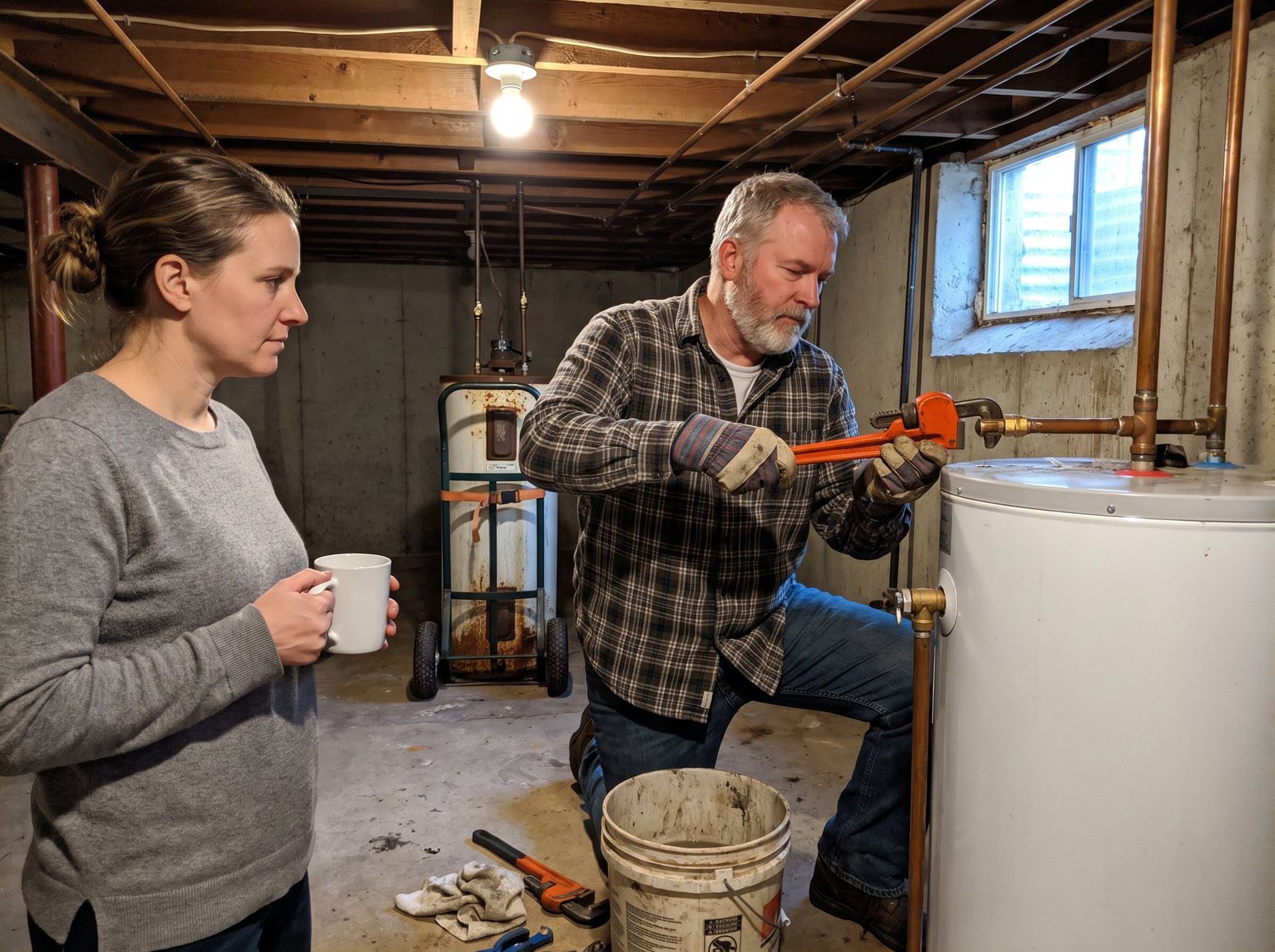
So we pull those dates and send a friendly note as each heater nears that age. We use the same 10-year line as our own rule of thumb for electric tanks. Same idea for drain maintenance on homes and restaurants with repeat clogs.
Marketing emails must follow the FTC’s CAN-SPAM rules. Each email needs your valid physical postal address, and anyone who unsubscribes has to be taken off within 10 business days. Texting has separate consent laws, so texts only go to customers who opted in. We add a text-consent line to your booking form and dispatcher script, so customers opt in before review and estimate texts go out.
BuilderBase, our own social media tool, keeps the same offers in front of people on Facebook and Instagram. Social rarely brings an emergency call, but it keeps your name known between jobs.
Phone answering
Almost every channel above ends in a phone call. Restoral, our AI system, answers calls and chats when your office can’t and books jobs onto your calendar. It works with Google Calendar, Jobber and most trade CRMs, and our team sets up the connection.
When plumbing searches spike
Plumbing demand isn’t flat, and each job peaks at its own time. We pulled a year of US monthly search estimates from Ahrefs (October 2025 to September 2026) for a few plumbing searches. The swings are big enough to plan a budget around.
| Search | Lowest month | Highest month | What we do with it |
|---|---|---|---|
| “frozen pipes” | About 1,080 (Jun 2026) | About 38,200 (Jan 2026) | Freeze pages and emergency ad budget ready by mid-November. Phone coverage for cold snaps. |
| “sump pump” | About 83,000 (Nov 2025) | About 114,600 (May 2026) | Sump pump checks to past customers in late winter. Replacement ads in spring. |
| “drain cleaning” | About 49,200 (Feb 2026) | About 81,500 (Aug 2026) | Summer: more map and Local Services Ads coverage, plus maintenance offers to restaurants and repeat-clog homes. Paid search goes to main line and sewer terms, not single-sink clogs. |
| “water heater replacement” | About 103,700 (Mar 2026) | About 135,700 (Feb 2026) | Steady all year, so it gets a steady budget plus the 10-year reminder list. |
The freeze spike is the wild one. Searches for “frozen pipes” went from about 1,100 in October to about 38,200 in January, roughly 35 times higher. If your freeze page and emergency budget aren’t ready until the first cold snap, you’re late.
Water heater searches are the opposite. The busiest month (February) was only about 31% above the slowest (March, right after it). That’s close to flat. That makes it a good always-on campaign, and a good reason to work your past-customer list in the quiet months.
One warning. This is a national pattern, not your local forecast, and a shop in Minneapolis and a shop in Tampa will see very different freeze months. When we build your plan, we line this up with your own calls from past years. In a warm climate with no real freeze season, the summer drain peak and the steady water heater demand matter more.

Plumbing lead costs vs. the cost of a booked job
Plumbing search leads cost more than the home services norm. LocaliQ’s benchmark study covered 3,211 US home services search campaigns that ran from April 1, 2024, to March 21, 2025. Across that set, the median plumbing lead cost $129.02. That’s about 42% above the $90.92 median for home services overall. And it only means something once you know how many leads turn into jobs, and what those jobs pay.
| Search ads (LocaliQ, 2025) | Click-through rate | Cost per click | Conversion rate | Cost per lead |
|---|---|---|---|---|
| Plumbing | 4.97% | $10.49 | 7.63% | $129.02 |
| All home services | 6.37% | $7.85 | 7.33% | $90.92 |
Plumbing clicks cost $10.49 against a $7.85 home services median, and only landscaping had a lower click-through rate. Our read: results for “plumber near me” are crowded with Local Services Ads, map results and regular ads, so a plain text ad gets a smaller share of the taps.
Now turn that into jobs. These are example numbers, so swap in your own.
- Booked call: say a search lead costs about $129 and your office books 1 in 2. That’s about $258 in ads for each job on the schedule.
- A $250 drain clearing: using the blended plumbing median, you just spent about $258 to book it. Drain-only searches may cost less, but rarely enough to fix the math on a $250 ticket. That’s a loss before the truck rolls, unless the customer comes back or needs a heater later. That’s why we chase drain work through cheaper channels.
- A water heater replacement: if you close half the water heater estimates you book, a sold heater costs about $516 in ads. On an example $1,800 install, $516 in ads is under 30% of the ticket.
The same $129 lead can be a bargain on a water heater and a loss on a sink clog. Split the campaigns, or the cheap jobs eat the budget.
This is why we never run plumbing ads as one big campaign. We’d rather book small drain calls through your map listing and your customer list, where each extra call costs less. Paid search money goes where the ticket can carry it.
Plumbing advertising on Google: the searches we block
Plenty of people typing “plumber” want a job, a class or a how-to video, not a plumber at their door. If your ads aren’t told to skip those searches, you pay for their clicks at plumbing prices.
The fix is a negative keyword list. Here’s the starter list we put on a new plumbing account before it spends a dollar. Words in quotes are phrase match negatives in Google Ads; the rest are plain (broad) negatives.
- Careers: “plumbing jobs,” “plumber jobs,” “plumbing job openings,” “now hiring,” “plumber hiring,” apprentice, apprenticeship, salary, resume, “plumbing union”
- School and licensing: “plumbing school,” “trade school,” “plumbing course,” “plumbing class,” training, exam, “plumber certification,” “plumbing certification”
- Do it yourself: “how to,” diy, youtube, tutorial, yourself.
- Parts shoppers: wholesale, for sale, “plumbing supply,” “supply house,” “plumbing parts”
- Wrong service: plumbing code, plumbing symbols, games, software.
Notice “plumber jobs” and “plumbing jobs” are both on there. That’s on purpose. Google’s help page says negative keywords won’t match to close variants. Its example: block “flowers” and your ad can still show for “red flower.” So plurals and other word forms each need their own line. (Google says misspellings and capital letters are handled for you.)
Then we add to it. Every week in the first two months, we read the search terms report line by line. Each account turns up its own junk. In one town it’s a trade school by name. In another it’s a local supply house. Those go on the list too.
Check every negative against your own services and town names before you add it. A plain “video” would block “sewer video inspection.” A plain “union” would block a shop that serves Union County. A plain “jobs” would block “plumber for small jobs,” and “class” would block a shop named First Class Plumbing.
Google also says a plain, unquoted negative blocks any search that contains all its words, in any order. That’s why “how to” is in quotes: a loose version would also block “how much to unclog a drain,” the exact caller you want.
One caution. Don’t block “cost” or “price.” Someone typing “water heater replacement cost” is pricing the job, not the part. We’d rather answer the price question on the page than lose that caller.
Missed calls, LSA billing and the price shopper
In the accounts we audit, a lot of the wasted money is wasted at the phone. With Local Services Ads, a call you miss can still cost you. And the calls you do answer often start with one question: “How much?”
How a missed call becomes a paid lead
Google spells out which contacts count as a valid lead. An unanswered call inside your business hours qualifies once the customer has stayed on longer than 20 seconds. So does a voicemail. That means when your tech is under a house and the office line rings out, you can pay for that lead while the customer calls the next plumber.
Two more rules matter. If your phone menu asks callers to press a key and they hang up without pressing one, Google says you aren’t charged. And Google’s credit page says it no longer supports credits when a lead is for a job type or an area you don’t serve. If you don’t do sewer work, that job type has to be off from day one.
You can still report a spam or junk lead in the lead’s feedback survey, and Google says it may occasionally credit leads you report as poor quality.
On the phone side, we put four things in place:
- Local Services Ads hours that match the hours somebody is actually free to answer.
- Overflow routing, so a second phone rings before anything hits voicemail.
- A set callback window for every missed lead, agreed with your office.
- Restoral to answer nights, weekends and overflow.
A script for “how much to unclog a drain?”
A caller asking “how much?” is still a caller. In our experience, many hang up when nobody gives them a number. A flat “we don’t quote over the phone” sends them to the next listing. This is the shape we give dispatchers. Adjust the words and your real fees.
- Answer the real question first: “Sure. Our service call is [your fee]. A single clogged sink or tub usually runs [your price range]. A main line runs more, and the tech confirms the price before any work starts.”
- Ask one thing: “Is it one drain or more than one? Any water backing up into a tub or floor drain?”
- Give a reason to book now: “If it’s backing up in more than one spot, it could be the main line, and that’s better caught before it overflows. I’ve got a tech free at 2.”
- Close with a choice: “Does 2 o’clock work, or is first thing tomorrow better?”
Then write down where the caller found you. That one line on every booking is what lets us tell you which ads pay.
Plumbing marketing budgets at $1,500, $5,000 and $15,000
These are starting points for your total monthly marketing spend, not packages. Once tracking shows what books, the split changes.
Around $1,500 a month: the small shop
Money this tight should go only where it’s a short step from a booked job:
- A complete Google Business Profile, a review text after each job, and tracking numbers that tag where each booking came from.
- Local Services Ads limited to the towns you want and the jobs you actually do.
- A water heater age list and a short note to past customers before freeze season.
We’d hold off on broad search ads. Do the math: even if all $1,500 went to search ads at the $129.02 median, that’s about 11 leads a month, and fewer once tracking and other costs come out. At a 1 in 2 booking rate, that’s five or six jobs. That’s not enough data to steer by.
About $5,000 a month: a shop with a dispatcher
Now there’s room to chase replacements on purpose. We’d keep everything above and add:
- Search ads split into emergency, water heater, and sewer and main line campaigns (not single-drain clogs), each with its own budget and the negative list from day one.
- Water heater and sewer line pages built to sell the estimate, with financing noted if you offer it.
- A link between your field software and the ad account, so Google sees which leads booked and sold.
- A text and email follow-up for every open estimate.
Facebook comes in small, only for water heater and maintenance offers to people near your past jobs.
About $15,000 a month: several crews, maybe commercial
At this spend, the biggest leak is two channels paying for the same customer, with nobody sure which one booked it. Everything on this page runs, and we add:
- Budgets set by month from your own call history and the freeze and summer drain peaks, checked weekly in busy months.
- Revenue from sold jobs sent back to Google Ads, so bidding learns from real sales.
- A separate commercial campaign and pages for restaurants, property managers and backflow testing.
- Retargeting for people who read a water heater or sewer page and didn’t call.
- Extra phone coverage for cold snap nights and weekends.
Whatever the budget, we never switch off reviews, phone coverage or the customer list. They’re cheap next to ads, and they decide how many paid calls end up as work.
How we measure plumbing marketing
We count booked jobs, by job type and by channel. Clicks and calls are only steps on the way there.
Phone calls are the usual blind spot. Google Ads has two ways to score a call as a conversion: by having Google’s AI review call recordings, or by counting calls longer than a minimum length you set. Both filter out a lot of wrong numbers and hang-ups. Neither one knows if the call became a job.
So we match calls and forms to jobs in your field software. Once there’s enough spend, booked and sold jobs go back into the ad account, and Google’s bidding learns from paid work instead of talk time.
Your monthly report shows:
- Booked jobs by channel and job type: emergency, water heater, drain and sewer, commercial.
- Cost per booked job for each paid channel.
- Every sold replacement, traced to the ad, listing or email it came from.
- Missed calls, and the minutes until someone called back.
- Reviews gained this month and where your star rating sits.
- Our changes for next month and the reason for each.
A paid channel gets 60 to 90 days to prove it books work. If it can’t, its money goes somewhere that does. SEO runs on a longer clock, and the report says where it is.
Your first 90 days of plumbing marketing
Many shops have ads nobody has checked in years, set up once, left running and quietly billing every month since. What they often don’t have is a clear view of which ads book jobs. Here’s how the first three months usually go. Paid ads can start bringing calls within weeks. SEO and reviews take longer, so they start in month one too.
Month 1: find the leaks
We audit your profile, ad accounts and site. Tracking goes on every call and form and gets wired into your field software. After that we plug the obvious holes: job types you don’t want in Local Services Ads, junk searches, voicemail during business hours, pages with no tap-to-call button. The review request after every job goes live too.
Month 2: build by job type
Emergency, water heater, drain and sewer each get their own campaign and page. Review requests keep going out after every job. We pull your water heater install dates and send the first reminder batch.
Month 3: move the money
Three months in, the larger channels usually have enough calls behind them to show a cost per booked job. Smaller budgets need more time, and we’ll tell you that. Then the money moves to what books. If freeze season is coming, the emergency plan gets locked in now.
Questions to ask a plumbing marketing agency
Whoever you hire, ask these before you sign.
- Whose name are the accounts in? Everything from the ad accounts to the domain should be owned by your business. The agency gets user access. That way, if you part ways, the data and history are still yours.
- Do you report booked jobs or leads? Have them show you a real report from another client with the names hidden. Rankings and impressions alone are a warning sign.
- How do you split emergency, water heater and drain work? “One campaign called Plumbing” means your install budget is paying for drain clicks.
- What’s on my negative keyword list? If they can’t show you one, you’re probably paying for job seekers.
- What happens to missed calls? A good answer covers hours, rollover and callbacks, not just ad spend.
- What’s the term, and what does leaving look like? Get the term, the notice period and who keeps the website in writing.
- Who touches my account each week? Get a name and a way to reach that person.
If they can’t answer one of these clearly, keep looking.
Who we are
D&J Contractor Marketing is based at 1172 Bedford Street in Stamford, Connecticut. We do marketing for contractors and home service businesses. We hold Google Partner, Meta Business Partner and Yelp Partner status.
We handle all of it in-house: local SEO, Google Ads, Local Services Ads, website design, reviews, BuilderBase social posting, call tracking with reporting, and Restoral on the phones. One team runs it all, so you’re not chasing three vendors when the numbers look off. You can see some of our work on our case studies page. Shops that also do electrical work can see our electrician marketing plan.
Our restoration work includes more than 30 SERVPRO franchises, and not one of them has left us. Water damage work runs on the same thing plumbing does: someone answering the phone fast when water is on the floor.
Plumbing marketing FAQ
How much should a plumbing company spend on marketing?
We don’t use a set percentage of revenue. Start from the jobs you want. Work out the profit on a booked water heater, sewer or drain job, then decide the most you’d pay in marketing to land one. A cost that works for replacements often fails for small drain calls. Then spend more ahead of your busy months, like freeze season, and less in the quiet ones.
What is the best marketing for plumbers?
For most shops, the best return comes from the basics done well: a strong Google Business Profile, steady reviews, Local Services Ads with the right job types, and someone who answers the phone. After that, search ads for replacements and regular reminders to past customers. Social media helps with offers and staying known, but it rarely brings an emergency call.
Are Local Services Ads worth it for plumbers?
Often, yes, if someone answers the phone. Billing is per valid lead, not per click, and that fits urgent plumbing calls. The catch: an unanswered call in your business hours can still be billed once the caller has waited past 20 seconds. Google also says it no longer supports credits for leads on job types or areas you don’t serve, so set those carefully before you turn ads on.
How long does plumbing marketing take to work?
Paid ads can bring calls soon after they go live. Local Services Ads first need you to pass Google’s screening, and plumbers get an extra level that includes background checks. Search rankings and review counts grow over months. That’s why we start them in month one while the ads carry the early load, and judge paid channels on booked jobs after 60 to 90 days.
Do plumbers need Facebook ads?
Not for emergencies. When a pipe bursts, people want a plumber in the next hour, and Facebook isn’t where that search happens. Facebook works better for water heater offers, maintenance plans and staying in front of past customers. LocaliQ’s 2026 Facebook benchmark for lead campaigns in the broad home and home improvement group is $42.95 per lead, but those are form fills that still need a callback.
Should plumbers buy leads from Angi or Thumbtack?
They can fill gaps, but treat them like any other paid channel. Track what each lead costs and how many turn into booked jobs, and compare that with your own ads and listing. We cover how each platform charges in our review of Angi leads and our take on whether Thumbtack is worth it.
What to do this week
You can start fixing leaks before you talk to any agency, us included. Four things to do this week:
- List every job you booked last month and note how each customer found you. If nobody knows, write that down too.
- Ring your business line at dinnertime and again on Saturday morning, and see what a customer hears.
- Open your Google Ads search terms report for the last 30 days and count the job seeker and how-to searches you paid for.
- Export every water heater you installed more than eight years ago. Those heaters hit the 10-year mark within two years.
Want a second set of eyes first? Request a free local SEO audit, or contact us to plan your plumbing marketing together. Looking for more ideas? Read our 15 plumbing marketing ideas and our broader list of contractor marketing ideas.


