
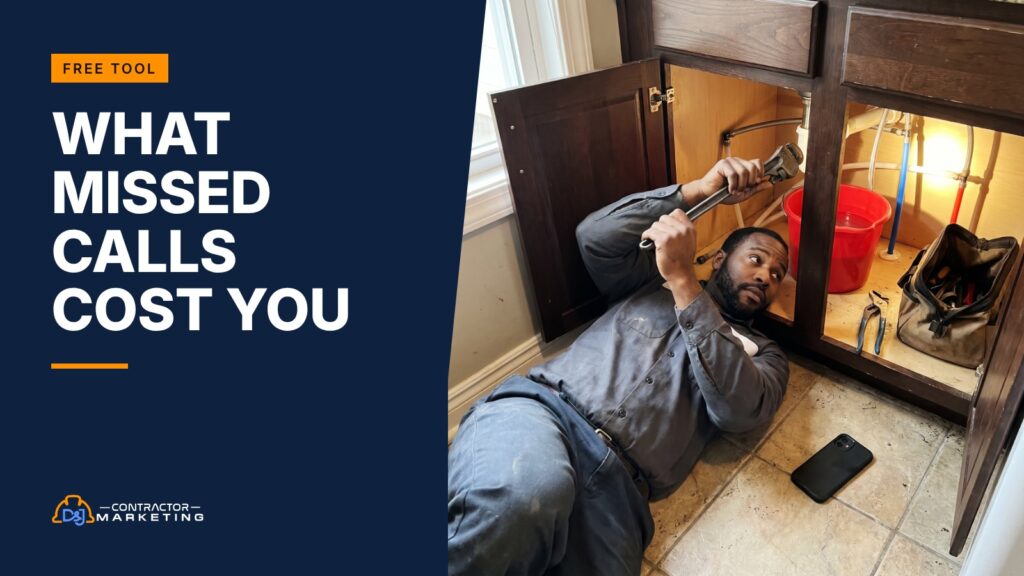
You’re under a sink, the phone rings, and by the time your hands are free they’ve called the next plumber. You know it happens. You probably don’t know what it costs you each month. Plug your numbers into the missed call revenue calculator below and you’ll have it in about a minute. It takes out spam and existing customers first, and it shows profit, not just revenue.
The short answer: multiply your missed calls by the share that are real job leads, then by your booking rate, then by the share you wouldn’t win back on a callback. That’s your lost jobs. Multiply by your average ticket for lost revenue, and by your gross margin for lost profit.
Key takeaways
- Not every missed call is a lost job: across home services, 38% of answered calls were leads in Invoca’s 2026 data. How the math works
- Google Business Profile dropped call history on July 31, 2024, so count misses in your phone system, Google Ads or the LSA lead inbox. Counting missed calls
- Answer rates ran from 32% to 74% by trade, counting every call, misdials included. HVAC was 34%. Benchmarks by trade
- Break-even is your monthly coverage cost divided by the gross profit on one job. In our HVAC example, $300 a month needs about 1.3 saved jobs at $225 each. Profit and break-even
- On Local Services Ads, missed calls may hurt your ranking, and since October 1, 2026, some missed calls over 20 seconds during business and ad hours can be billed. Ads and LSA
- Text right away and call back fast, then offer two times. In Invoca’s data, 55% of businesses didn’t ask for the booking. Winning calls back
How the missed call revenue calculator works
The math is simple on purpose, so you can check it with a pencil. We start with your missed calls, take out the junk, apply your booking rate, take out the jobs you’d save with a callback, and only then put a dollar figure on it.
A lot of calculators skip the junk step and treat every missed call like a lost sale. That makes the number look huge, and it’s wrong. Plenty of the calls you miss are spam, vendors, wrong numbers or a customer asking when the tech will show up.
Here’s what goes in each box:
- Missed calls per week. We turn it into a month by multiplying by 52 and dividing by 12. That’s about 4.33 weeks a month, not a flat 4.
- Share that are real job leads. This is the filter. Across home services, Invoca’s 2026 benchmarks report found that 38% of calls answered by a person are leads.
- Booking rate. Of the real leads you do reach, how many book? The same report puts it at 45% of leads converting on the call.
- Share you’d still win on a callback. Some people pick up when you call back. Nobody has good public data on this for contractor calls, so it’s your guess. If you call back within minutes, set it higher. If voicemails sit until tonight, set it low.
- Average job value and gross margin. Revenue is the ticket. Gross profit is what’s left after parts, materials and the tech’s time. We show both, because you pay for answering out of profit, not revenue.
Lost jobs = missed calls x lead share x booking rate x (1 minus callback win-back). Then lost revenue = lost jobs x average job, and lost profit = lost revenue x margin.
One catch: Invoca’s lead share comes from answered calls. We use it on missed calls because it’s the best published number we’ve found for contractors, not because it’s perfect.
Your own lead share could be higher or lower than 38%. Invoca’s answer rate climbs from 52% to 65% once you drop calls under 15 seconds, so a good chunk of unanswered calls are misdials and quick hang-ups. That would push your lead share down. Emergency callers who give up and call someone else push it up. One week of sorting your own log settles it.
The optional boxes at the bottom don’t change the lost jobs number. They add two things: the ad money you spent on calls nobody answered, and whether a monthly coverage cost would pay for itself.
How to count your missed calls
The one number you have to bring is how many calls you miss. Most owners we talk to guess low. They remember the calls they returned and forget the ones that rang out while they were on a ladder.
Pull a real week. Pick a normal one, not your slowest, because a slow week hides the leak and you’ll end up deciding about coverage based on a number that’s too small. Then check these places:
- Your phone system or carrier app. Most business VoIP systems and cell carriers keep a call log that marks missed calls. Count the unanswered ones and the voicemails.
- Your call tracking tool, if you have one. This is the cleanest source, because it shows missed calls by hour and by marketing source.
- Google Ads. If call reporting is on, Google’s help page on call reporting data says you can see “whether the call was missed or received” for each call from your ads. To add the columns, click the Campaigns icon, open the Campaigns drop down, choose Campaigns, Ad groups, Ads, then click the Columns icon and pick Call Details.
- Local Services Ads. Sign in and open the Leads section. Google’s lead inbox help page says you can review phone calls generated by your ad and listen to phone lead recordings (US only).
One place you can’t look anymore is your Google Business Profile. Google removed call history from Business Profile on July 31, 2024. Google says you’ll still get calls from your profile and can still track other engagement numbers. But it won’t show you which calls you missed.
Count each caller once. If someone called three times and then got through, that’s not a lost job. Then sort the missed calls into three piles: new job leads, existing customers and junk. Do that for one week and you’ll know your real lead share. That beats any benchmark, including ours below.
Also note when the misses happen. Misses at lunch or after 5 p.m. point to overflow or after-hours coverage. Misses all day long mean you need coverage all day, whether that’s a person, a service or AI. Know which one you have before you shop for answering service options for contractors.
Missed call benchmarks by trade
If you don’t know your lead share or booking rate yet, start with real call data instead of a guess. Invoca’s Home Services Lead Conversion Benchmarks Report, published July 2026, breaks answer rates, lead rates and booking rates out by trade. The trade presets in the calculator use these numbers.
| Trade (Invoca’s group) | Calls answered by a person | Answered calls that are leads | Leads that book on the call |
|---|---|---|---|
| Plumbing | 74% | 30% | 55% |
| Pest control | 73% | 33% | 55% |
| Carpeting | 65% | 45% | 29% |
| Lawn and trees | 54% | 50% | 54% |
| Doors and windows | 53% | 48% | 28% |
| Restoration | 51% | 34% | 30% |
| HVAC | 34% | 45% | 43% |
| Construction | 32% | 32% | 29% |
| All home services | 52% | 38% | 45% |

The answer rate column needs context. It counts every inbound call, misdials and quick hang-ups included. Invoca says the home services answer rate rises to 65% for calls longer than 15 seconds and 73% for calls over 30 seconds. So a low number doesn’t always mean a shop is ignoring the phone.
Also, these are averages across Invoca’s customers, and those customers may not look much like a one-truck shop. And “leads that book on the call” only counts jobs booked during that call, not ones closed later at the kitchen table.
Here’s how we’d use the table. A plumber gets fewer real leads per call (30%), but books more than half of them. If you’re buying calls, compare that with what plumbing leads cost.
A doors and windows company gets more leads per call (48%), but books far fewer on the spot. Our read: many of those calls are quote requests, not emergencies, and a big window job rarely books on the first call. For a remodeler, that low booking number on the phone is normal. Your real close happens at the estimate, so use your own estimate-to-signed rate if you track it.
In Invoca’s data, HVAC answered 34% of calls, but 45% of those answered calls were leads. If your shop looks like that, a lot of real jobs are going unanswered. Our guide to getting HVAC leads covers the other side of the problem.
Use profit, then find your break-even
Use profit, not revenue, when you decide what to pay for answering. A $500 job at a 45% margin leaves $225 to cover everything else, answering included. Once you know the gross profit you lose each month, the break-even on any coverage option is one line of math.
Example calculation (use your own numbers):
Say you run an HVAC shop that misses 12 calls a week. That’s 52 a month. The HVAC preset says 45% are real leads (23.4) and you book 43% of them. Say you’d win back 20% with a callback. To follow along in the calculator, pick HVAC, enter 12, and set job value to $500 and margin to 45%.
That leaves about 8 lost jobs a month. At a $500 average ticket, that’s about $4,025 in revenue. At a 45% gross margin, it’s about $1,811 in gross profit, or roughly $21,700 a year.
Now the break-even. Each saved job is worth $500 x 45% = $225 in gross profit. Divide any monthly coverage cost by $225 and you get the number of saved jobs it needs to pay for itself:
| Monthly cost to cover calls (example) | Saved jobs needed to break even at $225 profit a job |
|---|---|
| $300 | 1.3 |
| $1,000 | 4.4 |
| $3,167 (one full-time receptionist’s wages, see below) | 14.1 |
Where does that last row come from? The Bureau of Labor Statistics says the median hourly wage for receptionists was $18.27 in May 2025. At 40 hours a week, that’s about 173 hours a month, or about $3,167 in wages. That’s before payroll taxes, benefits or paid time off.
So in this example, a hire needs 14 saved jobs a month just to cover pay. The shop is only losing about 8. That doesn’t mean never hire. A good office person also books, dispatches and chases payments. But if the only goal is catching missed calls, a person at a desk from 8 to 5 is the hardest option to make pay off. They also can’t answer two lines at once or pick up at 9 p.m.
This math leaves out a few things that make a missed call cost more:
- Repeat work and maintenance plans from a new customer.
- Referrals and reviews that customer would have sent your way.
- Bigger jobs that start as a small service call, like a repair visit that turns into a system replacement.
The break-even also assumes your coverage catches the calls you’re missing now. No service catches every one, so leave some room. If a quote looks borderline at break-even, ask how they handle the hours your call log says you miss most. And if a service will book at a lower rate than you do, lower the booking rate box when you test it.
The ad money and LSA cost of a missed call
A missed call from an ad costs you the job and the money you paid for the call. With Local Services Ads, Google says missed calls may count against you on ranking too.
Start with the money. The calculator multiplies your missed calls by the share that come from paid sources and your cost per paid call. To get cost per call, divide what you spent on calls by the number of calls. In LSA, that’s your charged phone leads. In Google Ads, use the cost of call clicks, not your whole budget, if your ads also bring in forms.
This money is already spent, so the calculator shows it on its own and doesn’t add it to lost profit. In the default example, 43 missed calls a month, half from ads, at $40 a call, works out to about $867 a month in ad spend on calls nobody answered. Watch for repeat callers: if the same person called three times from your ad, the job math counts them once, but you may have paid for all three calls.
With Google Ads, Google’s call assets help page says clicks on your call button “cost the same as headline clicks.” You pay for the click either way, answered or not.
LSA now bills for some missed calls too. In August, Search Engine Land reported that Google would start charging for some missed calls on October 1, 2026. Google’s how leads work page now says you’re charged when you miss a call during your business hours, while your ads are scheduled to run, and the caller stays on the line for more than 20 seconds.
That includes calls that go to voicemail, “whether or not they leave a message.” So when you fill in the paid share for LSA, count only missed calls that ran past 20 seconds during business hours while your ads were on. Those are the ones Google can charge. If your phone menu asks callers to press a key, Google says you aren’t charged when they hang up without pressing one. Lead sites vary, so check their terms for missed calls too.
Then there’s ranking. On its ad rankings help page, Google lists your responsiveness to customer inquiries as a factor. It says: “Missed calls may negatively affect your responsiveness.” Its lead management page adds that “having a consistently fast response time could improve your ad’s ranking on search and increase your ability to receive leads.”
That’s why we tell LSA clients to fix answering before they raise the budget. Pouring more money into a phone that rings out just buys you more missed calls, and now some of them come with a bill. Our guide to how Local Services Ads rank and charge covers bidding and lead credits.
If you run Google Ads too, two simple moves help. Set your call asset to show only during hours someone can answer, which Google’s call assets page says you can do. And turn on call reporting so you can see missed ad calls by hour.
What to do with the calls you still miss
You won’t answer every call, even with good coverage. Speed matters. A homeowner with a leak has other numbers to try. That’s the “win back” box in the calculator, and a missed call text plus a fast callback are the cheapest ways to win some back.
Call back fast. The best-known study on speed is about web leads, not phone calls, so treat it as a rough guide. The data is also about 15 years old. A 2011 Harvard Business Review article described a study of 1.25 million sales leads. Firms that tried to reach a lead within an hour were nearly seven times as likely to have a real conversation with a decision maker as firms that tried even an hour later.
Here’s the routine we’d set up for a shop without full coverage yet.
Step 1: Send a text right away
Many business phone systems and call tracking tools can send an automatic text after a missed call. Make sure the number sending the text is registered for business texting (called A2P 10DLC), or carriers may block it. Keep it short and give them a reason to reply instead of calling the next company:
“Hi, this is [Company]. Sorry we missed you, we’re on a job. What’s going on at your place? Reply here and we’ll call you back within 15 minutes.”
Only promise a time you can keep. If 15 minutes isn’t real, say 30.
Step 2: Call back and ask for the booking
When you call back, don’t open with “you called us?” Lead with help, then book the visit. Something like:
- “Hi, it’s [your name] with [Company] returning your call. Sorry I missed you. What’s going on with [their problem]?”
- Get the address, the problem and how urgent it is.
- “I can have a tech there between 2 and 4 today, or first thing tomorrow. Which works better?”
In Invoca’s 2026 data, 55% of home services businesses didn’t ask leads to buy or book the job. So when you get them on the phone, offer two time slots. Don’t end the call with “give us a call when you’re ready.”
Step 3: Track what happened
Mark each missed caller as booked, lost or junk. After a month, you’ll know your real win-back rate. Until then, try the calculator at 10% and at 30% to see the range, then swap in your real number instead of our 20% guess.
Missed call FAQ
How do you calculate the cost of a missed call?
Take your missed calls and keep only the real job leads. Multiply by your booking rate, then by the share you wouldn’t win back with a callback. That gives lost jobs. Multiply lost jobs by your average ticket for revenue, and by your gross margin for profit. The calculator above does each step and shows the math.
What counts as a missed call?
Any call that rang out, went to voicemail or hung up before someone answered. Not every missed call is a lost job, though. Spam, vendors, wrong numbers and existing customers don’t count as lost work. The lead share box in the calculator takes them out, so you only count real job leads.
How many calls do contractors usually miss?
In Invoca’s 2026 home services report, 52% of all inbound calls were answered by a person. For calls longer than 15 seconds, which filters out misdials and quick hang-ups, the answer rate was 65%. So about half of all calls, and about a third of calls over 15 seconds, didn’t reach a person. Rates ranged from 32% to 74% by trade. Your own call log is the number that counts.
Do missed calls hurt Local Services Ads?
They can. Google’s Local Services Ads ranking page lists responsiveness as a factor and says, “Missed calls may negatively affect your responsiveness.” Google also says you can be charged for a missed call during business hours, while your ads are running, if the caller stays on the line more than 20 seconds. So a missed LSA call can cost you a lead fee, and it may hurt your ranking.
Can I see missed calls in Google Business Profile?
No. Google removed call history from Business Profile on July 31, 2024. You still get calls from your profile, but you can’t see which ones were missed. Use your phone system, a call tracking tool, Google Ads call details or the Local Services Ads lead inbox instead.
Is an answering service worth it for a small contractor?
Run the break-even. Divide the monthly cost by the gross profit on one average job. If you lose more jobs a month than that number, coverage likely pays for itself. In our HVAC example, a $300 a month option needed about 1.3 saved jobs at $225 profit a job.
What to do this week
Run your real numbers, then pick one fix to start this week.
- Pull last week’s call log and count missed calls by hour.
- Sort them into leads, existing customers and junk, and put your lead share in the calculator.
- Turn on a missed call text and use the callback script above.
- Get one coverage quote and check it against your break-even.
- If you buy ads, match your call hours to the hours someone can answer.
If you’d rather not staff a phone at all, look at Restoral. It’s our own AI system that answers calls and chats and books jobs onto your calendar. It works with Google Calendar, Calendly, Cal.com, Jobber and most trade CRMs, and our team sets up the integration. Compare it with live options in our guide to live and AI answering, and see how calls fit your bigger plan in our guide to lead generation for contractors.
Want to know how many calls your Google listing should be bringing in? Start with a free local SEO audit. We’ll show you where you rank on Google and what’s keeping your listing from ringing more.


