
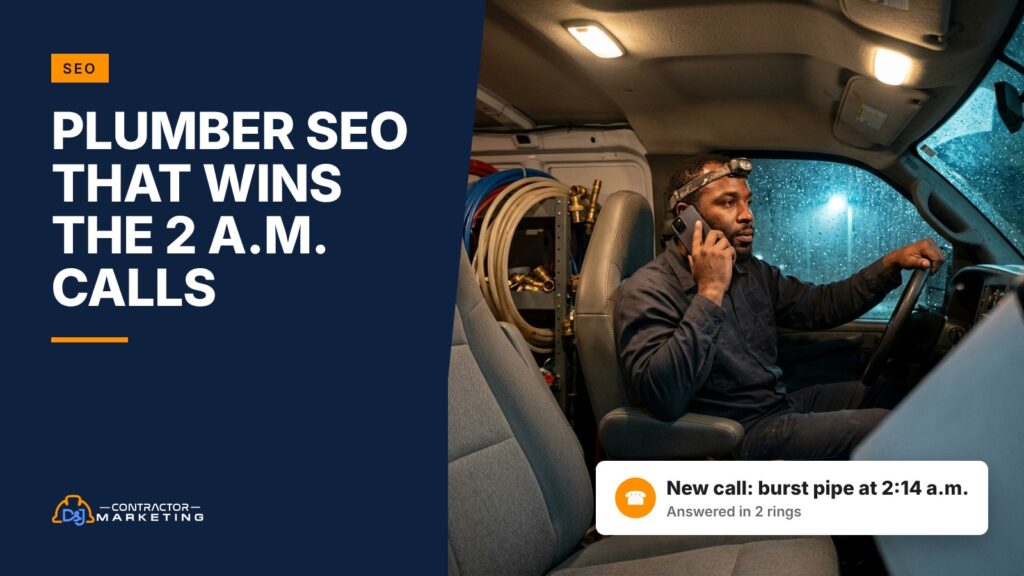
A burst pipe at 2 a.m. goes to whoever Google shows and whoever picks up. Plumber SEO decides whether that’s you or a call center with a stuffed business name.
We pulled Ahrefs search data on 25 plumbing searches, read Google’s own rules for plumbers, and built our plumber SEO work around both.
In plain terms, plumber SEO means showing up in the map pack for emergency searches and having a strong page for every big job you want. Google ranks the map pack on relevance, distance and prominence, which in practice means your profile, your reviews and how close you are. Job pages for sewer lines, water heaters and leak detection win the planned work, where people read before they call.
Key takeaways
- All 23 plumbing job searches we checked showed a map pack, but planned jobs like “trenchless sewer repair” also showed an AI Overview, so those need full job pages. Where people search
- Google asks for “as few categories as possible,” so we keep “Plumber” as the main one and put jobs like water heaters in your Services list. What we do
- Only list 24 hours if someone really answers, because missed calls can also hurt your Local Services Ads rank. The 2 a.m. problem
- “Water heater replacement” gets about 117,000 US searches a month and “sewer line repair” about 93,000, and both are big-ticket jobs worth their own pages. Big-ticket pages
- “Frozen pipes” searches hit 36,644 in January 2025 versus about 1,000 to 1,140 in most months from spring to fall, so winter pages go up in the fall. The plumbing calendar
- Google uses a plumber as its example for hiding a home address, and sets a soft limit of about 2 hours of driving on your service area. Service area rules
- Report fake plumbing listings with Google’s Business Redressal Complaint form. You can upload 10 or more profiles, or a spreadsheet, in one report. Fighting spam
- We measure booked jobs by type, because in our example math four water heater jobs outearn 36 small repairs. How we measure
Where people search for a plumber on Google
The map pack is the box of three businesses Google shows under the map. We pulled US search data from Ahrefs in October 2026 for 25 plumbing searches, including which features showed in Ahrefs’ latest snapshot of each results page. All 23 job searches showed a map pack. The two how-to searches, “frozen pipes” and “burst pipe,” showed an AI answer and no map pack.
What changed by job was whether Google also put an AI answer on top.
Here are 19 of them. “Monthly searches” is Ahrefs’ estimate for the US.
| Search | Monthly searches | Map pack | AI Overview |
|---|---|---|---|
| plumber near me | 455,000 | Yes | No |
| water heater repair | 169,000 | Yes | No |
| emergency plumber | 122,000 | Yes | No |
| water heater replacement | 117,000 | Yes | Yes |
| drain cleaning near me | 101,000 | Yes | No |
| hydro jetting | 95,000 | Yes | Yes |
| emergency plumber near me | 94,000 | Yes | Yes |
| sewer line repair | 93,000 | Yes | No |
| water softener installation | 66,000 | Yes | No |
| tankless water heater installation | 39,000 | Yes | Yes |
| leak detection | 20,000 | Yes | No |
| trenchless sewer repair | 17,000 | Yes | Yes |
| 24 hour plumber | 17,000 | Yes | Yes |
| slab leak repair | 14,000 | Yes | Yes |
| sewer line replacement | 7,100 | Yes | Yes |
| commercial plumber | 5,600 | Yes | No |
| backflow testing | 3,300 | Yes | Yes |
| frozen pipes (how-to) | 7,400 | No | Yes |
| burst pipe (how-to) | 2,100 | No | Yes |
Not shown, all with a map pack: drain cleaning (61,000), toilet repair (17,000), gas line installation (11,000), sewer camera inspection (7,100), sump pump replacement (6,000) and repipe (2,800).
There’s a rough pattern, with exceptions. Most fix-it-now searches, like “emergency plumber,” “drain cleaning near me” and “water heater repair,” went straight to the map pack, though “emergency plumber near me” also showed an AI Overview. Bigger planned jobs, like “water heater replacement,” “trenchless sewer repair” and “slab leak repair,” showed one more often, but not always: “sewer line repair” didn’t. We read an AI answer as a sign people want to learn before they call.
So plumber SEO has two halves. The map pack wins the emergency calls, through your profile, reviews and distance. Job pages win the planned work. For those, Google says a page that’s indexed and eligible for a normal snippet is eligible to show as a link in an AI Overview. There’s no extra technical trick, but nothing is guaranteed (Google Search Central).
One caution: these results change, and Google says AI Overviews often don’t show at all. Treat the table as a snapshot from Ahrefs’ October 2026 data.
What our plumber SEO work covers
The 90-day plan further down shows the order.
A profile set up like a real service-area plumber
Your Google Business Profile is the base. Google says local results are “mainly based on relevance, distance, and popularity” (Google). You can’t change how far a searcher is from you. You can change the other two.
We set “Plumber” as the primary category. Google asks for “as few categories as possible to describe your overall core business” (Google’s guidelines). So a second category only goes on if it’s a real part of your business that people hire on its own, like a separate septic or drain crew.
Run plumbing and HVAC together? Make the trade that brings most of your work the primary category, add the other as a secondary one, and see our HVAC SEO page for the heating side.
Water heaters, leak repair and repiping go in the Services list instead, written the way customers say them. Then we fill in hours, service area, real photos and the description. Our Google Business Profile guide for contractors walks through every field.
A page for every job you want more of
One “Services” page with 20 bullet points doesn’t rank for much. We build a page for each job worth chasing: drain cleaning, water heater repair, tankless installs, sewer line repair, leak detection and so on. Each page answers what the job is, signs it’s needed, what affects the price, how long it takes and what happens on the visit. Each one has a click-to-call button near the top.
We’d hold off on the blog until these exist. Our read: ten solid job pages will do more for a plumber than fifty posts about why drains clog.
Reviews after every job, asked the right way
Google says more reviews and better ratings “can help your business’s local ranking.” But the rules are strict. Google doesn’t let a business offer discounts or freebies for reviews. It doesn’t let you only ask happy customers. It even bans asking staff to collect “a certain number of reviews” (Google’s review policy). If you run review contests between your techs, that last rule is the one to watch.
So we set up a simple text after every job with a one-tap link to your review form. Everybody gets it. Starting from zero reviews? Send the same text once to every customer from the last few months, not just the happy ones, then keep it going after each job. You can make that link with our free review link generator. And we help you reply to every review, good or bad.
Links from people you already work with
Google also counts “how many websites link to your business” (Google). Plumbers have natural link partners. Think supply houses, the brands you install, trade groups, the restoration company you send burst-pipe jobs to, and property managers. We don’t buy links or spam directories.
A site built for a panicked person on a phone
These calls tend to come from a phone, sometimes from a wet basement with the lights off. We keep pages light, put the phone number and service area at the top, and make every number tap-to-call. The form stays short.
Tracking every call to a job
Call and form tracking ties each lead to its source, then to a booked job. That’s how you know if this works (more on that in how we measure).
The 2 a.m. problem: hours, answering and emergency pages
A burst pipe doesn’t wait for business hours. “Emergency plumber” alone gets about 122,000 US searches a month, and “24 hour plumber” gets about 17,000. If your profile says open 24 hours, someone has to pick up.
Google’s rule for hours is short. It wants your “regular customer-facing hours of operation” (Google). So only list 24 hours if a real person, or a service that can book the job, answers at 2 a.m. If nights go to voicemail or a next-morning callback, list your real staffed hours on Google and explain your after-hours line on your site.
Missed calls hurt twice. You lose tonight’s job. And if you run Local Services Ads, Google warns that “if you regularly fail to answer calls or respond to messages, your ad ranking may be affected” (Google Local Services help). That’s why we talk about phones on day one, not month six. An on-call tech, an answering service or an AI receptionist like our Frontline can cover the nights.
Your emergency page should give a scared homeowner what they need fast:
- A tap-to-call number at the top, repeated lower down
- Which hours you really answer, and what happens after hours
- The towns you cover, in plain words
- What to do right now: where the main water shutoff usually is and when to turn it off
- What an after-hours visit costs, or how you price it, if you’re willing to say
- Real photos of your crew and trucks, not stock photos
The shutoff tip can save a homeowner’s floors while your tech drives over, and it shows you know the work.
Sewer, drain and water heater pages carry the big tickets
A clogged sink pays the bills. A sewer line or a tankless install pays for the next truck. Those bigger jobs have their own searches, and the people typing them want answers before they call.
Look back at the table. “Water heater replacement,” “trenchless sewer repair” and “slab leak repair” all showed an AI Overview in Ahrefs’ October 2026 snapshot. Our read: people searching these want to know what the job is, whether they need it and what it costs before they call. (“Hydro jetting” showed one too, though some of those searches may be DIYers or people shopping for a jetter.)
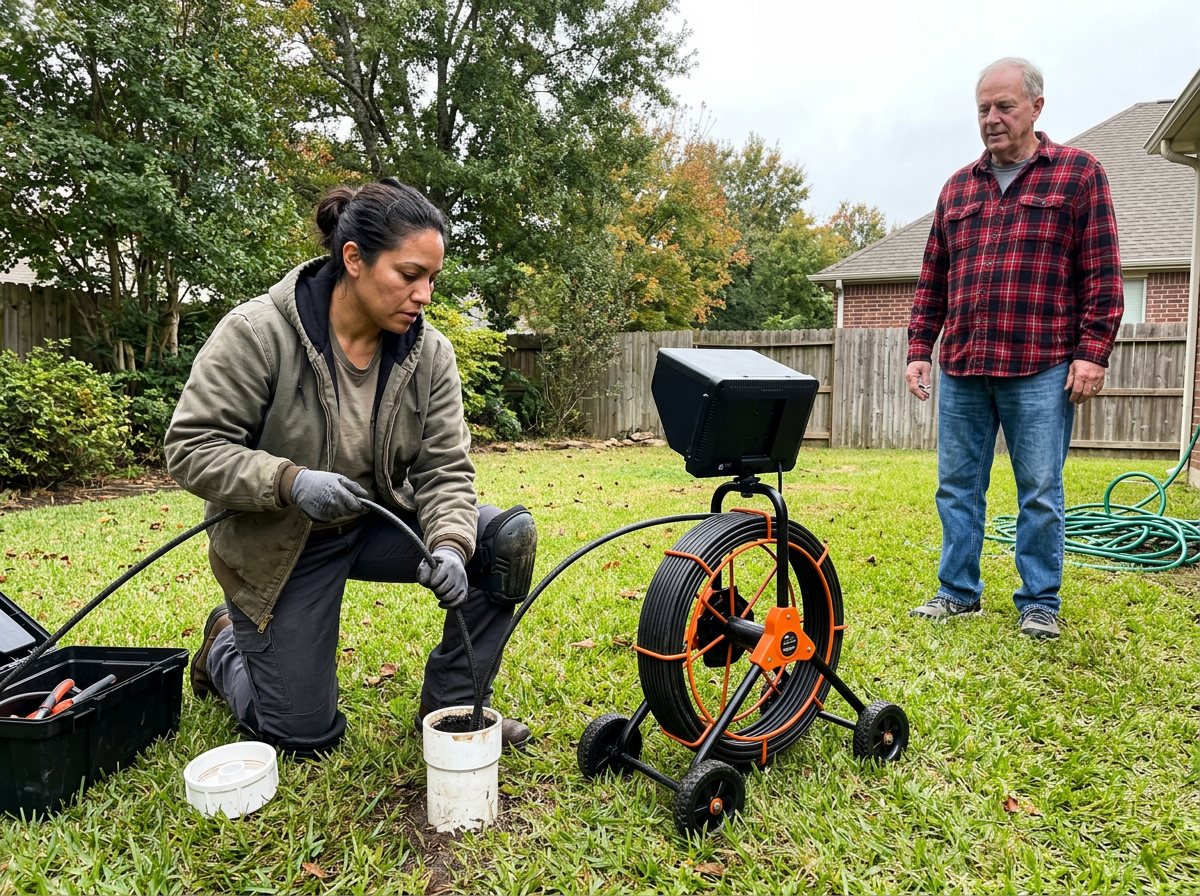
So a big-ticket page has to do more than say “we do sewer lines.” Each one we build covers:
- What it is, in plain words: Trenchless vs dig-and-replace. Tank vs tankless. Jetting vs snaking.
- Signs you need it: Slow drains in more than one fixture, sewage smell, wet spots in the yard, rusty water, no hot water.
- How you find the problem: Your camera inspection, your leak detection gear, your water heater check.
- What changes the price: Pipe depth, length, access, permits, venting, fuel type. Give ranges only if you’re comfortable.
- Your proof: Photos of your own jobs, a short video from a camera inspection, reviews that mention the job.
Why push these pages? This is example math, so swap in your own numbers. Say a drain call is worth $300 to you and a sewer replacement is worth $8,000. One extra sewer job a month from SEO is worth about the same as 27 extra drain calls. A shop that only ranks for “drain cleaning” is leaving the biggest checks on the table.
These pages also feed each other. A drain cleaning page links to the camera inspection page. The camera page links to sewer repair. That way, the homeowner who calls about a slow drain can see why you’d want to run a camera first.
A plumbing SEO calendar built on frozen pipes and sump pumps
Plumbing searches move with the weather. Look at frozen pipes. Searches for “frozen pipes” hit 36,644 in January 2025, per Ahrefs. From March through October they stayed between about 1,000 and 1,140, apart from a 1,778 bump in July. Post your frozen pipe page in January and it won’t rank until the rush is over. And since “frozen pipes” showed an AI answer but no map pack, that page catches people reading what to do, so put your emergency number at the top.
Sump pumps run on a different clock. “Sump pump replacement” searches climbed from 4,149 in January 2025 to 8,615 in April and peaked at 10,991 in July. By November they were back down to 4,277.

New pages can take weeks or months to rank, so we publish ahead of the season, not during it. This is the calendar we’d start from in a cold-winter market:
| When we publish | What we publish or update | Why then |
|---|---|---|
| September and October | Frozen and burst pipe page, winter prep tips, the emergency page | Ready before the first hard freeze |
| November | Sump pump and basement flooding pages | Ranking before searches start climbing in December and January |
| June | Refresh sump pump and storm flooding pages | July was the peak month for “sump pump replacement” |
| Every month | Reviews, profile photos, one job page improved | Small monthly work adds up. A once-a-year push doesn’t |
Warm markets shift this, so we build the calendar from your call history, not just national data.
Your service area, and why we don’t build 40 city pages
Most plumbers work out of a shop, a yard or their house and drive to the customer. Google calls that a service-area business. Its guidelines use a plumber as the example: if you run the business from your home, “clear the address from your Business Profile” (Google). Your house stays private, and you can still show up in local results.
Google also sets a soft limit on reach. Your service area “shouldn’t extend farther than about 2 hours of driving time from where your business is based.” Google caps you at 20 service areas anyway, and listing more towns wouldn’t make you rank in all of them. Distance is one of Google’s main local factors, so plumbers close to the searcher have an edge.
That’s why we don’t sell 40 copy-paste city pages with the town name swapped. Pages like that are thin. Google’s spam policies call pages “created to rank for specific, similar search queries” doorway abuse (Google). What we do instead:
- One strong page for each job you want, written for your whole area
- A real page for a town only when you have something real to say there: jobs done, photos, local rules, reviews from people there
- Town names in the profile service area and in the site’s footer, kept honest
To grow into a town 40 minutes away, do more jobs there, earn reviews that name it, and give it a real page once you have jobs to show. Expect distance to keep you behind closer shops on emergency searches. A second real location with its own staff and its own service area can have its own profile. A mailbox can’t.
Already paid for 50 thin city pages? We’d merge them into the matching job pages and redirect the old URLs, and keep any town page that brings in real calls.
Fake plumbers in the map pack, and how to report them
You may have seen one near you: a listing called “Best Emergency Plumber Springfield 24/7” with no real shop, no photos of real work and a phone number that rings a call center. It sits above you and takes your calls.
Here’s the routine we’d run for a plumbing shop:
- Search your main terms from a few spots in your area and screenshot the map pack.
- Flag listings with stuffed names, fake addresses, or the same phone number on several “companies.”
- Check what you can: is there a real building at that address? Does the business show up in your state or city license lookup?
- For a simple wrong detail, use “Suggest an edit” on the listing in Maps.
- For fraud, use Google’s Business Redressal Complaint form. Google says to use it for “misleading business names, phone numbers, or business URLs” and that you can report “10 or more profiles or a spreadsheet with all URLs” at once (Google Maps help).
- Save your screenshots and the date you filed so you can report again if nothing changes.
One warning. Don’t fight spam by copying it. Adding “emergency” or a city to your own business name feels tempting. Google says “including unnecessary information in your business name isn’t permitted, and could result in the suspension of your Business Profile” (Google). A suspended profile can’t send you calls. Your name on Google should match your trucks, your sign and your invoices.
Commercial plumbing and backflow testing need their own pages
A property manager doesn’t search like a homeowner with a leak. They’re hiring for a building, maybe for years. “Commercial plumber” gets about 5,600 US searches a month, and “backflow testing” about 3,300. Those numbers are small next to “plumber near me,” but one commercial account goes a long way. Example math with made-up numbers: a property manager with 12 buildings, each needing a yearly backflow test and two service calls, is 36 jobs a year from one relationship.
If you do commercial work, give it its own page. A property manager won’t dig through drain-clog tips to find your backflow service. A commercial page needs things a home page doesn’t:
- The kinds of buildings you work on: restaurants, offices, apartments, schools, stores
- How fast you show up for a commercial call, and whether you offer service plans
- Who on your team is certified to test backflow devices, and how you handle the test reports
- Your license and insurance, stated plainly
- A way to ask for a bid or a walk-through, not just “call now”
Backflow testing earns its own page if you offer it. Ask your local water system how often owners must test. If it’s yearly, that’s repeat work from the same buildings.
How plumber SEO, LSA and Google Ads split the work
SEO is the slow one. Ads are the fast ones. We’d run at least one paid channel while the SEO builds, then lean on it less as organic calls grow.
| Channel | What you pay for | Speed | Best for |
|---|---|---|---|
| SEO | The work, not the clicks | Months | Steady calls and big-ticket job pages you own |
| Local Services Ads | A lead, when a customer contacts you from the ad | Fast once you’re approved, but screening takes time, so start early | Emergency calls with a Google trust badge |
| Google Ads (search) | Each click | Quick to start | Filling gaps, pushing one job type, slow weeks |
Local Services Ads let you “only pay when a customer gets in touch from your ad,” per Google’s LSA help page. Passing Google’s screening earns you the Google Verified badge. We cover setup and the badge in detail in how Local Services Ads work and our guide to the Google badge on LSA.
For a plumber starting from scratch, we’d split it like this. Once you pass the checks, LSA covers the emergency calls. A small search campaign targets one or two high-value jobs, like water heater replacement. SEO builds the profile and job pages underneath. Your Google reviews also show on your LSA ad, so every review works twice. Google says LSA reviews “include reviews from your Google Business Profile” (Google).
Tight budget? We’d fix your profile and turn on LSA before paying anyone for blog posts. If organic calls grow later, test cutting ad spend one job type at a time and watch booked jobs.
How we measure plumbing SEO: booked jobs by type
We report booked jobs, not just rankings. We track calls and forms back to the jobs they turned into, and we split the results by job type.
The monthly report covers:
- Calls and forms from organic search and from your Google profile, kept apart from ads
- Booked jobs from those leads, matched using reports from your scheduling or field software
- Jobs by type: emergency and repair, drains, water heaters, sewer, commercial
- Map pack position for your main searches, checked from several spots in your area, not just your shop
- New reviews and your average rating
- What we did that month and what’s next
Why split by type? Another bit of example math, so plug in your own numbers. Say SEO brought 40 booked jobs in a month: 36 small repairs at $300 and 4 water heater replacements at $3,000. The four water heaters bring in $12,000, more than the $10,800 from all 36 repairs. A report that only says “40 jobs” hides the part that matters most.
If your shop doesn’t record where each job came from yet, we’ll help you set that up first, because it’s the piece everything else depends on. Without it, nobody can tell you if SEO is working, including us.
What the first three months look like
SEO for plumbers takes months, not weeks. Anyone promising the top of the map pack by next Friday is guessing, and Google itself says “there’s no way to request or pay for a better local ranking” (Google). This is how we’d run the first 90 days.
Month 1: fix what’s broken
We audit your profile, site and tracking. We fix the category, services, hours and service area. We set up call tracking and the review text, and report the worst spam listings near you. If phones go unanswered after hours, that gets fixed first.
Month 2: build the pages that earn money
We write or rebuild the emergency page and the job pages for your best work, usually water heaters, drains and sewer. Each gets real photos and a clear call button. We start on links from your supply house, brands and local partners.
Month 3 and on: grow what’s working
We publish ahead of the next season on the calendar. We add pages where your call data shows demand, like slab leaks or commercial work. Every month we report booked jobs by type and adjust.
What to ask before you hire a plumber SEO company
Ask any agency these before you sign for plumbing SEO, and ask us on the first call. If an agency dodges any of these, ask why.
- Who owns the website, the Google profile and the call tracking numbers if we part ways? (The answer should be you.)
- Will you report booked jobs, or just rankings and traffic?
- How do you get reviews? Any answer with discounts, gift cards or “only text the happy ones” is a problem.
- Do you build city pages? How many, and what’s on them besides the town name?
- What will you do in month one, by name?
- Do you guarantee rankings? (Run if the answer is yes.)
- How long is the contract, and what happens if I leave?
Question 3 matters more than it used to. Google already bans review incentives and selective asking. On top of that, the FTC’s rule on fake reviews and testimonials took effect on October 21, 2024, and it lets courts impose civil penalties for knowing violations (FTC). The FTC’s warning letter template, dated December 2025, says courts could impose civil penalties of up to $53,088 per violation (FTC). A vendor who buys reviews for you isn’t saving you money.
For more on getting reviews the right way, see our guides to getting more Google reviews and replying to reviews.
Why D&J for plumbing SEO
We’re D&J Contractor Marketing, based in Stamford, Connecticut. We do marketing for contractors and home service businesses. Local SEO, Google Ads and Local Services Ads are core work for us, and we’re a Google Partner and a Meta Business Partner.
We also handle the pieces plumbing SEO leans on: websites, reviews, and Frontline, our AI receptionist for the calls that come in after hours. We’ve worked with 30+ SERVPRO franchises and have never lost a SERVPRO client.
If you also run HVAC, our HVAC SEO page covers that side. For more ideas past search, see our plumbing marketing ideas, or look at our case studies. Want the bigger picture beyond plumbing? Read our plain-English guide to contractor SEO.
Plumber SEO FAQ
How long does plumber SEO take to work?
Profile fixes can show up in calls within the first few months. New job pages and rankings for crowded searches like “emergency plumber” in a big metro usually take longer. That’s why we suggest running Local Services Ads or search ads while SEO builds, so the phone keeps ringing. We’ll give you a straight read on your market after the audit.
How much does plumbing SEO cost?
Price depends on the work. A shop with a solid site and a clean profile needs less than one starting from scratch. Price also moves with how many job pages you need, how crowded your market is and whether you want ads managed too. Our free local SEO audit shows what needs work, and we quote from there. Whoever you hire, get the monthly deliverables in writing, by name, and be wary of pricing per city page.
Do I need a page for every city I serve?
No. Google’s spam rules call copy-paste pages built to rank for similar searches doorway abuse. Build one strong page per job for your whole service area. Add a town page only when you have real jobs, photos or reviews from that town to put on it. Your profile can list up to 20 service areas, Google’s limit, so pick the towns and ZIP codes you want most.
Should I list my home address on Google?
No, not if customers don’t come to you. Google’s own example is a plumber working from home, who should clear the address from the Business Profile and set a service area instead. You can still show up in local results, and your house stays private.
Is SEO or Local Services Ads better for plumbers?
You want both for different jobs. Local Services Ads charge when a customer contacts you from the ad, and they can start sending emergency calls once you pass Google’s checks. SEO takes longer but builds calls you don’t pay for one by one. We’d run LSA while the SEO grows.
Can I add “emergency plumber” to my business name on Google?
Only if that’s your real business name on your trucks, sign and paperwork. Google says adding unnecessary information to your business name isn’t permitted and can get your profile suspended. Put “emergency plumbing” in your services, your description and your website instead, and earn the ranking with reviews and a strong emergency page.
What to do this week
You don’t need us to start. Start with these, this week:
- Search “emergency plumber” and “water heater repair” from your phone at home and at the shop. Screenshot who shows up.
- Open your Google Business Profile. Check that “Plumber” is the main category, your hours are true and your home address is hidden if you work from home.
- Add every job you do to your Services list, in the words customers use.
- Start a review text after every job, sent to every customer, with a one-tap link.
- Call your own number after hours. If nobody answers, fix that first.
Want a second set of eyes? Our free local SEO audit looks at your profile, your site and the plumbers around you, and tells you what we’d fix first.


