
AC searches peak in July. Furnace searches climb from July and stay high through December. If your phones die in the weeks between, this is for you.
HVAC phones follow the weather. AC calls spike in summer. Furnace calls climb all fall. In between, the board can go quiet. HVAC SEO gets your pages up before each rush, not during it.
Broken-system searches like “ac repair near me” are won in the map pack, mostly with your Google Business Profile and reviews. Planned jobs like heat pump installs are won with a clear page for each job, posted a season early.
Key takeaways
- Emergency searches like “emergency ac repair” (about 25,000 a month) showed a map pack with no AI answer. Heat pump installs and plain “ac repair” showed both. Where customers find you
- In 2025, “ac repair” searches ran about 4x higher in July than January, and “furnace repair” 2.6x higher in October than May, so pages go up a season early. The two-season calendar
- If you do heating and cooling all year, keep “HVAC contractor” as your main category instead of swapping it each season. The category question
- The 25C credit, once up to $2,000 a year for heat pumps, isn’t allowed for property placed in service after 2025, so those promises must come off. Heat pump credit fix
- R-410A parts made after January 1, 2025 are labeled for servicing existing equipment only, and refrigerant searches are small but real. Refrigerant pages
- People search “ac tune up” about 22,000 times a month and “furnace tune up” about 12,000, and a maintenance plan page is where those visits turn into yearly members. Maintenance plan page
- We measure HVAC SEO by booked jobs split by type, because in our example math a couple of replacement jobs outearn a month of repair calls. How we measure
Where HVAC customers find you on Google
HVAC customers find you in two places on Google: the map pack and the regular results under it. Many searches now show an AI answer at the top too. It comes down to whether the system is broken right now or the homeowner is planning.
| Search | US searches a month | Map pack? | AI Overview? |
|---|---|---|---|
| furnace repair | 226,000 | Yes | No |
| ac repair | 224,000 | Yes | Yes |
| furnace repair near me | 135,000 | Yes | No |
| hvac near me | 125,000 | Yes | No |
| ac repair near me | 103,000 | Yes | No |
| ac installation | 64,000 | Yes | No |
| heat pump installation | 39,000 | Yes | Yes |
| emergency ac repair | 25,000 | Yes | No |
| ac tune up | 22,000 | Yes | Yes |
| ac not blowing cold air | 11,000 | No | Yes |
| ductless mini split installation | 9,300 | Yes | Yes |
Broken-system searches are map searches. “Emergency ac repair,” “ac repair near me” and “hvac near me” all pulled up the map with no AI answer on top. Those calls are won mostly by your Google Business Profile, your reviews and how close you are. Plain “ac repair” did show an AI answer too, so the page behind your listing still matters for repair calls.
Planned jobs look different. Heat pump installs, mini splits and AC tune-ups showed the map and an AI Overview. In our experience, those homeowners compare before they call. So the page behind your listing has to answer their questions, like how long the install takes and what drives the price.
Then there are the “what’s wrong with my system” searches. The “ac not blowing cold air” search had no map at all in Ahrefs’ check, only an AI answer and regular results. A short troubleshooting article can catch that homeowner before they decide it’s a repair call. Your own results will vary by city, so search these from inside your service area.
What our HVAC SEO work covers
Here’s the work, in the order we do it. The profile and the tracking come first, because everything else gets measured through them.
A profile that says HVAC contractor
For most heating and cooling shops, the main category on the Google Business Profile should be “HVAC contractor.” Google’s guidelines say to choose “the fewest number of categories it takes to describe your overall core business.” So we don’t pile on ten extras. Furnace repair, heat pumps, mini splits and duct work go in your services list, where people can see them.
Most HVAC shops go to the customer, so we set a service area and hide the street address, which Google says service-area businesses should do. That area shouldn’t stretch past about 2 hours of driving from where you’re based. Your business name stays your real name, the one on the trucks. No “Best AC Repair Dallas” tacked on the end. Our Google Business Profile setup guide walks through each field.
A page for every job you want more of
One “Services” page with a list of 20 things has a hard time ranking for any of them. We build a real page for each money job: AC repair, furnace repair, system replacement, heat pump installs, ductless mini splits, tune-ups and commercial service if you do it.
Each page answers what people ask your CSR on the phone. Do you charge a diagnostic fee? How fast can you get here in a heat wave? Repair or replace on a 15-year-old unit? What brands do you install? Use your own install photos. In our view, real crew photos beat stock photos.
If you do commercial work, it gets its own page, written for a different buyer. A property manager with six rooftop units doesn’t care about your financing offer. They want to know about service contracts, response times and whether you can work after hours so the tenants aren’t disturbed. “Commercial hvac” alone gets about 25,000 US searches a month in Ahrefs’ estimate, and it showed a map pack too.
We also add the trust details HVAC buyers look for. The EPA requires Section 608 certification for techs who service equipment that could release ozone-depleting refrigerants, so saying your techs are certified is worth a line. Behind the scenes, we mark up the site with schema.org’s HVACBusiness type so search engines read your name, area and services cleanly.
Reviews after every visit, tune-ups included
Google says prominence in local results is partly based on “how many reviews you have.” You see maintenance customers twice a year. Every tune-up visit is a chance to ask for a review, so ask the customers who haven’t left one yet.
We set up a short text your tech sends when the job closes, with a direct review link. You can make one with our free review link generator. Ask everyone, not just the happy ones, and don’t ask customers to name the tech. Google’s review policy bans offering discounts or freebies for reviews, it bans asking only the customers you expect to be happy, and it bans requesting specific content, including staff names. More in our guide to getting more Google reviews.
Links from people you already work with
Google also counts “how many websites link to your business.” HVAC shops have easy ones sitting right there. The distributor you buy from. The builders you do new construction for. The equipment brand’s dealer finder, if you’re a listed dealer, so ask your rep whether it links to your site. The local chamber, and the Little League team you sponsor.
Start with your distributor and the equipment brand’s dealer page. Those two are the easiest yes. We help you ask. Skip anyone selling links: Google’s spam policies treat links made “primarily for the purpose of manipulating search rankings” as link spam.
A site that loads on a phone in a heat wave
In July, people search from their phone in a hot house. If your page is slow or the number is hard to find, they hit back and call the next shop.
So every page gets a tap-to-call button at the top, fast-loading images and a short form: name, phone, address and “what’s it doing?” That’s it. Nobody sweating in the kitchen wants a long form.
Tracking every call to a job
We set up call and form tracking so every lead shows where it came from: the map listing, a page on your site or an ad. Then we match it to what it turned into in your field software. A repair, a tune-up or a full system. Without that step, you’re judging SEO on a hunch.
Two busy seasons need two publishing calendars
HVAC has two search curves, not one. In 2025, Ahrefs estimates that “ac repair” searches ran about four times higher in July than in January. “Furnace repair” ran 2.6 times higher in October than in May.
Here are the monthly numbers. Combined, AC and furnace searches were lowest from January into May. In cold markets January is still no-heat season, so your real slow weeks are probably late spring. Check your own call log.

Why does this matter for SEO? Because a new page doesn’t rank the week you publish it. Google has to find it, and it has to earn trust. If you post your AC tune-up page in June, it’s showing up for the rush after the rush.
So we plan pages a season ahead. This is the calendar we work from for a typical shop. Shift it a month earlier in hot southern markets.
| Publish in | What goes up | Why then |
|---|---|---|
| January to February | AC repair, AC replacement, AC tune-up pages | AC repair searches start climbing in February and peak in July |
| March to April | Mini split and heat pump pages, “AC not cooling” articles, plus new photos and prices on old pages | Planned cooling jobs get researched before the heat hits, and the crew has time |
| May to June | Furnace repair, furnace replacement, furnace tune-up pages | Four to five months ahead of the October peak, so pages have time to get found |
| July to August | Heating problem articles, maintenance plan page refresh | Ready for the fall rush and the tune-up sign-ups |
| September to December | Keep it light: review texts after every furnace call, and line up spring AC page drafts in the office | The board is full with heating work, so the techs stay in the field |
Your slow weeks are when your techs and your office actually have time. Use them to shoot job photos, answer page questions and get reviews from tune-up customers. For seasonal ideas beyond search, see our HVAC marketing ideas by season.
Should you switch your main category each season?
You’ll hear some HVAC marketers tell you to swap your main Google category with the seasons: an air conditioning category in summer, a heating one in winter. We don’t do it, and here’s why.
A July 2020 study by the agency YDOP found 45% of the HVAC companies it checked used “HVAC Contractor” as the main category and 18% used “Air Conditioning Contractor.” Only 6% led with “Heating Contractor.” The authors guessed the summer timing might mean some shops were switching for the season. That data is six years old, so treat it as a peek, not a rule.
Google asks for categories that describe your “overall core business.” For a shop doing heating and cooling all year, that’s HVAC contractor in both seasons. That’s our reading; Google doesn’t address seasonal swaps directly. Swapping twice a year is a bet that the trick helps more than it hurts. Nobody outside Google can tell you for sure that it does.
What we do instead:
- Keep “HVAC contractor” as the main category all year if you do both.
- Add “Air conditioning contractor” or “Heating contractor” as a second category only if you’d be happy to get that call every day of the year.
- Win each season with the things you control: seasonal services on the profile, the right pages up early and a steady flow of fresh reviews.
- Post profile updates about tune-ups in spring and furnace checks in fall.
If a shop really is cooling only, like some mini split installers, then a cooling category may describe it better. That shop isn’t swapping. Cooling is its real category.
Heat pump and AC pages: drop the tax credit promise
If your heat pump page still says “save up to $2,000 with the federal tax credit,” it’s wrong now. The IRS says the energy efficient home improvement credit (section 25C) “will not be allowed for any property placed in service after December 31, 2025.”
For a lot of HVAC sites, that credit was the headline. The 2025 instructions for Form 5695 show how big it was. It was 30% of the cost, with a $2,000 yearly limit for heat pumps. Central air conditioners and gas, propane or oil furnaces were capped at $600 each.
Those numbers ended up on plenty of contractor pages, ads and estimate PDFs. A homeowner books the install because your page promised a credit. Then the tax preparer says no, and the customer blames you, maybe in a review.
The fix:
- Search your own site for “tax credit,” “25C,” “Inflation Reduction Act” and “$2,000.” Check blog posts and PDFs too.
- Take out any line promising a federal credit for equipment placed in service in 2026 or later.
- Replace it with what still helps: utility rebates and state programs. Point people to the DSIRE database to look up what applies where they live.
- Add your own financing options, if you offer them, since that’s the money question you can actually answer.
Customers whose equipment was placed in service in 2025 may still claim it on their 2025 return, so don’t tell past customers it’s gone. We’re not tax advisors, and your website shouldn’t act like one either. Send people to their tax preparer.
Refrigerant searches are small but real
“A2L refrigerant” gets about 2,600 US searches a month in Ahrefs’ estimate, and “r410a phase out” about 300. Most are probably techs. A2L is the safety group for lower flammability refrigerants, and the EPA lists R-454B and HFC-32 in it. Our guess is that the homeowners in that group are often holding a replacement quote and asking one thing: is my old system about to become a problem?
That’s a question your techs answer at the kitchen table every week. It belongs on your website too, in plain words. From the EPA’s own pages:
- Newly made home AC systems need lower-impact refrigerant. The EPA’s HFC questions page lists a global warming potential (GWP) limit of 700 for new residential and light commercial AC. One exception is covered below.
- R-410A parts are still made for repairs. Key R-410A components built after January 1, 2025 must be labeled “for servicing existing equipment only,” per the same page. So an existing R-410A system can still be repaired.
- The switch was bumpy. An EPA fact sheet from September 2025 says spring and summer of 2025 brought “shortages, price spikes, and stockpiling of R-454B.” It also says most major equipment makers had already moved to R-454B.
- The rules keep moving. In May 2026 the EPA finalized a rule that, per its pre-publication summary, drops the install deadline for home AC and heat pump systems whose key parts were all made or imported before January 1, 2025. Check the final version on the EPA’s rule list the month you publish.
So what do we build? One clear article: “What the refrigerant change means for your AC.” It explains why a repair still makes sense on many R-410A systems, and when replacing makes more sense. It links to your replacement page. And it skips scare tactics. “Your system is illegal now” isn’t true, and it hurts trust.
Your replacement page should also say which refrigerant the systems you install use. It’s a small line, but it shows a buyer you know what changed.
Give your maintenance plan its own page
In our view, your maintenance plan is the steadiest money in the business, and on many contractor sites it’s just a footer link. Give it a real page.
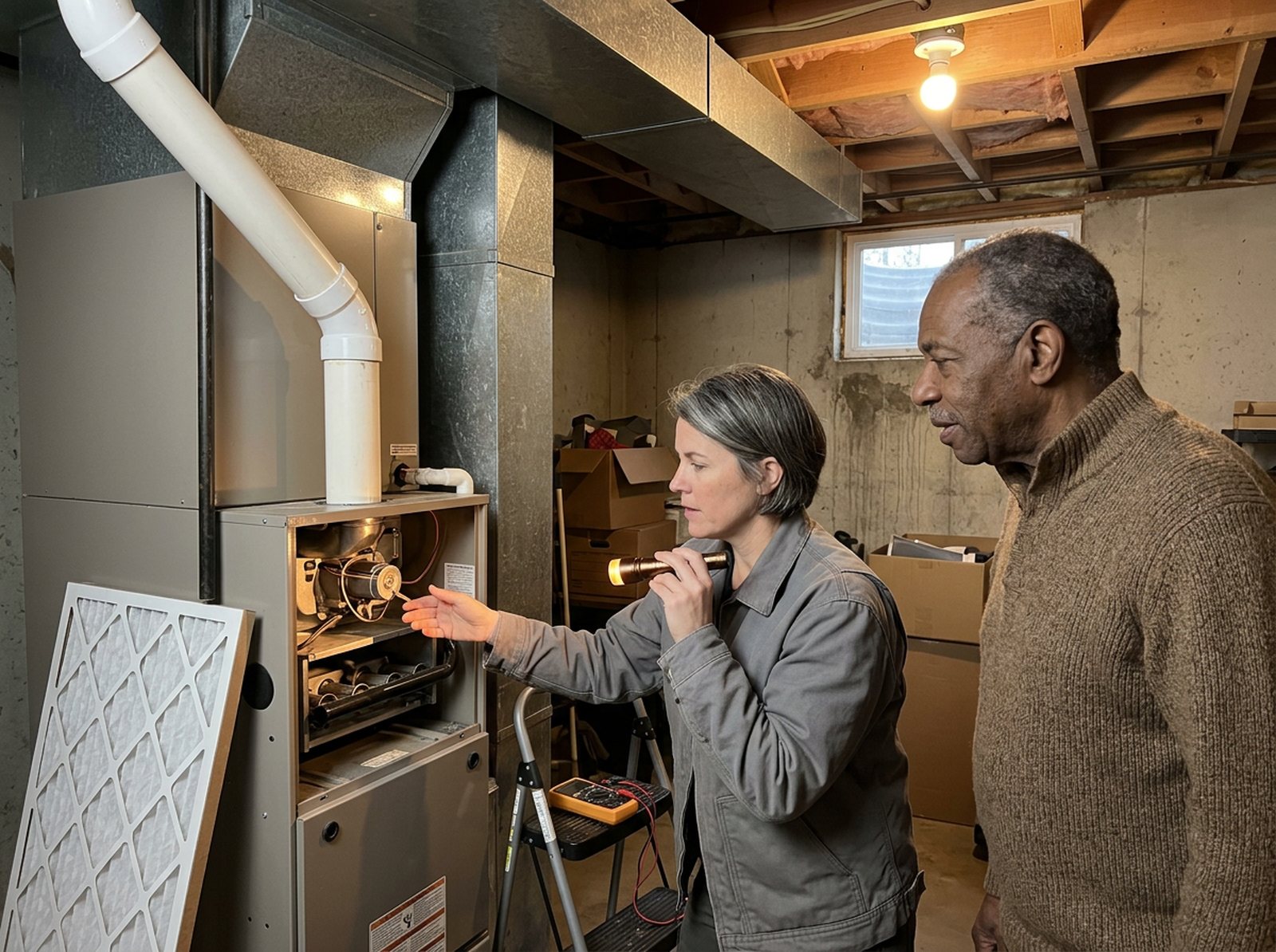
People search for this stuff. In Ahrefs’ US estimates, the “ac tune up” search gets about 22,000 a month, “furnace tune up” about 12,000 and “hvac maintenance plan” about 1,800. The tune-up searches showed a map pack. The AC tune-up and maintenance plan searches also showed an AI answer, so a page that answers questions clearly has a chance to be quoted. Nobody controls what the AI answer picks.
What goes on a good maintenance plan page:
- The price, or a clear “from” price, and how billing works (monthly or yearly)
- Exactly what each visit checks, as a list a homeowner can read in 20 seconds
- When the visits happen: one cooling check in spring, one heating check in fall
- Member perks you really honor, like priority scheduling or a repair discount
- How to cancel, in one plain sentence
- A sign-up form or a “call to join” button near the top
- Short FAQs: Does it cover parts? What if I have two systems?
Plumbing and HVAC under one roof
Lots of shops do both. Google’s guidelines say “there should only be one profile per business,” so you don’t get a second listing for the plumbing side out of the same shop.
That forces a choice. Your main category should match what most of the business is. If 70% of your revenue is heating and cooling, lead with “HVAC contractor” and add a plumbing category as a second one. If it’s the other way around, flip it. Then list the other trade’s jobs as services so they still show. If plumbing is the bigger half, our plumbing SEO page covers that side.
Some shops try to get around this with a second profile at a buddy’s address or a rented mailbox. Don’t. Google says it can suspend profiles that break its guidelines.
How SEO, LSA and Google Ads split the work
Paid ads still have a job in HVAC. SEO just means you lean on them less, and mostly in the weeks you choose.
Think about the two rushes. In a heat wave, most shops in town fill up at once. If your map listing and pages already bring in more calls than you can run, paying for more clicks just burns money. That’s the week to pull ad budgets back, not push them up.
The slow weeks are the opposite. Fewer people search, for ads and organic alike. Ads let you grab a bigger share of what’s left, and they suit tune-up and replacement offers. That’s our view, and it’s when we’d spend.
How we weigh each one for an HVAC shop:
| Channel | What it’s best at in HVAC | Where it falls short |
|---|---|---|
| SEO (map pack and pages) | Steady repair and replacement calls you don’t pay for per click | Slow to build, and it can’t turn up on demand |
| Local Services Ads | Filling gaps fast, since you pay when a customer gets in touch, not per click | Slow answers can hurt your ad’s rank, and you’re renting the spot |
| Google search ads | Hitting high-dollar replacement searches in your best zip codes | Every click costs you, and the calls stop the day you stop paying |
Answer fast. Google’s Local Services help page says a “consistently fast response time could improve your ad’s ranking.” A shop that lets LSA calls ring out in July loses that job and can slip in the LSA rankings for the next one. For the setup side, read our Local Services Ads guide, and for a channel-by-channel cost breakdown, see what each HVAC lead channel really costs.
How we measure HVAC SEO: booked jobs by type
We judge HVAC SEO by booked jobs, split by type. A system replacement and a tune-up special both count as “a lead,” but they’re not worth the same, and a report that lumps them together hides what’s working.
So every month we sort calls and forms from search into buckets like these:
| Job type | What we track | Why it matters |
|---|---|---|
| Repair calls | Booked calls from the map and repair pages | The steady base, and the door to replacements |
| Replacement and install leads | Estimates set, then estimates sold | Few of them, but they carry the year |
| Tune-ups and plan sign-ups | Visits booked and plans sold | Fills the slow months and feeds reviews |
| Commercial | Service calls and contract inquiries | Longer sales cycle, so we count inquiries, not just closes |
| Junk | Sales calls, wrong numbers, jobs you don’t do | If this grows, a page or a setting is pulling the wrong traffic |
Why split them? This is an example calculation with made-up round numbers, not client data. Say a shop gets 40 booked repair calls from search in a month and 6 replacement estimates. If it sells 2 of those estimates at $9,000 each, that’s $18,000 from two jobs. The 40 repairs at $350 each come to $14,000. If the replacement page fell off page one, a “leads are up” report could still look fine while the bigger money slipped away.
Use your own average tickets and close rates, not ours or anyone’s “industry average.” Your field software already has them. We pull those numbers in month one so the reports mean something.
We’ll also show you rankings and traffic. They help us spot trouble early, but booked jobs are the score.
What the first three months look like
SEO takes months, not weeks. And Google says “there’s no way to request or pay for a better local ranking,” so anyone who promises page one by a set date is guessing. Here’s the order we work in.
Month 1: fix the foundation
- Audit the profile: category, services, service area, hours, photos
- Set up call and form tracking and connect it to your field software
- Pull out dead tax credit lines and old refrigerant claims
- Fix the big site problems: slow pages, missing phone buttons, broken forms
- Start the review text after every job
Month 2: build the pages for the next season
We start with whichever season is coming, not the one you’re in. Start with us in October and the furnace rush is already on. So we tighten the heating pages you have, then build the AC pages for spring. Each one gets real photos and real answers from your team. From you, that’s mostly job photos and a short call to answer page questions. Then the maintenance plan page.
Month 3 and on: grow what’s working
By now the tracking shows which pages and searches bring booked jobs. We add problem articles and links where they’ll help most, and update pages before each rush. Crowded markets take longer. We’ll tell you early if yours is one.
What to ask before you hire anyone for HVAC SEO
Whether you hire us or someone else, ask these questions first.
- Who owns the website and the Google profile? You should. If you leave, both go with you.
- How many city pages will you build? If the answer is “one for every town you serve, same text with the name swapped,” walk away. Google’s spam policies call pages made “to rank for specific, similar search queries” doorway abuse. We’d rather build one strong page per job. A real second office with its own staff and service area is different: Google allows it its own profile.
- How do you get reviews? If they mention review gating, paid reviews or “a discount for a five-star,” that breaks Google’s review rules, which say incentivized reviews “will be removed from Maps.”
- Where do your links come from? “We have a network” can mean paid links. Ask for examples.
- What will the monthly report show? You want booked jobs by type, not just “impressions are up 40%.”
- What happens in the off-season? A good answer sounds like a plan for next season’s pages. A bad one sounds like “we keep optimizing.”
Already have 60 near-copies from your last agency? We don’t delete them in a panic. We check which ones bring calls, move anything useful into the main job pages and redirect the rest to the closest real page.
Why D&J for HVAC SEO
Our whole business is marketing for contractors and home service companies. We’re a Google Partner and a Meta Business Partner, based in Stamford, Connecticut.
SEO is one piece. We also run Google Ads and Local Services Ads, build websites, handle reviews and reputation, and offer Frontline, our AI receptionist, for the 9 p.m. no-heat calls nobody’s in the office to answer. When one team runs your map listing and your ads, it can pause the ads in a week when the map already fills your board.
We’ve also worked with more than 30 SERVPRO franchises and never lost a SERVPRO client. That’s restoration, not HVAC. But it’s emergency, phone-first work, like a no-heat call. You can read our case studies. We use the same playbook in other trades too, like electrician SEO and roofing SEO. For the rules that apply to every trade, see our SEO for contractors guide.
HVAC SEO FAQ
How long does HVAC SEO take to work?
Plan on months, not weeks. Profile and tracking fixes can show up in calls fairly fast, but new pages take time to get found and trusted. If you start in October, the work you do now is mostly aimed at next spring’s AC rush, not this week’s furnace calls.
How much does HVAC SEO cost?
It depends on how much needs fixing: how many job pages you need, whether the site needs a rebuild, how crowded your market is and whether you want ads managed too. Our free local SEO audit shows what needs fixing, and we quote from there.
Should I change my Google category in summer and winter?
We don’t. If you do heating and cooling all year, “HVAC contractor” describes your business in every month, and Google asks for categories that describe your core business. We’d rather win each season with the right pages, seasonal services on the profile and steady reviews. A cooling-only shop is different and may fit a cooling category.
Can I still mention the heat pump tax credit?
Not as a promise for new work. The IRS says the section 25C credit isn’t allowed for property placed in service after December 31, 2025. Take those lines off your pages and estimates. Point homeowners to utility rebates, state programs and the DSIRE database instead, and tell them to check with their tax preparer.
Is SEO or Local Services Ads better for HVAC?
You’ll usually want both, used at different times. SEO builds calls you don’t pay for per click, but it’s slow and can’t be turned up on demand. Local Services Ads charge when a customer gets in touch, and they can fill a slow week fast. In a peak week with a full board, we’d pull paid spend back first.
Do I need a separate page for every city I serve?
No. Pages that copy the same text with a new town name are what Google calls doorway abuse. Set your service area on your profile, then build one strong page per job. If you have a real second office with its own staff and its own service area, that office can have its own profile and page.
What to do this week
You don’t need an agency to start. Here’s what you can get done in the next five days:
- Open your Google Business Profile. Check that the main category is “HVAC contractor” (or the closest fit for your shop) and that your services list covers every job you want.
- Search your website for “tax credit” and “25C.” Fix every page that promises a federal credit.
- Next time you or a tech is in three different towns you serve, search “ac repair near me” and “furnace repair” from a phone there. Write down who’s in the map each time.
- Have your techs text a review link to every customer from this week’s jobs and tune-ups.
- Pick the one page you’ll build before spring. For most shops, it’s AC replacement or the maintenance plan.
Want a second set of eyes? We’ll look at your profile, your site and the shops beating you in the map, then tell you what we’d fix first. It’s free.


