

Most roofers know what they pay per lead. Few know what they paid in marketing for each roof they signed last quarter. That second number decides whether your marketing makes money. Below, we rank the main sources of roofing leads by cost per signed roof. We use published prices where they exist and plain example math where they don’t. We’ll also cover the storm and insurance rules that can turn a good lead into a legal problem.
The short answer: in our example math, past customer referrals are the cheapest roofing leads. Local Services Ads, knocking near your jobs and your Google Business Profile land close behind, near $500 a roof in our example. For paid leads, start with Local Services Ads. Search ads come later, because roofing had the highest cost per lead in LocaliQ’s latest home services data. Shared marketplace leads look cheap but can cost more per signed roof than leads at twice the price.
Key takeaways
- Cost per signed roof is cost per lead divided by close rate: a $100 lead that signs 1 in 6 costs $600 a roof. The one formula
- In our example math, referrals cost less per signed roof than any paid source. Those numbers are assumptions, so plug in your own. All sources ranked
- Local Services Ads charge per lead, but Google no longer credits leads for job types or areas you don’t serve. LSA setup
- Roofing and gutters had the highest cost per lead ($228.15) in LocaliQ’s latest home services search data. Search ad costs
- On Angi you pay for leads even if you don’t win the job, and a lead may go to several pros. Buying leads
- In Texas, advertising or giving a deductible waiver without the insurer’s consent is a Class B misdemeanor. Storm and insurance rules
- Firms that tried to reach web leads within an hour were nearly seven times as likely to qualify them as firms that tried an hour later. Callback speed
What a roofing lead really costs you
Lead price is only half the math. The number that pays your crew is cost per signed roof: what you spent on leads divided by how many signed.
Cost per signed roof = lead spend ÷ roofs signed. Or, per lead: cost per lead ÷ close rate.
Take an example. Say you pay $100 a lead. If one lead in six signs, each roof cost you $600 to win. If one in three signs, it cost $300. Same lead price, half the marketing cost per roof.
That’s why a “cheap” $30 lead can be the most expensive one you buy. If it goes to four other roofers and you sign one in 25, you just paid $750 for that roof.
This math matters more in roofing than in most trades:
- Big tickets, few repeat buyers. A roof lasts decades, so the homeowner probably won’t buy another one from you. The first job has to pay back what you spent to get it.
- Long decisions. Replacement buyers get several quotes and talk it over at home. A lead can take weeks to sign, so you need to track it until it closes or dies.
- Insurance changes the buyer. On a claim, the insurer sets most of the price, so the homeowner picks the roofer they trust with the adjuster and the paperwork. That changes which leads close and what you’re allowed to promise.
So before you add any new source, write down two numbers for every source you already pay: what you spent last quarter and how many roofs it signed. If you can’t fill in the second number, fix that first. To see how these sources fit into a plan across the storm year, read our page on roofing marketing.
The main roofing lead sources, ranked by cost per signed roof
This table puts eight main sources side by side. The paid lead prices come from the platforms and from published benchmarks, with links in the sections below. Everything marked as an example is an assumption we picked to show the math. Swap in your own numbers before you trust the last column.
| Source | What it costs | Example close rate | Example cost per signed roof | Best for |
|---|---|---|---|---|
| Past customer referral | Example: a $250 reward, paid only when the referral signs | Not needed: you pay per signed roof | $250 (example) | Any shop with past customers |
| Local Services Ads | $79 to $153 (99 Calls campaigns, nationwide, last 12 months) | 1 in 4 | About $464 (example, at $116, the middle of the range) | Homeowners ready to book now |
| Knocking around an active job | Example: $500 per roof signed, for an owner or salaried rep who knocks (commission reps often cost more) | Not needed: you pay per signed roof | $500 (example) | Neighborhoods you’re already in |
| Google Business Profile and SEO | Example: $1,500 a month in SEO work | Example: 3 roofs a month once rankings are built (expect few early on) | $500 (example), falling as rankings grow | Shops planning 12+ months out |
| Facebook and Instagram lead ads | $42.95 average for home and home improvement (LocaliQ 2026, not roofing only) | 1 in 15 | About $644 (example) | Retail reroofs, financing offers |
| Shared marketplace (Angi, Thumbtack) | Varies by job and market (example: $60) | 1 in 12 | About $720 (example) | Filling gaps if you call back fast |
| Pay-per-call vendor | $85 to $550 for roofing (Service Direct; you set it) | 1 in 4 | About $800 (example, at $200 a call) | Adding calls without running ads |
| Google search ads | $228.15 median (LocaliQ, roofing and gutters, 2024 to 2025) | 1 in 6 | About $1,369 (example) | Volume on demand |

Referral and knocking costs are already per signed roof, so there’s no close rate to divide by. Your own close rates decide the real order.
We set Local Services Ads and pay-per-call higher than search because most of those leads are a homeowner calling one roofer directly. We set social lowest because those buyers are earlier in the decision, and the LocaliQ figure covers all home improvement, not just roofing. These are our assumptions, not measured rates.
Your order may differ. Example: a storm roofer whose rep is at the door the same afternoon might sign one shared lead in five. At $60 a lead, that’s about $300 a roof. A retail shop whose office calls back the next morning might sign one in twenty. Run your own numbers.
A few sources aren’t on the table because their cost swings too much to give one example: direct mail, Nextdoor, real estate agents and home inspectors who pass along roof problems, and home shows. Track them the same way if you use them.
Local Services Ads for roofers
If you only turn on one paid channel, we’d make it Local Services Ads. Roofers are an eligible category in the US, and Google says you pay only for leads related to your business and the services you offer. You don’t pay for clicks. The homeowner calls or messages you from the ad.
Google doesn’t publish a price list for these leads. 99 Calls, a lead vendor that runs these ads for roofers, lists $79 to $153 per roofing lead as the 10th to 90th percentile of what businesses paid nationwide over the last 12 months (as of October 2026), a smaller share of its roofing leads than Google Ads. 99 Calls gets those figures by dividing its ad spend by the vetted leads it delivered, so your own account could run higher or lower.
Where roofers lose money on these ads is setup. Google’s lead credit page says it no longer supports credits for “job type not serviced” and “geo not serviced” leads. So if a homeowner asks for gutters you don’t list, or calls from outside your area, you can’t get that lead credited anymore. And any job type or ZIP code you leave switched on is a lead you agreed to pay for.
When we audit a roofer’s Local Services Ads account, these are the five settings we check first:
- Job types: turn on only the work you want. If your crews are booked with replacements, switch off small repairs until the schedule opens up.
- Service area: list the ZIP codes your crews reach on a normal day, not the ones you’d drive to for a big job.
- Hours: set the hours someone picks up. Google warns that if you regularly miss calls or messages, your ad ranking may suffer. And a missed call during your business hours can still count as a charged lead if the caller stays on the line for more than 20 seconds.
- Reviews: ask every finished customer. Google lists reviews, “subject to category requirements,” among the things you need before your ads can run, even before the full Google Verified badge.
- Lead log: mark each lead booked, signed or dead every week, so you know your real cost per signed roof.
Brand new with no reviews? Google lets some businesses run pre-badge ads after the first checks, but those listings sit below fully verified ones, and reviews can still be required for your category. Ask your past customers for reviews before you turn the ads on.
Our Local Services Ads guide walks through the full setup and the Google Verified badge checks.
Google search ads for roofing leads
Search ads can bring roofing leads any day you want them. You also pay for every click, good or bad. Roofing clicks aren’t cheap. LocaliQ’s home services search benchmarks cover 3,211 campaigns that ran from April 2024 to March 2025. For roofing and gutters, the medians were:
- $10.70 per click, third highest after painting and electricians
- 3.70% of clicks turning into leads, second lowest of the categories LocaliQ tracked
- $228.15 per lead, the highest of the home services categories LocaliQ tracked
The home services average in the same report was $90.92 a lead. A roofing lead from search cost about two and a half times what the average home services lead did, and fewer roofing clicks turned into leads than in almost any other home services category. These are medians from LocaliQ’s sample, and your town can land well above or below them.
99 Calls reports $135 to $404 a lead for the Google Ads campaigns it runs, so prices swing a lot by market and by who manages the account.
With clicks that pricey, the money is won or lost in what you block. When we audit a contractor’s ad account, the search terms report is the first thing we open. On day one, we’d add these as negative keywords:
- Job seekers: jobs, hiring, salary, apprentice, how to become a roofer
- Do-it-yourselfers: DIY, YouTube, tutorial, video
- Material shoppers: shingles for sale, bundle price, roofing nails, supply, and big-box store names
- Work you don’t do: metal, tile, flat or commercial, if you don’t install it
- Free stuff: free roof replacement, roof grants, government roof programs. Don’t add “free” on its own, or you’ll block “free roof inspection” searches.
At $10.70 a click, 20 clicks from job seekers cost you $214 before a single homeowner calls.
Then track calls, not just form fills. If your account only counts forms, Google’s bidding chases more forms. Forms often come from people collecting quotes, so we weigh calls more. Recorded calls let you tag which keywords brought real roof estimates.
One more check: split repair and replacement into separate campaigns. Someone typing “roof leak repair” has water in the kitchen. Someone typing “roof replacement cost” is planning. They need different ads and different budgets.
Buying roofing leads: shared, exclusive and pay per call
Bought leads can fill a slow month. What matters is who else got the same lead.
Three common models, in the platforms’ own words:
- Angi (shared). The Angi Pro Agreement says you “will pay for the leads you receive, even if you do not win the job,” and that Angi “may send a lead to multiple pros, based on the homeowner’s choice.” Our Angi leads review covers credits and contracts.
- Thumbtack (you pick the price). Thumbtack’s help center says you pay for leads. You choose your lead prices with a slider, and Thumbtack says that “is the exact amount you’ll pay for each lead.” It also says prices vary with the job, how many pros are available and your market. For its Opportunities, you only pay if the customer responds. We break down whether Thumbtack is worth it separately.
- Pay-per-call vendors (exclusive calls). Service Direct lists a roofing price range of $85 to $550 per lead. You choose your price and there’s no term contract.
Shared leads cost less per lead and often more per roof, because you’re racing other roofers to the same kitchen table. Exclusive leads cost more up front. They only win if your close rate rises enough to cover the higher price.
Before you hand any vendor a card, get answers to these five questions in writing:
- How many other roofers can get the same lead?
- What counts as a billable lead? Wrong numbers, out-of-area calls, people selling you something?
- How do credits work, and how many days do I have to ask?
- Is there a contract, a subscription or an early exit fee?
- Can I hear the call recordings or see the form the homeowner filled out, including what they agreed to about being contacted?
If a rep can’t answer number two in one sentence, keep your card in your wallet.
Storm and insurance leads play by different rules
Storm leads come in bursts, and claim jobs carry deductible rules retail jobs don’t.
Start with timing. Ahrefs estimates about 1,700 US searches for “hail damage roof” in December 2025, rising to about 4,800 in April 2026. That’s nearly three times as many. September 2025 hit about 4,900, so storms can spike demand in fall too. Retail demand moves less: Ahrefs puts “roof replacement” searches at about 92,000 in January 2026 and about 128,000 in November 2025. Plan by season:
- Winter: build the storm plan, line up phone coverage, and work your past customer list. Retail shops in cold states can book spring replacements now.
- Spring: keep budget in reserve for the first big hail event, and move it within a day.
- Summer: knock around every job while crews are busiest, and collect reviews.
- Fall: watch for storms again, and push “before winter” replacements.
Insurance jobs change what you’re allowed to say. Texas is the clearest example. Its Insurance Code says the homeowner “shall pay any deductible” on a property claim.
Under Business and Commerce Code Section 27.02, a seller commits an offense if it advertises or promises to “pay, waive, absorb, or otherwise decline to charge or collect” the deductible, or to offset it with a rebate or credit, without the insurer’s consent. It’s also an offense to actually waive, absorb or rebate the deductible on a job without that consent. Either one is a Class B misdemeanor.
Two more Texas rules matter for your paperwork. A contract of $1,000 or more that you expect to be paid from a claim must include a deductible notice “in at least 12-point boldfaced type.” And the insurer can hold back recoverable depreciation until it gets reasonable proof the homeowner paid the deductible.
So in Texas, a door hanger that says “we cover your deductible” can be a crime. If you work outside Texas, check your own state’s rules with your attorney before you print anything that mentions deductibles.
For steady claim work without chasing storms, look at managed repair networks. They send insurance jobs to approved contractors. Contractor Connection, part of Crawford, says that aside from an initial application fee, you only pay for work you perform.
The three kinds of roofing leads also behave differently once you have them:
| Lead type | Who pays | What the buyer wants | What to watch |
|---|---|---|---|
| Retail reroof | The homeowner | A fair price, financing, a clean job | Several quotes, so follow up for weeks |
| Storm, paid by the homeowner | The homeowner | A fast inspection and a crew date | Many roofers knocking the same street |
| Insurance claim | The insurer, minus the deductible | Someone they trust to handle the paperwork | Deductible rules and slower payment |
Tape this storm-week checklist to the office wall:
- Raise Local Services Ads and search budgets the day after the storm, and cap them so one day can’t eat the month.
- Add “hail,” “wind” and “storm damage” ad groups that point to a page about inspections, not prices.
- Put someone on the phones for evenings and weekends. Storm callers don’t wait for Monday.
- Check every ad, flyer and script for deductible language before it goes out.
- Email or call past customers in the hit ZIP codes and offer a free inspection.
Door knocking that doesn’t burn the street
In our example math, the neighbor watching your crew tear off the roof next door costs about the same per signed roof as Local Services Ads, and you don’t need an ad budget to reach them. They can see the dumpster, the trucks and how clean the yard looks at 5 p.m.
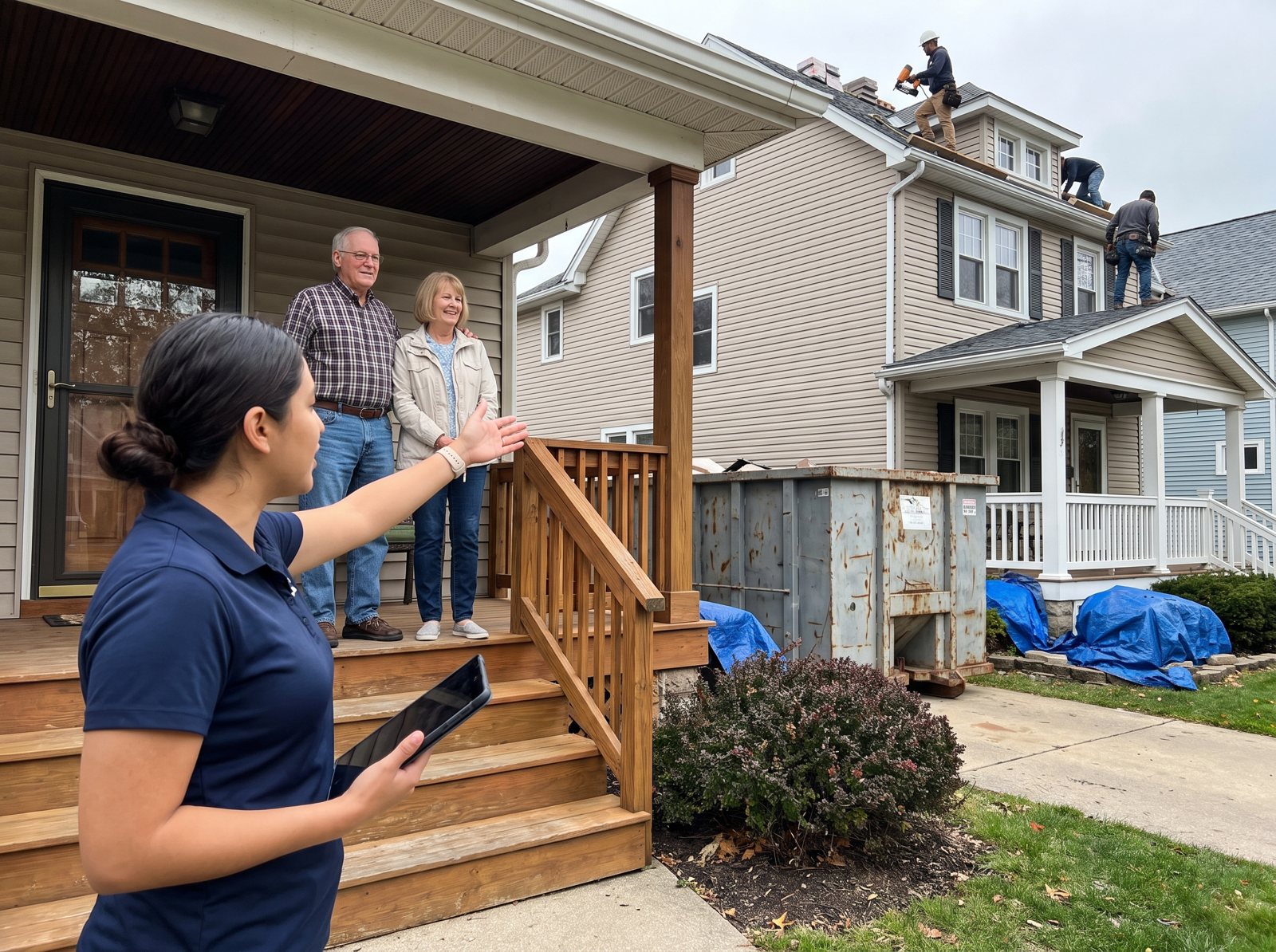
So knock on the houses on both sides of every job and the ones across the street, while the work is still going. Keep it short and give them a reason to say yes:
“Hi, I’m (your name) with (your company). We’re replacing the roof next door this week, so sorry about the noise. While we’re set up, we’re doing free roof checks for the neighbors. If you want, I’ll take a look and text you the photos. No pitch at the door.”
The script leaves out three things on purpose: your customer’s name, insurance and any ask for a decision on the porch. Ask your customer before you mention them by name. Some will say yes, and that helps.
Before you knock, know two rules.
The FTC’s Cooling-Off Rule gives buyers three days to cancel many sales made at their home. The FTC’s own page uses “a home improvement like a new roof that you’re not sure you really need” as an example. It doesn’t cover sales under $25, sales needed to meet an emergency, or a repair the homeowner asked you to come out for.
But if they asked for a repair and you sell them a full new roof, the FTC says the extra purchase is covered, so you must give the cancel notice. Don’t lean on the emergency exception either. The simplest rule: give the notice on every sale made at the home.
The seller has to tell the buyer about the right to cancel at the time of the sale. You also have to hand over two copies of a cancellation form and a dated contract that explains the right to cancel, in the same language you used to sell. The buyer has until midnight of the third business day, and Saturday counts as a business day. Build all of that into your contract packet.
Then call the town clerk before you send reps out. Local rules can be strict. League City, Texas, for example, requires door-to-door solicitors to get a permit, pass a background check and carry a city ID card. It also says a posted “No Soliciting” sign legally bars solicitors from the property. Skip those houses, everywhere.
If you don’t want to knock at all, yard signs on every job, left up until the final inspection, do some of the same work. So do door hangers on the homes around each job. Skip any with a No Soliciting sign, and check your town’s rules on hangers too.
The cheapest leads: past customers, reviews and your profile
After every job, ask for three things: a review, a referral and photos you can post.
The review. Ask at the final walk-through, while the homeowner is looking at a clean yard and a new roof. Send the link by text or email before you leave the driveway. Our free review link generator makes the link and a QR code, and our guide to getting more Google reviews has the follow-up messages.
The referral. Don’t wait for referrals to show up. Ask for them a few weeks after the job, once the first big rain has come and gone. Something like this, sent from the owner’s own phone:
“Hi (customer’s name), it’s (your name) from (your company). Just checking that the roof held up fine in last week’s rain. If any neighbors or family are thinking about their roof, I’d be glad to take a look for them. As a thank you, we send a $250 gift card when someone you send our way signs with us.”
Pick a reward you can afford on your smallest job, and pay it only when the referral signs. Check your state’s rules on referral fees and gifts before you offer one. And in Texas, never offer the new customer a discount or gift that could offset their deductible on a claim job, since Section 27.02 makes it an offense to offer a rebate or credit that offsets the deductible without the insurer’s consent.
The photos. Before, during and after shots of real jobs belong on your Google Business Profile and on your service pages. They show a homeowner the work is real before they pick up the phone.
This is also where long-term search traffic comes from. A well-built profile and a page for each type of roof you install keep bringing calls after the ad budget runs out. Plan on months, not weeks, before it pays. Our roofing SEO page shows how we build it.
Where commercial roofing leads come from
Commercial roofing leads mostly don’t start with a “roofer near me” search. They start with the people who manage buildings and with projects that go out for bid.
- Bid platforms. Dodge Construction Network and ConstructConnect track commercial projects and bid opportunities for contractors and subs. Get a price from each before you sign up, and weigh it against how many jobs you can actually bid each month.
- Property and facility managers. One manager can control dozens of roofs. Offer a free roof survey with photos and a written condition report. Managers often use a report like that to plan next year’s repairs, so your name is on the plan.
- Maintenance agreements. Twice-a-year inspections and drain cleaning keep you on the roof. When it’s time to replace, you’re the roofer who already knows it.
- General contractors. Get on the bid list of the GCs who build in your area. Finish the first job on time and clean, and ask the GC’s estimator to keep you on the list.
Online, the commercial buyer searches differently too. Think “TPO roof repair,” “flat roof leak” or “commercial roof coating,” not “roofer.” Give each of those its own page with photos of commercial jobs you’ve done.
Call back in five minutes, not five hours
Speed is the cheapest fix on this page, and it raises your close rate on every lead you already paid for. In a Harvard Business Review study of online leads, firms that tried to reach a lead within an hour were nearly seven times as likely to qualify it as firms that tried even an hour later. Compared with firms that waited 24 hours or more, they were more than 60 times as likely.
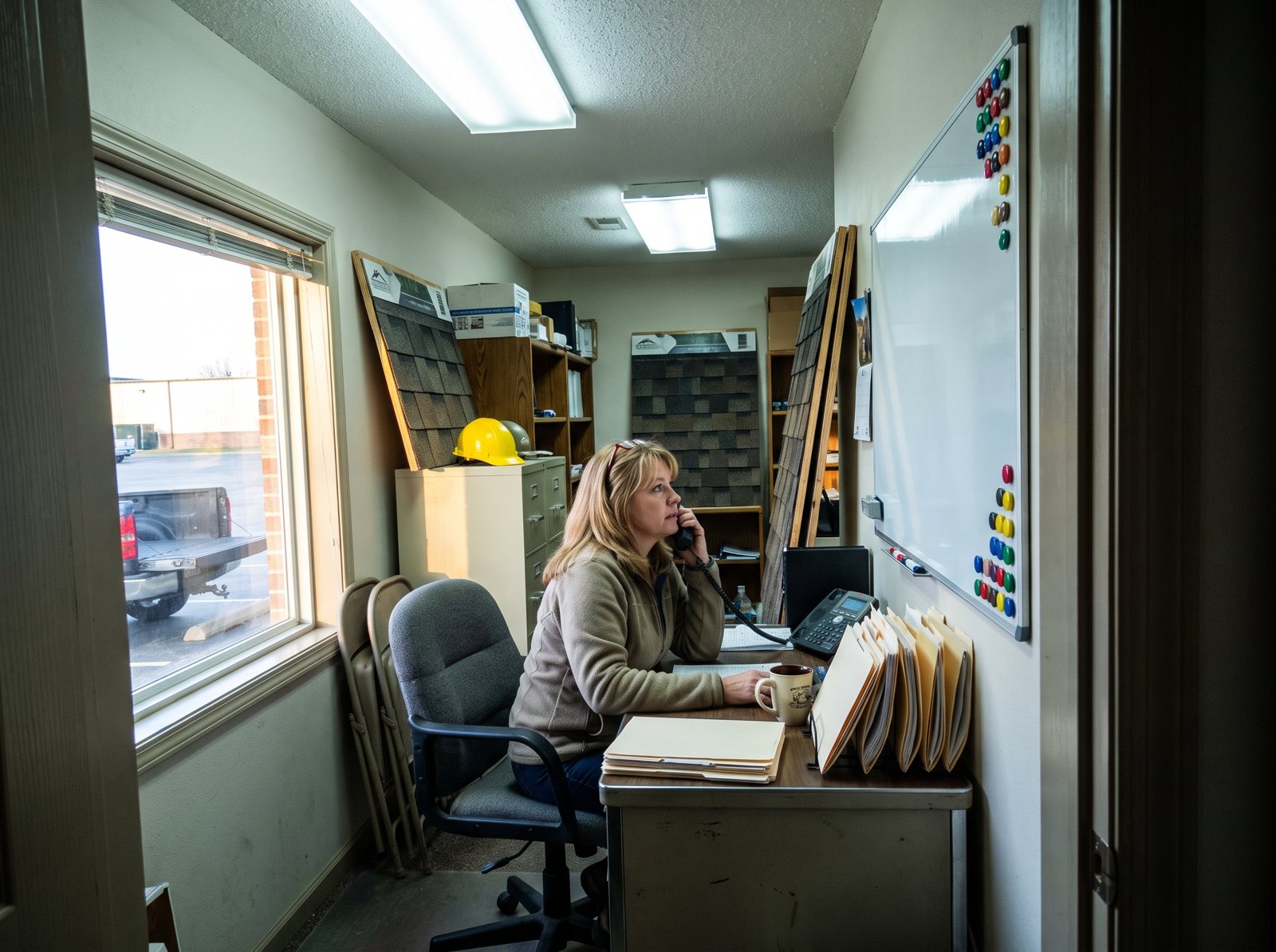
The study measured the first hour. Five minutes is our own target, because in storm season the next roofer is one search away.
The same researchers tested 2,241 US companies with a web lead. 23% never responded at all. Among those that replied within 30 days, the average wait was 42 hours. That study is from 2011 and wasn’t about roofing.
Use a callback script that books an inspection instead of quoting a price over the phone:
- “Hi, this is (name) with (company). You just asked about your roof. Is now an OK time for two quick questions?”
- “Is water coming in right now, or is this a planned replacement?” (A leak goes to the front of the line.)
- “Has an insurance claim been opened?” (This tells you which paperwork to bring.)
- “I can have someone on the roof tomorrow at 10 or Thursday at 3. Which works?”
- “I’ll text you a confirmation with a photo of who’s coming.”
Can’t pick up at 9 p.m. on a Saturday? We built Restoral, our AI system that answers calls and chats and books jobs onto your calendar, for that gap. A good answering service works too. Just don’t let the lead sit until Monday.
What we’d do with $1,500, $5,000 or $15,000 a month
Here’s how we’d split a monthly roofing lead budget at three sizes. Treat these as starting points to test, not promises. The dollar amounts include ad spend and any outside help, like an SEO company. They don’t include your own time or a call tracking tool. They assume you track every lead to signed or dead.
| Where the money goes | $1,500 a month | $5,000 a month | $15,000 a month |
|---|---|---|---|
| Local Services Ads | $1,100 | $2,000 | $3,500 |
| Google search ads (repair and replacement split) | None yet | $2,200 | $6,000 |
| Facebook and Instagram (retargeting, financing offers) | None | None | $1,500 |
| SEO, service pages and profile work | Your own time | Your own time | $3,000 |
| Referral rewards (a cap, paid only when one signs), yard signs, door hangers | $400 | $800 | $1,000 |
Example: $1,100 of Local Services Ads at about $116 a lead is about 9 leads. At 1 in 4, that’s about 2 roofs a month.
Why this order? Local Services Ads come first because you pay per lead, not per click, so a small budget isn’t spent on clicks that never call. Wrong leads still cost you, which is why the settings above matter. Search ads come next, once the budget buys enough clicks to tell good keywords from bad ones. At LocaliQ’s $10.70 median for roofing, moving even $500 of the $1,500 plan into search buys only about 47 clicks. That’s too few to judge anything.
SEO ranks well per roof in our table, but it pays back in months, not weeks. On the two smaller budgets, we’d spend that money on leads that ring this month and have you do the profile work yourself.
Facebook waits until the biggest budget. LocaliQ’s 2026 Facebook lead ads average for home and home improvement was $42.95, but that’s a broad category, and we assume roofing buyers there are earlier in the decision, as in the table above. We’d mostly use it to show your ads again to people who already visited your site.
At every size, keep the referral line. The rewards are only paid when a referral signs. The signs and hangers are a fixed cost.
Mistakes we see when we audit roofing lead accounts
When we open a roofer’s Google Ads and Local Services Ads accounts, these are the problems we find most.
- One phone number for everything. The truck, the website, the ads and the yard signs all ring the same line. Nobody can say which one made the phone ring, so every source looks equally good. Give each source its own tracking number. On your Google Business Profile, put the tracking number as the main number and your real number as an additional phone.
- Job types turned on “just in case.” Gutters, skylights and small repairs you don’t really want are switched on in Local Services Ads. Every one of those leads is billable, and since Google stopped crediting wrong job type or area leads, there’s less room to get money back.
- Ads showing for job hunters. No negative keywords for “jobs,” “hiring” or “salary.” Check your search terms report: if “roofing jobs” or “roofer salary” shows up, you’re paying for job hunters.
- Paying for people who already know you. Ads bidding on your own company name, with no check on how many of those people would have called anyway. Sometimes it’s worth it. Often it just buys back your own customers.
- No close rate by source. The office knows how many leads came in. Nobody knows how many signed. Without that, you can’t do the math at the top of this page.
Fix that one first. Every Friday, log spend and roofs signed for each source.
FAQ
How much do roofing leads cost?
It depends on the source. LocaliQ’s home services data put roofing search leads at a median of $228.15, Service Direct lists $85 to $550 for roofing calls, and 99 Calls reports $79 to $153 for its Local Services Ads leads. Divide by your close rate to see what a signed roof costs.
Are exclusive roofing leads worth the higher price?
Sometimes. You aren’t racing anyone to the door, but you pay more up front. If your close rate on exclusive leads is more than double your close rate on shared ones, the exclusive lead wins even at twice the price.
How do I get roofing leads without door knocking?
Ask every finished customer for a review and a referral, leave yard signs up until final inspection, and post real job photos on your Google Business Profile. For paid leads, start with Local Services Ads and answer every call fast, evenings included.
How do I get roofing leads from insurance companies?
One route is a managed repair network that sends claim work to approved contractors. Contractor Connection, part of Crawford, says that aside from an initial application fee you only pay for work you perform. Expect requirements like licensing, insurance, background checks and a credit review.
How do I get commercial roofing leads?
Get on bid platforms like Dodge Construction Network or ConstructConnect, offer property managers free roof surveys with written reports, sell maintenance agreements, and get on local general contractors’ bid lists. Build web pages around terms like TPO or flat roof repair.
How fast should I call a roofing lead back?
Within minutes if you can, and always within the hour. A 2011 Harvard Business Review study of online leads found firms that tried within an hour were nearly seven times as likely to qualify a lead as firms that tried an hour later.
What to do this week
Five things to do before you spend another dollar on leads:
- Make a two-column sheet for last quarter: spend and roofs signed, one row per source.
- Divide. That’s your cost per signed roof for each source.
- Open Local Services Ads and switch off every job type and ZIP code you don’t want.
- Add the job-seeker and DIY negative keywords to your search campaigns.
- Send your last 20 customers the referral note above, from the owner’s phone.
Is your profile quiet? Our free local SEO audit checks it. It looks at your Google Business Profile and local rankings. Then it lists what we’d fix first. For the bigger picture, see our guide to lead generation for contractors.


