

Remodeling leads don’t act like other trade leads. The jobs are big, the homeowners take months to decide, and plenty of the people who fill out your form are still picking tile on Pinterest. Buy the wrong leads and you’ll spend your evenings bidding against several other remodelers on price. Work the right sources first and follow up longer than the next remodeler, and you’ll sign more jobs without a bidding war.
The short answer: the best remodeling leads come from past clients and referral partners, because few other remodelers get them. Next is your Google Business Profile: you compete on the map, but the homeowner contacts you directly. Then add Local Services Ads and Google Ads aimed at hire-ready searches. Use lead sites last, and only when your cost per signed job works. Whatever the source, answer fast and follow up until their start date.
Key takeaways
- Leads from past clients usually reach only you, and partner referrals go to just a few remodelers, so you start with little or no bidding war. Sources compared
- Map leads come in warm, but you compete on the map, so photos and fresh reviews matter. Profile fixes
- Houzz found kitchen projects averaged 9.5 months of planning before 5.8 months of construction, so a quiet lead is often an early one. The planning timeline
- Set a lead budget from your job size. Example math: if you spend 4% of a $24,000 kitchen to win it and one in five leads signs, you can pay up to $192 a lead. Cost per signed job math
- Google lists Kitchen remodeling and Bathroom remodeling as US Local Services Ads categories, and the product is moving into Google Ads. Local Services Ads for remodelers
- There are about as many searches for “bathroom remodel ideas” as for “bathroom remodel near me,” so negative keywords matter a lot. Google Ads setup
- Ask scope, timing, budget, decision makers and source on the first call, every time. The qualifying script
- A short, useful note every month keeps you in the running until the homeowner is ready. Follow up sequence
Where remodeling leads come from
The best remodeling leads come from people who already trust you: past clients, their friends, and the pros they work with. Next come leads you own, like your Google map listing and your website. Paid ads come third. Rented leads from lead sites come last.
The order comes down to how many other remodelers get the same lead. A referral usually calls one remodeler. A shared lead from a lead site may go to several. When a homeowner has three bids on the table, the talk turns to price fast.
| Source | How you pay | Who else gets it | How fast it starts (what we see) | Best for |
|---|---|---|---|---|
| Past clients and referrals | Your time, maybe a thank-you gift | Usually nobody | Weeks | Every remodeler |
| Designers, realtors, showrooms | Your time and good work | A few remodelers they trust | One to three months | Kitchen and bath, whole home |
| Google Business Profile | Free | You compete on the map | One to three months | Everyone, starting now |
| Website and SEO | Monthly work or a monthly fee | You compete in search | Three to twelve months | Remodelers planning to stay put |
| Local Services Ads | Per lead | The homeowner picks from a short list | Days once you’re verified | Kitchen, bath and general contractors |
| Google Ads | Per click | You compete in the auction | Days | Bigger budgets, clear service pages |
| Lead sites (Houzz, Angi, Thumbtack) | Varies by site (see our reviews below) | Often other pros | Days | New companies, slow months |
| Job site signs and neighbor notes | Printing | Nobody | During the job | Every active job |
Run at least two or three of these at once, so a slow month at one source doesn’t empty your calendar. If you want the bigger picture on why owned sources win over time, our guide on how to own your leads instead of renting them walks through it.
Harvard’s Joint Center for Housing Studies expects annual spending on home improvements and repairs to hover around $525 billion through the third quarter of 2027, with yearly growth of just 1.5% by then. Spending is barely growing, so a bigger year mostly means winning jobs other remodelers would have gotten. That’s why this guide keeps coming back to signed jobs, not lead counts.
Homeowners plan a remodel for months before they sign
A kitchen lead that goes quiet isn’t always a dead lead. In the 2026 U.S. Houzz & Home Study, kitchen projects averaged 9.5 months of planning and 5.8 months of construction. Primary bathrooms averaged 8.4 months of planning and 4.8 months of work. Planning took longer than the build.
So when a homeowner fills out your form in March, they may not want to start until fall. They’re collecting ideas, saving money, waiting on a bonus, or arguing with their spouse about the island. None of that makes them a bad lead. It makes them an early one.
This is the biggest difference between remodeling leads and, say, plumbing leads. A plumber’s lead has water on the floor. Your lead has a Pinterest board. Here’s what that means in practice:
- Give any new source at least 90 days before you judge it, and about six months before you cut it. A source that books nothing in month one may be filling your fall calendar.
- Ask every lead when they hope to start, and write it down in your CRM (the software where you keep customer records).
- Plan to follow up until their start date. We cover a simple sequence further down.
- Don’t cut a lead source just because it brings “not ready yet” people. Cut it if they never become ready.

A common gap we find: homeowners marked “lost” after one unanswered call, with no start date written down. (More in the mistakes list.)
What you can afford to pay for remodeling leads
Most remodelers ask what a lead costs. The better question is what a signed job costs. Start with your typical job size, then work backward to the most you can pay for one lead.
Houzz’s 2026 study gives a useful starting point. For projects done in 2025, the median spend was $24,000 for kitchens, $15,000 for primary bathrooms and $7,000 for guest bathrooms. Median means half of homeowners spent more and half spent less. For major kitchen remodels, where at least all cabinets and appliances get replaced, the median was $35,000 for smaller kitchens and $55,000 for large ones.
Now pick a ceiling for what you’ll spend to win a job. We’ll use 4% of the job’s price in this example. That number is ours, not a rule. Use your own margins. Then multiply by your close rate, meaning the share of leads that become signed jobs.
| Job (Houzz median) | Budget to win it at 4% | Max per lead if 1 in 5 sign | Max per lead if 1 in 10 sign |
|---|---|---|---|
| Guest bath, $7,000 | $280 | $56 | $28 |
| Primary bath, $15,000 | $600 | $120 | $60 |
| Kitchen, $24,000 | $960 | $192 | $96 |
| Major kitchen under 200 sq ft, $35,000 | $1,400 | $280 | $140 |
Example math: a $24,000 kitchen times 4% is $960. If one in five leads signs, you can pay up to $192 per lead ($960 times 0.2). If only one in ten signs, your ceiling drops to $96.
Compare that with search ads. In LocaliQ’s 2025 home services benchmarks, built from its own customers’ campaigns, the general construction and contractor group averaged $165.67 per lead. Only 2.61% of clicks became leads, at $5.31 a click.
Those two numbers don’t quite match: $5.31 a click divided by 2.61% is about $203 a lead, not $165.67. Treat both as rough. That group mixes all kinds of contractors, not just remodelers, and the data is from April 2024 to March 2025, so your costs may differ.
At $165.67 a lead, a guest bath remodeler would need to sign about 6 in 10 leads to stay under a $280 budget. That’s not realistic for most. A kitchen remodeler signing 1 in 5 has a $192 ceiling. That only just clears the $165.67 average, and it misses if your leads cost closer to $200. Paid search can work for kitchens, but only if you track it closely.
That’s why small bath jobs lean on referrals and the map listing, while bigger kitchen and whole-home jobs have a shot at paid search.
Track this by source. Count leads, estimates and signed jobs for each one. Then divide what you spent by signed jobs. That’s the number to compare sources by.
Your Google Business Profile and reviews come first
Your Google Business Profile is the free listing that shows on Google Maps. In the remodeler accounts we’ve looked at, it’s often the cheapest lead source and the most neglected one. It’s also what people check after a friend refers them, so it backs up your referrals too.
Here’s what we fix first on a remodeler’s profile:
- Primary category. Pick the one that matches the job you most want more of. If kitchens pay your bills, choose a kitchen remodeling category as your primary one, not a general contractor category, and add your other services as secondary categories.
- Services list. Add each job you do, like tub to shower conversions, basement finishing or cabinet refacing. Write a sentence or two for each one in plain words.
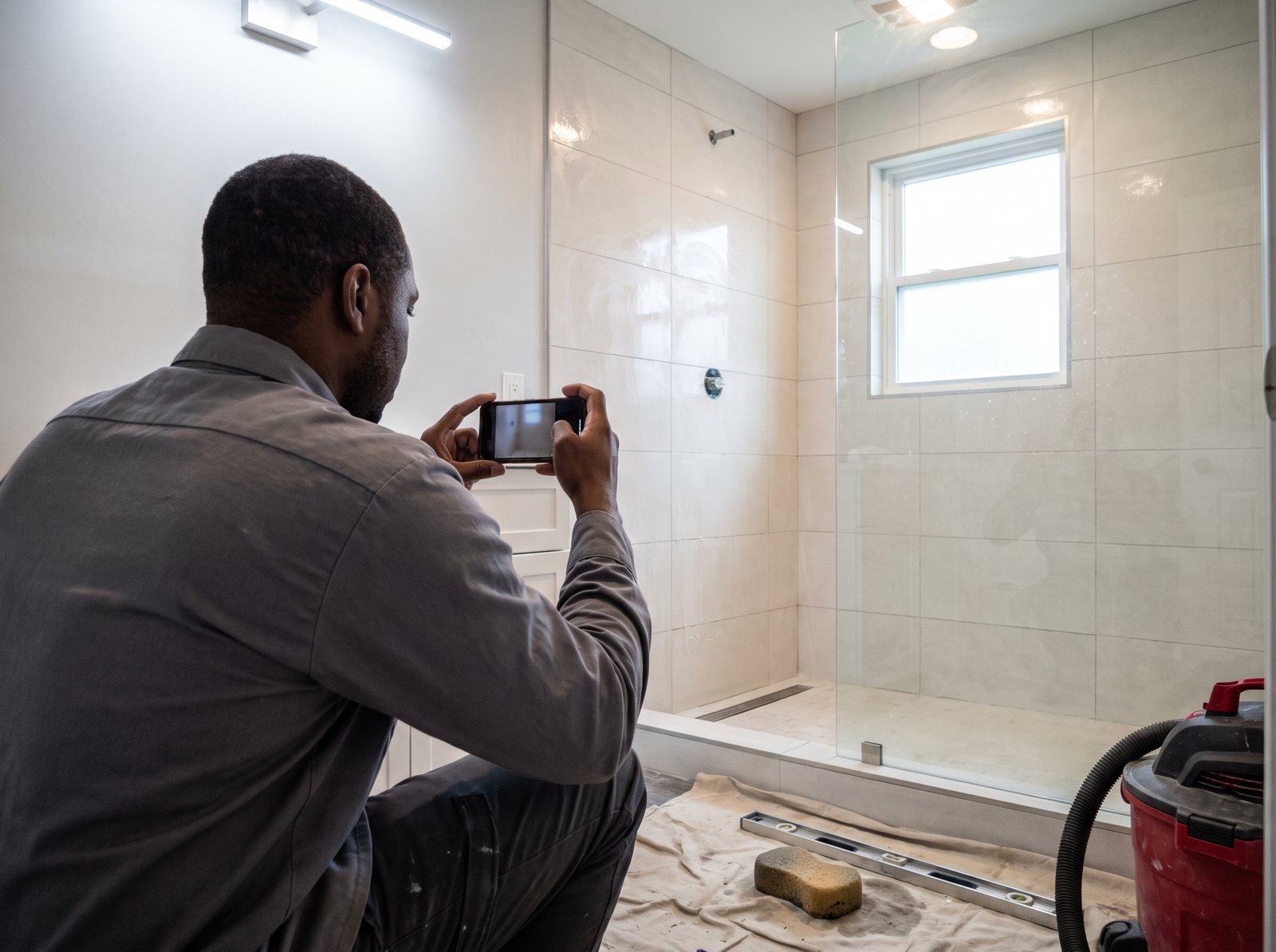
- Photos from real jobs. Shoot every finished job before you pack up, and post before, during and after shots. Homeowners want proof you’ve done a job like theirs.
- Description. Say who you serve, what you build and how your process works. Skip the slogans.
Reviews are the other half. A remodeler finishes far fewer jobs a year than a plumber or a cleaner, so each job is a rare chance to earn one. Don’t wait for the final invoice. Ask at the moment the homeowner is happiest. That’s often the day the cabinets go in or the tile is done. If you’d rather not ask mid-job, ask at the final walkthrough, while they’re still admiring the room.
Make it easy. Send a direct link by text with a one-line note: “Would you mind sharing how the project’s going? Here’s the link.” Our free review link generator makes that link in a minute. For more scripts and timing, see our guide to getting more Google reviews.
One mistake we see a lot: remodelers with great work and a handful of reviews that are years old. A homeowner about to spend $35,000 notices that. Keep a steady stream coming, even one or two a month.
Local Services Ads for remodelers
Local Services Ads are the Google ads where you pay per lead, not per click. Remodelers can use them, because Google’s US category list includes Kitchen remodeling, Bathroom remodeling and General contractor. Countertop and flooring services are on the list too.
The leads come in as calls and messages. Google says you pay only for leads related to your business and the services you offer, and that homeowners pick your profile before they contact you. That’s a better start than a form that went to five companies.
There’s a catch. Google also says that if you regularly fail to answer calls or reply to messages, your ad ranking may be affected. If you’re on a ladder or running a tile saw when the phone rings, that’s a real risk. Somebody has to pick up. If that can’t be you, set up a person or a system that can. That can be an answering service or Restoral, our own AI system that answers calls and chats and books jobs onto your calendar.
Local Services Ads are changing. Google is moving them into Google Ads as Performance Max campaigns with pay-per-lead goals. In plain terms, there are still no keywords to manage, and you still pay per valid lead. The first phase started in August 2026 for select trades like plumbing, HVAC and roofing. Google says broader groups, including service-area businesses without a storefront, follow in late 2026, and the remaining categories move in 2027.
Remodeling isn’t in the first group Google names. Google says the late 2026 phase includes service-area businesses without a storefront, but it doesn’t list which trades. So you may get a migration notice soon, or not until 2027, when Google says all remaining categories move. Watch your email either way.
If you run these ads, save your lead reports before your account moves. Google says your old performance reports won’t carry over, suggests screenshots if you need them right away, and says a download option is coming. If you don’t run them yet, our page on how Local Services Ads work covers setup and verification.
Google Ads that skip the DIY crowd
Regular Google Ads, where you pay per click, can bring big remodeling jobs. They also attract dreamers and do-it-yourselfers. The fix is a negative keyword list, so your ad stays off searches from people who want ideas or want to do it themselves.
Look at how people search. Ahrefs estimates about 24,000 US searches a month for “bathroom remodel near me.” That’s someone looking to hire. But “bathroom remodel ideas” gets about 23,000, and “diy bathroom remodel” about 2,000. On the kitchen side, “kitchen remodeling near me” gets about 15,000 and “kitchen remodel cost” about 11,000. (Ahrefs estimates, checked November 2026.)
For bathrooms, “bathroom remodel ideas” gets nearly as many searches as “bathroom remodel near me.” If your ads show for both, you’ll pay for clicks from both. Here’s a starter list of negative keywords, the words that tell Google not to show your ad:
- diy, do it yourself, how to, tutorial, youtube
- ideas, pictures, photos, inspiration, pinterest, small bathroom ideas
- jobs, hiring, salary, career, apprentice, course, school
- free, cheap, grant, rental, apartment (unless you do that work)
- software, design app, 3d planner, calculator
- big box store names, if their install programs keep showing up in your search terms report
Those idea browsers aren’t worthless. Most renovators end up hiring help: in Houzz’s 2025 study of its users (covering 2024 projects), 9 in 10 homeowners worked with a pro, as reported by Contractor magazine. Idea searchers just aren’t ready to hire yet, so let your website and follow up reach them instead of paid clicks.
Cost searches are a judgment call. Someone typing “kitchen remodel cost” is often months out, which fits the long planning window we covered above. We’d start without them and test them later on a small budget.
Three more things decide whether paid search works for a remodeler:
- One page per service. Send kitchen ads to a kitchen page with your kitchen photos, your process and a short form, never to your homepage. If your site can’t do that, see how we build contractor websites.
- Track calls and forms as conversions (tell Google which clicks turned into a call or a form). Without it, Google can’t tell a real lead from a bounce, and you can’t either.
- Read the search terms report every week (the list of what people actually typed before clicking your ad). Add new negatives as you find them.
Expect a low conversion rate. LocaliQ’s general construction and contractor group converted 2.61% of clicks into leads, the lowest of the home services groups in its 2025 report. That’s normal for a big, slow purchase. It’s why the rest of your system (fast answers, good follow up) matters so much.
What about Facebook, Instagram or Yelp ads? They can work if you have strong project photos, but they reach people who weren’t searching. We’d add them after search and Local Services Ads are working, and qualify those leads hard.
Buying remodeling leads from lead sites
Lead sites like Houzz, Angi and Thumbtack can fill gaps, especially when you’re new or a slow month hits.
Don’t expect a promise on volume. The Angi Leads pro FAQ on HomeAdvisor’s pro site answers the question “How much work can service professionals expect Angi Leads to generate?” with “We make no guarantee.” Assume no lead source guarantees volume, and judge each one by signed jobs.
We’ve written full breakdowns elsewhere, so we won’t repeat them here. See what Houzz Pro costs, our Angi leads review, and our list of lead sites ranked by job type.
Before you pay any lead seller, get written answers to these questions:
- How many other remodelers get the same lead?
- Do I pay per lead, per month, or both?
- Can I filter by job type, ZIP code and project size?
- What counts as a bad lead, and how do I get a credit?
- Is there a contract length or a cancellation fee?
- Who owns the homeowner’s contact info after the job?
Shared leads aren’t always worse. A cheap shared lead you call in two minutes can beat a pricey exclusive one you call tomorrow. But with shared leads, speed decides a lot, and price talks start early. If you can’t answer within minutes, a shared lead often isn’t worth buying.
If you’re new with no reviews, a lead site can keep the calendar moving while you earn your first reviews. Ask every early client, and anyone you did work for before you went out on your own. If you do basement finishing and got burned by shared leads, filter hard by job type and ZIP code, ask how many pros get each lead, and run a 90-day test before you commit.
Run each site’s numbers through the cost per signed job table above. Give it at least 90 days, since remodel buyers plan slowly. If it still doesn’t pay, cut it and move that money to a source you own.
Referral partners and the job you’re already on
Your next client may live next door to your current one. Referral partners and job site marketing cost little, and the homeowner shows up already trusting you because someone they know sent them.
Pros who meet your clients before you do
Lots of people talk to a homeowner before a remodeler does. Think about who they are in your town:
- Interior designers and kitchen designers who don’t build
- Realtors with buyers who want to update a house they just bought
- Cabinet, tile and plumbing fixture showrooms
- Home inspectors, who hand buyers a list of things to fix
- Trades you hire, like electricians and plumbers, who get asked “know a good remodeler?”
Don’t send a cold email. Bring photos of one finished job to a showroom and ask a simple question: “When a customer needs someone to install this, who do you send them to now?” Then make sending you easy. Leave cards, show up on time when they refer someone, and tell them how the job went. A thank-you after a signed job keeps you on their short list.
Neighbors and past clients
Neighbors watch your truck for weeks. Use it. Put a yard sign out (if the homeowner agrees and local rules allow it). Leave a short note on nearby doors before demo day saying who you are, when it’ll be loud, and how to reach you. People like a heads up, and the note gives them your number for later.
Past clients are leads you already paid for. Reach out twice a year with a short text or a photo of a recent job. The 2026 Houzz study found renovating homeowners averaged 2.7 interior room remodels in 2025. People who remodel one room often do more than one, so ask what else is on their list.
Qualify every remodeling lead on the first call
A ten-minute call can save you a wasted evening estimate. Ask the same five questions every time, in a friendly way, and write the answers down.

- Scope: “Tell me about the project. What’s bugging you about the room right now?”
- Timing: “When would you love to have it done?” This one tells you if they’re early or ready.
- Budget: “Have you set a budget range? Most kitchens like yours land between X and Y for us. Does that feel close?”
- Decision makers: “Who else will help decide? Can we meet when everyone’s home?”
- Source: “How did you hear about us?” You need this for the cost per signed job math.
Fill in X and Y from your own past jobs, not from a national survey. Saying a real range out loud is the fastest way to find out if you’re a fit. If someone with a $10,000 budget wants a $40,000 kitchen, it’s kinder to say so on the phone than after a two-hour visit.
No budget, no date, and only one of the two decision makers on the call? That’s not a lead yet. That’s a maybe.
Thinking about charging for design? We cover the trade-off in the FAQ below.
Not ready yet? That’s fine. Tag the lead with their start date and move them into follow up. Not a fit? Thank them, refer them to someone who does smaller jobs, and move on.
Follow up through the long middle
In Houzz’s 2026 study, kitchen and primary bath projects averaged 8 to 10 months of planning. In the accounts we review, the remodeler who keeps sending something useful is often the one who gets the call when the homeowner is ready.
Start with the first minutes. Call back fast, and text if they don’t pick up: “Hi [first name], this is [your name] from [your company]. Got your note about the bathroom. Is now a good time for a quick call, or is tonight better?” If calls hit voicemail while you’re on a ladder, get help answering. A homeowner who’s ready to talk and gets voicemail will often call the next remodeler on the list.
Then, for leads who aren’t ready yet, use a simple sequence like this one. Adjust the timing to the start date they gave you.
| When | What to send |
|---|---|
| Day 1 | Thank-you text with a link to one similar project on your site |
| Week 2 | A short checklist: what to decide before a kitchen or bath design meeting |
| Month 1 | Photos of a job you just finished nearby |
| Month 2 until about 4 months before their start | One useful note a month, like lead times for cabinets or what permits usually involve in your town |
| About 4 months before their start date (sooner for custom cabinets) | “You mentioned starting around [month]. To hit that, design usually starts about now. Want to get on the calendar?” |
| Any “no” or “we went with someone else” | Thank them, ask what tipped it, and stop |
Keep every message short and useful. No “just checking in.” Each note should give them something or ask one clear question.
A CRM makes this easy. Many trade CRMs let you set reminders or automated texts by lead status. If you use one, put the start date in its own field, so you can pull a list of every homeowner planning to start in spring. Only text people who gave you their number and asked to hear from you, and stop when they ask.
What we’d do with $1,500, $5,000 or $15,000 a month
Here’s how we’d split a monthly marketing budget at three sizes. These are starting points, not rules. Your market, your job mix and your calendar will change them.
| Where it goes | $1,500 a month | $5,000 a month | $15,000 a month |
|---|---|---|---|
| Local Services Ads | $900 | $1,500 | $3,000 |
| Google Ads (per click) | $0 | $2,000 | $7,000 |
| Website, SEO and project pages | $400 | $1,000 | $3,000 |
| Lead site test | $0 | $0 | $1,000 |
| Signs, door notes, partner thank-yous | $200 | $500 | $1,000 |
Brand new with no reviews? Swap some of the $1,500 Local Services Ads money for a 90-day lead site test until your first reviews come in.
At $1,500, skip regular Google Ads. Here’s the example math, using LocaliQ’s averages for the general contractor group ($5.31 a click, 2.61% of clicks becoming leads). If you pulled $500 out for Google Ads, it would buy about 94 clicks, which works out to two or three leads. That’s too few to learn anything. Put the money into Local Services Ads and your profile, and spend your own time on reviews and partners.
At $5,000, add Google Ads aimed at your best service, with its own page. At those same averages, $2,000 buys about 377 clicks and roughly 10 leads. Combined with Local Services Ads and a referral push, that’s enough to see which source signs jobs within a few months.
At $15,000, you can run Google Ads for each main service, build out project pages for search, and test one lead site for 90 days against your cost per signed job ceiling. At this size, someone should own the numbers every week. That might be you, an office manager or an agency.
Whatever the budget, the order stays the same. Fix the free stuff first. Then pay for leads you can answer fast. Then rent leads only when the math says yes.
Mistakes we see in remodelers’ lead setups
These are the problems we find most often in remodelers’ accounts. Most are free to fix.
- No start date on file. Leads get marked “lost” after one missed call, when the homeowner simply wasn’t planning to start for months.
- Stale reviews. Great work, but the newest review is years old, so the profile looks like a business that slowed down.
- Ads sent to the homepage. A kitchen searcher lands on a page about decks and roofs and leaves.
- No negative keywords. The account pays for “ideas” and “diy” clicks every day.
- Quitting too soon. A source gets cut at week six, long before its slow planners were ready to sign.
- No source tracking. Nobody asks “how did you hear about us?”, so nobody knows which source signs jobs.
If two or more of these sound familiar, start there before you spend another dollar on new leads.
Remodeling leads FAQ
How much do remodeling leads cost?
It depends on the source. In LocaliQ’s 2025 benchmarks (its customers’ campaigns from April 2024 to March 2025, all contractor types), search ads for the general construction and contractor group averaged $165.67 per lead. Lead sites set their own prices by job type and area. Instead of chasing the cheapest lead, work out what a signed job is worth to you, then set a ceiling per lead from your close rate.
Are exclusive remodeling leads worth it?
Sometimes. Exclusive means the seller won’t sell that lead to other pros, not that the homeowner won’t call anyone else. It cuts the day-one scramble, which helps on big kitchen and whole-home jobs. A cheaper shared lead can still win if you call within minutes and close well. Compare both by cost per signed job over a few months.
How do I get remodeling leads without paying for them?
Start with people who already know you. Ask past clients for referrals and reviews, post real project photos on your Google Business Profile, and build relationships with designers, realtors and showrooms. Put out yard signs and neighbor notes on every job. These take time instead of money, and referral leads usually reach only you.
Can remodelers use Google Local Services Ads?
Yes. Google’s US category list includes Kitchen remodeling, Bathroom remodeling and General contractor. You pay for leads instead of clicks. Google screens your business before your ads run, and if you’re already verified, Google says that status carries over when your account moves into Google Ads, which is happening in phases through 2027.
How long does SEO take to bring remodeling leads?
In our experience, a Google Business Profile with steady reviews and new photos can start bringing calls within a few months. Ranking your website for searches like kitchen remodeling in your town usually takes longer, often six months or more in a busy market. That’s why we pair SEO with Local Services Ads early on.
Should I charge for a design consultation?
A fee screens out people who are only shopping and pays you for real design work, but it can scare off good buyers who are early in their planning. One option we like: a free first visit, then a paid design agreement that’s credited to the job if they sign. Try one approach for a few months and watch your close rate.
What to do this week
Don’t try all of this at once. Pick three and finish them by Friday:
- Pull your last 12 months of leads. Mark each one with its source and whether it signed.
- Work out your cost per signed job ceiling for your two most common jobs, using the table above.
- Add photos from your last three projects to your Google Business Profile.
- Text your last ten clients for a review, with a direct link.
- Call every “lost” lead from the past six months and ask where their project stands.
- Visit one showroom with photos of a finished job.
- If you run Google Ads, add the negative keyword list from this page.
Want a second set of eyes? We’ll look at your Google Business Profile, your website and how you show up for remodeling searches in your area, and tell you what we’d fix first. For more on lead sources across every trade, see our contractor leads guide.


