How to Start a Restoration Company (Costs, Licenses, Leads)
What it really takes to open a water damage restoration business: the order of steps, real gear costs, state license rules, how insurance pays and how to get your first calls.
 ChatGPT
 Claude
 Perplexity
 Google AI
 Grok
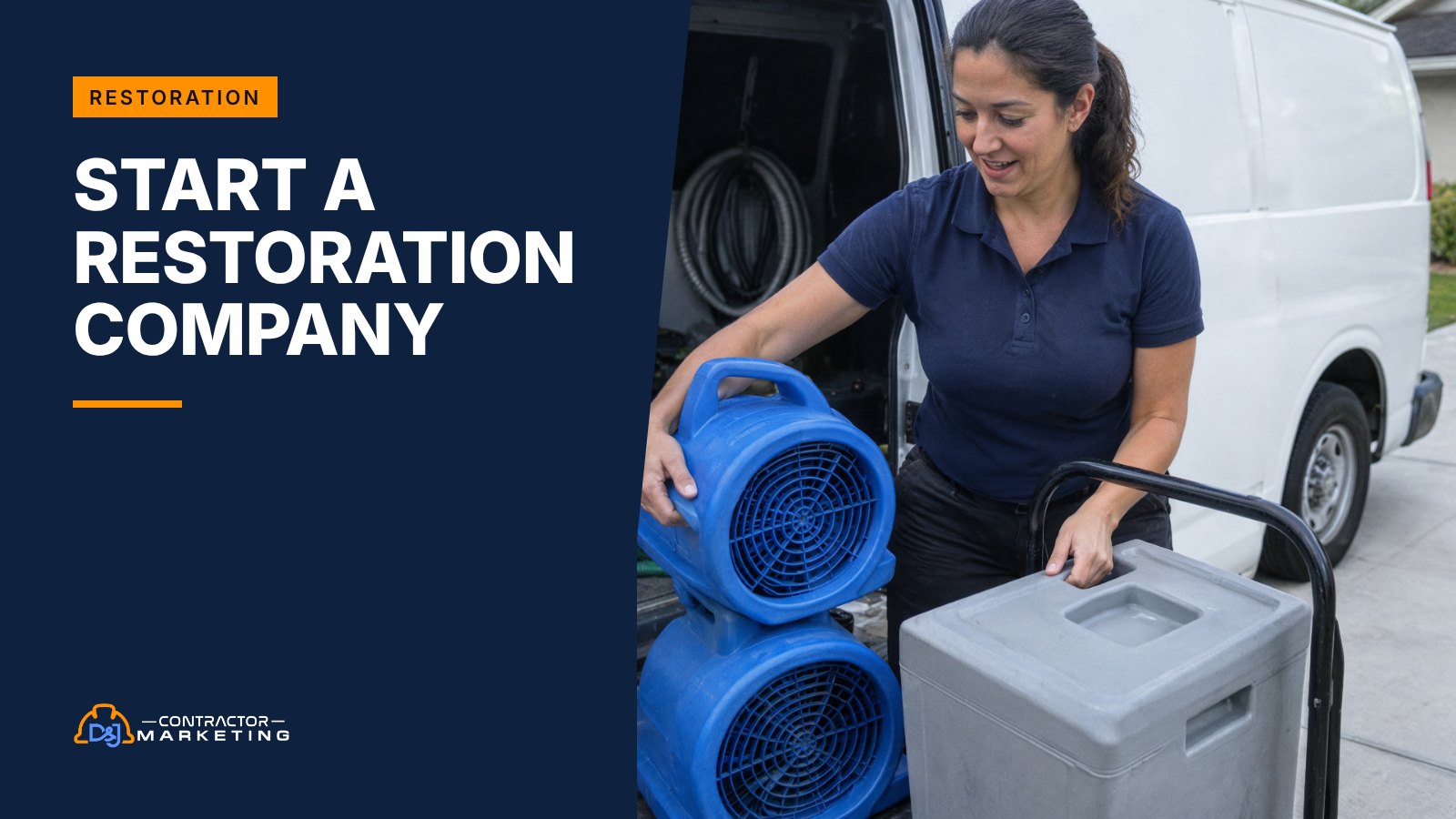
Drying a house and running a business are different jobs. If you’re figuring out how to start a restoration company, you probably know the first one already. What trips people up is the rest: a license they didn’t know they needed, too much gear, or running out of cash while an insurer takes its time.
Below: the order to do it in, gear priced from real listings, license rules in four big states, how insurance jobs pay and how to get your first calls. There’s a free checklist at the top and bottom.
The short answer: start with water damage only. Get IICRC WRT certified, check your state’s contractor and mold rules, and form an LLC with insurance and an attorney-written work authorization. Buy a lean drying kit (about $10,000 at November 2026 list prices, before the extractor, truck and PPE). Then spend your first months building referral partners and answering every call, day and night.
Key takeaways
- Water is the place to start: about one in 60 insured homes has a water damage or freezing claim, versus about one in 425 for fire and lightning. Why water first
- WRT has no prerequisites and runs 3 days (19 class hours); ASD, AMRT and other IICRC courses build on it. Certifications
- In Texas, most visible mold areas under 25 contiguous square feet can be cleaned without a license, while New York and Florida license mold work over 10 square feet. License rules by state
- A lean drying kit came to $9,965 at the list prices we checked; a two-job kit came to $19,231. Startup costs
- Florida bans assignment of benefits on property policies issued on or after January 1, 2023. How insurance pays
- For a franchise, you get the FDD at least 14 days before you sign, and Item 7 lays out the estimated initial investment. Franchise or independent
- First calls come from answering 24/7, a complete Google Business Profile with the right category, and plumbers, property managers and agents. Getting your first calls
The order to do it in
Here’s the order we’d follow, based on what we’ve seen working with restoration owners. Some steps take a weekend. A couple take months. The table shows both, plus the cost wherever we could find a real, published number.
| Step | What you’re doing | Cost we could verify | Rough time |
|---|---|---|---|
| 1. Pick your services | Water first. Mold and fire later. | None | A week of research |
| 2. Pick your path | Build your own, buy a franchise or buy a shop | Franchise costs are in the FDD, Item 7 | Weeks to months |
| 3. Write a one-page plan | Services, area, gear, cash, first referral sources | None | A weekend |
| 4. Get certified | IICRC WRT, then ASD | WRT is a 3-day, 19-hour course. Price depends on the school. | 3 days for WRT |
| 5. Check licenses | State contractor and mold rules, EPA lead rule | EPA firm cert: $300 | Days to months, by state |
| 6. Set up the business | LLC, EIN, bank account, insurance, contracts | EIN: free from the IRS | 1 to 3 weeks |
| 7. Buy the starter kit | Dehumidifier, air movers, air scrubber, meters | About $10,000 in drying gear, before the extractor | A few days |
| 8. Learn how insurance pays | Work authorizations, adjusters, Xactimate | Software is a monthly cost | Ongoing |
| 9. Make the phone ring | Google profile, referrals, 24/7 answering | Depends on what you buy | Week one, then every week |
Steps 4 through 7 can overlap. Step 9 shouldn’t wait until the gear shows up. The first plumber who sends you a job is worth more than a second dehumidifier.
Sources for the numbers: IICRC course lengths, the EPA firm fee table and the IRS EIN page. The kit total is our own math from supplier prices, shown in the cost section.
Start with water, add mold and fire later
Start with water. It’s far more common than fire, and it opens the door to mold, contents and rebuild work later. The Insurance Information Institute says about one in 60 insured homes has a property damage claim caused by water damage or freezing. For fire and lightning, it’s about one in 425. (Those ratios come from 2018 to 2020 claims data.)
Those water claims aren’t small, either. Triple-I puts the average water damage and freezing claim at $15,400 (a weighted average for 2019 to 2023). That’s the whole claim, not what a mitigation company bills. Still, these are big claims, and mitigation is usually the first work done on them.
Water work follows the ANSI/IICRC S500 standard. It sorts water into three categories by how dirty it is. Category 1 is the cleanest. Category 3 is “grossly contaminated” and can carry things that make people sick. Category 2 sits in between. For Category 2 or 3, the standard says restorers “shall use contamination controls and appropriate worker protection.”
So the category drives your scope, your protective gear and your bill. Learn it cold. One update to know: in March 2026, the S500 consensus body put out a position statement that says wind-driven rain and other storm water “are not automatically considered Category 3 Water.” So don’t call it Category 3 by default. Inspect, then decide. If you work storm losses, know it before an adjuster asks.
Why wait on mold and fire? Each one adds training, gear and, in some states, a separate license. Fire also brings contents cleaning, odor work and long rebuilds. We’d rather see a new owner run 30 clean water jobs than 10 messy jobs across four services.
- Water mitigation: extraction, tear-out, drying, moisture logs. Your core.
- Mold remediation: add it once you know your state’s mold rules (see the license table).
- Fire and smoke, contents, rebuild: add them when you have the people, the space and the cash to wait on bigger claims.
Build it, buy a franchise or buy a shop
You’ve got three ways in. Which one fits depends on what you know, how much cash you have and how fast you need work.
| Path | Good fit if you | What you give up |
|---|---|---|
| Build your own | Already know the work and have a few local contacts | No brand, no playbook, no one to call at 2 a.m. when the drying plan isn’t working |
| Buy a franchise | Are new to the trade and want training, systems and a known name | Upfront fees, ongoing royalties and rules on what you can sell and where |
| Buy a shop | Have more cash than time and want trucks, staff and referral partners on day one | You inherit old gear, old habits and any problems the seller didn’t mention |
If you’re looking at a franchise, the law gives you a tool. Under the FTC Franchise Rule, the franchisor has to give you its Franchise Disclosure Document (FDD) at least 14 calendar days before you sign or pay anything. Go straight to Item 7. It’s a table of your estimated initial investment, including costs you’ll pay to other people, like equipment and rent.
Item 20 of the FDD gives contact information for current owners and for owners who left. Call five current owners, not the two the sales rep picks. Then call a couple who left. Here’s what we’d ask:
- How many of your jobs come from the brand, and how many do you find yourself?
- How long did it take before you paid yourself a real salary?
- What did you spend in year one that wasn’t in Item 7?
- How close is the next franchise to you, and do you fight over the same calls?
- Would you buy it again?
Buying a shop? Have an accountant check the books and someone who knows restoration check the gear. Ask which referral partners send work, and whether they’ll keep sending it once the old owner leaves. Those relationships are often what you’re paying for.
Write a one-page restoration business plan
You don’t need a 40-page plan to start. You need one page that makes you write down the numbers you’d rather guess at. The SBA calls this a lean startup plan and says it’s typically one page. If you’re borrowing money, expect the bank to want the long version, which the SBA calls a traditional plan.
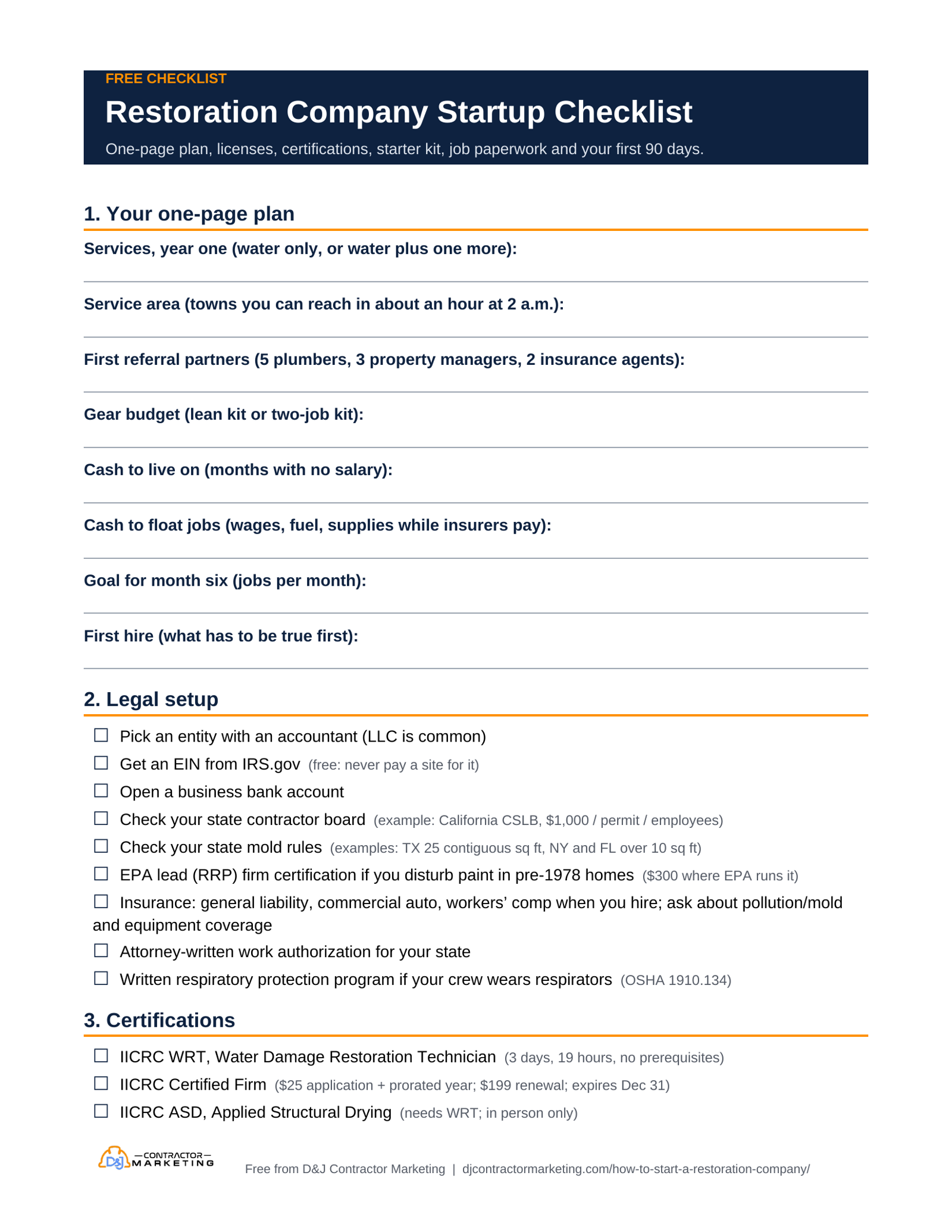
Fill in these eight lines. Our free checklist has them as a form you can type into.
- Services, year one: water mitigation only, or water plus one more. Be honest.
- Service area: the towns you can reach in about an hour at 2 a.m. Water jobs don’t wait.
- Who you’ll work with first: name five plumbers, three property managers and two insurance agents you could call this month.
- Gear budget: the lean kit or the two-job kit from the cost section.
- Cash to live on: how many months you can pay your own bills with no salary.
- Cash to float jobs: money for wages, fuel and supplies while insurance payments come in.
- Your goal for month six: jobs per month, not revenue. Jobs are what you control.
- Your first hire: what has to be true before you add a second tech.
Lines 5 and 6 are the ones people skip. They’re also how a tech with a full schedule can still run out of money in year one, because the work is done but the checks haven’t landed yet. Insurance money can take weeks to show up. Florida, for example, gives insurers up to 60 days to pay or deny a claim (Florida DFS). You carry the wages and the fuel the whole time.
Got a business partner? Write down who does what and how you split the money before you buy a single air mover. Then have an attorney turn it into a partnership agreement.
The certifications that matter first
Adjusters, property managers and program partners will want to know if your techs are IICRC certified. The IICRC (Institute of Inspection, Cleaning and Restoration Certification) is the group behind the S500 water standard. Start with its Water Damage Restoration Technician course, called WRT.
WRT has no prerequisites. It’s a 3-day course with 19 hours of class time, not counting the exam, and you can take it live-stream or in person. ASD, AMRT, fire and smoke (FSRT) and several other IICRC courses list WRT as a prerequisite.
| Cert | What it covers | Needs first | When we’d get it |
|---|---|---|---|
| WRT, Water Damage Restoration Technician | Water losses, sewage backflows, drying basics | Nothing | Before your first job |
| ASD, Applied Structural Drying | Drying plans and equipment on real structures | WRT. In person only. | In your first few months |
| AMRT, Applied Microbial Remediation Technician | Mold remediation | WRT | Before you sell mold work |
| IICRC Certified Firm | Your company, not a person | One certified tech and liability insurance | As soon as you have both |
The IICRC says ASD can help you “pursue partnerships with TPA’s,” the third-party administrators that hand out insurance work. Book it as soon as you pass WRT, since in-person seats can fill up.
Next, certify the company. It’s cheap: a prorated first-year fee plus $25 to apply, then $199 a year. Per the IICRC FAQ, you need current liability insurance, at least one active certified tech and an application. The first year is prorated plus a $25 application fee. Renewal is $199 a year, and every firm’s status runs out on December 31. It also puts you in the IICRC’s public firm locator.
One trap. Certified techs need continuing education credits to stay current. Put the renewal date in your calendar the day you pass.
Licenses and safety rules you can’t skip
This is the step that can shut you down. There’s no single national restoration license. Your state, and sometimes your city, decides what you need. Mold is where the rules get strict.
Here are four big states as examples. Water drying by itself may not need a state license where you are, but tear-out, rebuild and mold work can. Ask your contractor board and your health or labor department before you take a paid job.
| Where | Rule | What triggers it | Source |
|---|---|---|---|
| Texas | Mold remediation company and contractor licenses from TDLR. Company application fee is $850. You need a Texas office, insurance and a licensed mold remediation contractor as your responsible person. | Mold work for others, unless exempt. In most cases, visible mold areas under 25 contiguous square feet can be cleaned without a license. At 25 square feet or more, you also file a $25 state notice. | TDLR mold FAQ, company application, notices |
| New York | Mold remediation contractor license from the Department of Labor. $500 fee, approved training and at least $50,000 in liability coverage. | Mold projects over 10 square feet. A separate licensed assessor writes the plan first. | NY DOL mold FAQ |
| Florida | Mold remediator license from DBPR. You need four years of documented field experience (or a two-year degree plus one year), training in water, mold and respiratory protection, and a passing exam. | Mold remediation on more than 10 square feet | DBPR mold FAQ, Fla. Stat. 468.8411 |
| California | State contractor license from the CSLB | A project of $1,000 or more in labor and materials (all contracts on the project count together), any job that needs a permit, or any job where you use employees | CSLB |
Water jobs turn into mold jobs when you open a wall. In New York, once the mold area is over 10 square feet, a licensed assessor writes the plan before anyone remediates. In Texas, at 25 contiguous square feet you need a licensed remediator and a state notice. Know who you’ll call before it happens.
Two of those rules surprise people. In New York, Labor Law Section 936 says no licensee can do both the mold assessment and the remediation on the same project. Florida has a similar rule. A remediator can’t work on a building where the same company did the mold assessment in the last 12 months (Fla. Stat. 468.8419).
The Florida rule has an exception for some Division I contractors, so ask your attorney if you hold one of those licenses. Either way, if you planned to inspect and then sell the fix, plan again.
The two federal rules that apply almost everywhere
EPA lead rule (RRP). Water jobs mean cutting drywall and pulling trim. In homes built before 1978, that’s disturbing paint that may contain lead. The EPA says anyone paid to do that work must be certified, “even sole proprietorships.”
Firm certification costs $300 where EPA runs the program. Some states run their own program instead, and EPA’s RRP page lists them (Massachusetts, North Carolina and Wisconsin are three). Workers must be trained, either as certified renovators or on the job by a certified renovator. The rule has an emergency provision that relaxes some steps on sudden, unplanned jobs. Read EPA’s guidance before you count on it.
OSHA respirator rule. If respirators are needed for the job, or you require your crew to wear them (and on sewage and mold jobs you should), OSHA’s standard 1910.134 needs a written respiratory protection program. Each worker gets a medical evaluation before a fit test. For tight-fitting respirators, like the half-face masks many crews wear, fit tests happen before first use, when you change models and at least once a year.
None of this is legal advice. Rules change, and cities add their own. Book an hour with a local attorney who works with contractors. It costs less than one job you can’t bill.
Business setup, insurance and paperwork
Do the paperwork before your first paid job. An accountant and an insurance agent who already work with contractors will save you more than they cost.
- Pick your entity with an accountant. Most new shops look at an LLC. Your accountant can tell you if an S corp election makes sense later.
- Get an EIN from the IRS. It takes minutes online, and the IRS says “You never have to pay a fee for an EIN.” Ignore the sites that charge for one.
- Open a business bank account and keep every job’s money in it. Adjusters and lenders both want clean records.
- Buy insurance before the first job. You’ll need general liability for IICRC Certified Firm status. Ask your agent about commercial auto, workers’ comp once you hire, pollution and mold coverage, and coverage for equipment on job sites. Get at least three quotes before you set your budget.
- Get your contracts written. At minimum, a work authorization the owner signs before you start. Many shops add a direction to pay, a form asking the insurer to pay you directly. Pay a local attorney to write these for your state.
Don’t skip the last one. Your work authorization is the paper that says who hired you, what you’ll do and how you get paid. If a claim gets denied or short-paid, it’s the paper you’ll point to when you send the owner a bill. Free forms online are tempting. Have a lawyer read whatever you use.
Also write down a simple safety plan before you hire anyone. If your crew will wear respirators, OSHA already requires a written program (see the federal rules section).
What it costs to start a restoration company
About $10,000 buys a lean set of drying gear. You’ll still need an extractor, a truck and PPE on top of that. Or you can spend about twice that so you can run two jobs at once. We priced both from supplier listings we checked on November 14, 2026, so you can see where the money goes.
The lean kit follows a rule of thumb from Reets Drying Academy: for every extra-large dehumidifier, buy 7 to 8 air movers and one air filtration device. They also say you can get started for around $10,000 “if you build smart.” Our math lands in the same place.
| Item | Example model | Listed price | Lean kit | Two-job kit |
|---|---|---|---|---|
| LGR dehumidifier, extra large | Dri-Eaz LGR 7000XLi | $3,525 | 1 = $3,525 | 2 = $7,050 |
| Air mover | Dri-Eaz Velo Pro | $460 | 8 = $3,680 | 16 = $7,360 |
| HEPA air scrubber, 500 CFM | Phoenix GuardianR Pro | $1,325 | 1 = $1,325 | 2 = $2,650 |
| Moisture meter kit | Delmhorst BD-2100 with probes | $736 | 1 = $736 | 2 = $1,472 |
| Thermal camera | FLIR C5 | $699 | 1 = $699 | 1 = $699 |
| Total | $9,965 | $19,231 |

These are list prices from one seller each. Dealers run sales, and used gear costs less. The brands are examples, not picks. Reets also suggests picking one air mover and sticking with it, since they stack together and use the same parts.
Is one air scrubber enough? Phoenix says its Guardian R gives 4 air changes per hour, its recommended minimum, on 7,500 cubic feet. That’s a bit more than a 30 by 30 foot room with 8-foot ceilings. The Pro model in our kit may differ, so check its spec sheet. Fine for one small job. Not for a flooded basement and a kitchen on the same day.
What the gear total leaves out
- A truck or van, and a trailer if the gear won’t fit
- An extractor or truckmount (a carpet cleaner may already own one)
- A thermo-hygrometer for temperature and humidity readings, unless your meter already takes them
- PPE, respirators, containment poles and plastic, hand tools, antimicrobials
- Training fees, the $300 EPA firm fee, state license fees and insurance
- Estimating and job software, phones and marketing
- Months of cash to float wages and fuel while insurers pay
Get quotes for each line and add them to your one-page plan. The last line is the one that decides if you make it. Don’t spend your float money on a second dehumidifier. Rent extra gear for the big job instead, and buy more when the jobs say you need it.
How insurance jobs actually pay
A lot of water damage work gets paid through the owner’s insurance, not by the owner writing a check. That’s good for ticket size. It’s hard on cash flow. Here’s how the money moves on a typical claim.
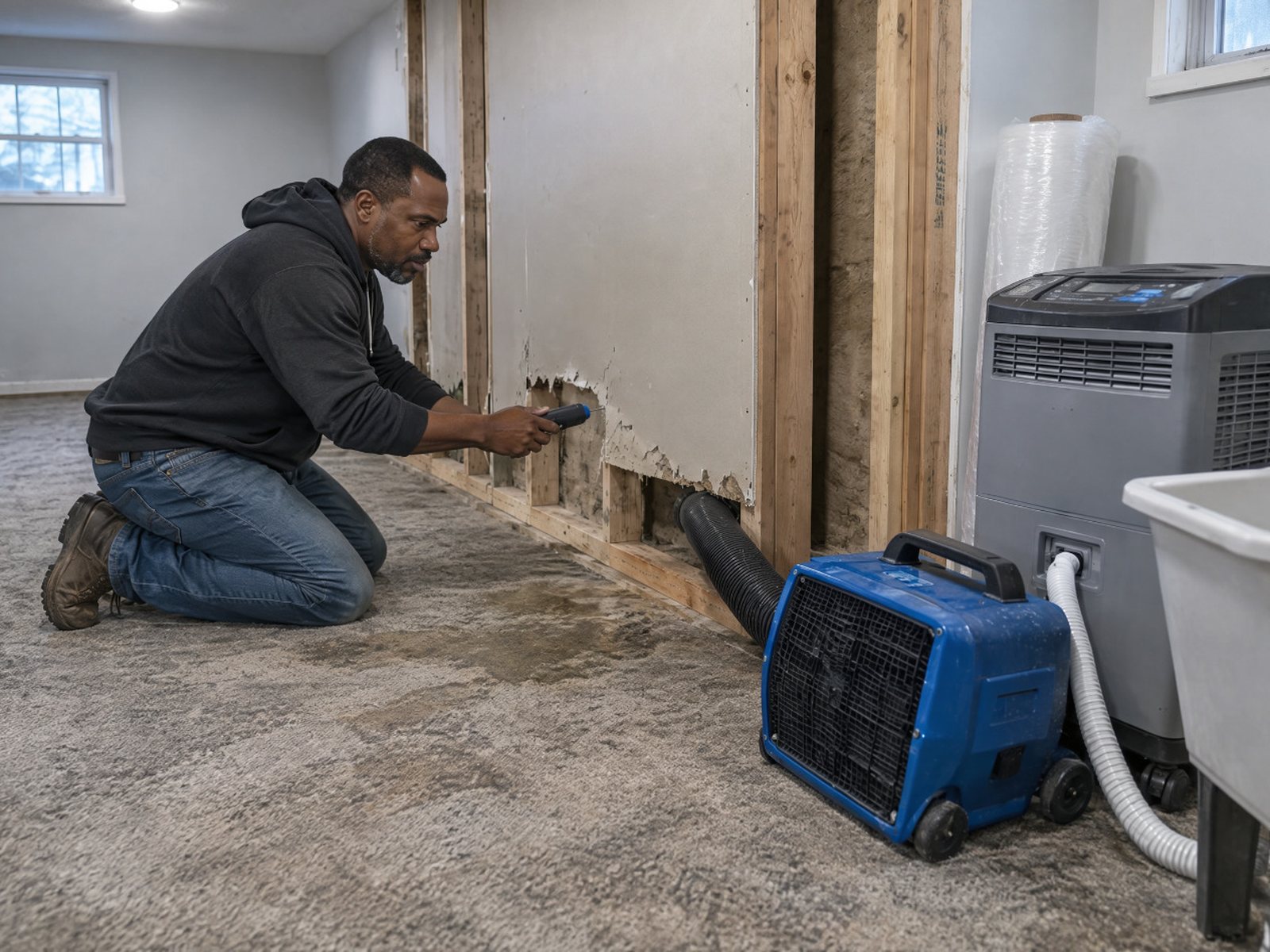
- The call. The owner calls you, or an insurer or TPA (third-party administrator) sends you the job.
- Signed paperwork. The owner signs your work authorization before you pull a single baseboard.
- Mitigation and daily logs. You extract, tear out what’s wet and set the drying equipment. You take moisture readings every day and photos of everything.
- The estimate. You write it line by line, usually in Xactimate.
- The review. The adjuster checks your estimate against your photos and logs, then approves, cuts or asks questions.
- Payment. The insurer pays, though the check may be made out to the owner rather than to you. Your signed paperwork is how you get paid either way. Collect the deductible from the owner.
Why Xactimate? Verisk, which makes it, says 80% of top property insurance carriers use and trust its property tools. When your estimate is in the format the adjuster already reads, there’s less to argue about. Budget for the software and for training on it.
Steps 3 and 5 are where new shops lose money. If it’s not in your logs and photos, the adjuster can cut it. A tech who skips a day of moisture readings can cost you part of the job.
Write every job file as if the adjuster will only believe what’s in it.
Program work and TPAs
Some insurers send water jobs through programs run by TPAs. Those jobs often arrive through XactAnalysis, which Verisk calls “the network your carriers and TPAs already use to send you work.” Program work can be steady. It also comes with rules on pricing, response times and paperwork that you agree to follow. Read the agreement before you sign, and ask what the program wants to see from a brand-new shop.
Assignment of benefits is gone in Florida
Some restoration shops used to have owners sign an assignment of benefits (AOB), which hands the right to file the claim and collect the payment to the contractor. Florida ended that. Under Fla. Stat. 627.7152, owners can’t assign post-loss benefits on residential or commercial property policies issued on or after January 1, 2023. If someone tells you to build your business on AOBs, check your state’s current law first.
Your first 90 days, week by week
Here’s what we’d get done in the first 13 weeks. Move faster if you already hold WRT or already have a truck full of gear.
Weeks 1 and 2: paperwork
- Form the company with your accountant, get the EIN and open the bank account.
- Get insurance quotes. Book the attorney for your work authorization.
- Sign up for the next WRT class near you.
- List the five plumbers and three property managers you’ll meet, and buy one of them a coffee.
- Look up your state’s contractor and mold rules, and find out if EPA or your state handles lead (RRP) certification where you work.
Weeks 3 to 6: certified and equipped
- Take WRT and book ASD right after. Apply for IICRC Certified Firm status once you pass and your insurance is active.
- Buy the lean kit. Do a practice dry-out in your own garage or a friend’s basement so you learn the gear before a paying job.
- Set up a business line that gets answered at all hours, by you, a person you pay or a system built for restoration calls. Set up your Google Business Profile too.
Weeks 7 to 10: get in front of people
- Meet the five plumbers, three property managers and two insurance agents from your plan. Bring a card and a one-page sheet on how you work.
- Take your first jobs. Ask every customer for a Google review when you pull your gear. Ask all of them, not just the happy ones. Google’s review rules ban review gating, which means only asking customers you think are happy. Our guide on how to ask for reviews has scripts.
- Write up each job: what came in, what it paid, what the adjuster cut and why.
Weeks 11 to 13: fix what broke
- Take ASD if you haven’t yet.
- Look at your job write-ups. If cuts keep hitting the same line items, fix the logging, not the adjuster.
- Decide whether to rent or buy for job number two. Let the bookings decide, not the catalog.
When should you hire? We’d wait until you’re turning down jobs, or your answering service is booking more than you can run. One missed water call can be a whole job, so see what missed calls cost you before you decide a hire can wait.
How to get your first water damage calls
Gear sitting in your garage costs you money every month until someone calls. We’ve worked with more than 30 SERVPRO franchises, and we’ve never lost one as a client. What we’ve learned there carries over to an independent shop: be easy to find, answer every call and know the people who see water first.
Ahrefs estimates about 82,000 US searches a month for “water damage restoration near me” (November 2026). Your profile, reviews and website decide whether you show up for the ones in your area.
1. Answer every call, day and night
Water calls come at 2 a.m., on holidays and in the middle of your other job. Someone standing in an inch of water calls the next company if you don’t pick up. Have a person, or a system built for it, answer 24/7. That’s why we built Restoral, our AI system that answers calls and chats and books jobs onto your calendar. Our answering service built for restoration page explains how it works.
2. Set up your Google Business Profile right
Use “Water damage restoration service” as your main category if water is your core. Add “Fire damage restoration service” only when you really do it. List your real service area, add your hours as 24 hours if you mean it, and post job photos (with the owner’s OK). Then ask every customer for a review. Our guide to getting more Google reviews covers the asks that work.
3. Look at Local Services Ads
Google lists “Water damage services” as a Local Services Ads category in the US. These ads show in Google search, and in some categories they carry a Google Verified badge. Google says you “pay only for leads” for your services. To go live, you’ll need your license or business registration and other checks done, so finish your paperwork first. Our Local Services Ads guide walks through setup.
4. Meet the people who see water first
- Plumbers. They’re at the leak before anyone else. Show up fast and make them look good in front of their customer.
- Property managers. One building can send you jobs for years. Give them a direct line and send clean reports.
- Insurance agents. Their clients call them first. Show them you document well and don’t pad estimates.
Be careful with referral payments. Florida’s contractor law, Fla. Stat. 489.147, bars contractors from offering or taking “any compensation, inducement, or reward” for referring work paid by property insurance. The same law says a contractor can’t advise owners on their coverage or adjust the claim without a public adjuster license. Other states have their own rules, so ask your attorney before you offer anything beyond a thank-you.
5. Build a simple, fast site
You don’t need a fancy site on day one. You need a fast one with your number at the top, a page for each service you offer, your service area and real photos. Our pages on SEO for restoration companies and water damage leads go deeper. For the whole picture, see our restoration marketing page.
What to do this week
Don’t try to do all of this at once. Here’s what to get done in the next seven days.
- Download the checklist below and fill in the one-page plan, even the lines you’d rather skip.
- Look up your state’s contractor board and mold rules. Write down what applies to you.
- Book the next WRT class you can get to.
- Call an accountant and an insurance agent who work with contractors.
- Write the names of five plumbers and three property managers you’ll meet in your first two months.
The checklist is our own original work, free to use and edit for your business. It isn’t legal advice, so have your attorney review your contracts.
Already open and want to know how you show up on Google? Get a free local SEO audit. We’ll show you where you stand in your service area and what we’d fix first.
FAQ: starting a restoration company
How much does it cost to start a restoration company?
A lean drying kit came to $9,965 at the supplier prices we checked in November 2026. A kit for two jobs at once came to $19,231. On top of that, budget for a truck, insurance, training, license fees and a few months of cash to cover wages while insurers pay. For a franchise, read Item 7 of its disclosure document.
Do I need a license to start a water damage restoration business?
It depends on your state. There’s no single national license. California needs a contractor license for jobs of $1,000 or more, jobs that need a permit or jobs with employees. Texas, New York and Florida license mold work. Anywhere in the US, paid work that disturbs paint in a pre-1978 home or child-occupied facility generally needs lead-safe (RRP) certification, from EPA or from your state if it runs its own program.
Is a restoration business profitable?
It can be, but the margin is earned in the paperwork. Phillip Rosebrook, quoted by DocuSketch, puts mitigation at 70% or more on direct labor and materials, mold at 55% and construction at 40% to 45%. That’s before gear, trucks, training and office time. Weak moisture logs and slow collections eat that fast.
Should I buy a franchise or start my own restoration company?
Buy a franchise if you’re new to the trade and want training, systems and a known name, and you’re fine paying royalties. Start your own if you already know the work and have local contacts. Either way, get the FDD at least 14 days before you sign and call current and former owners.
How long until a new restoration company gets steady work?
There’s no reliable public number, and anyone who promises one is guessing. What moves it is in your control: answering every call, a complete Google Business Profile with reviews, and regular visits with plumbers, property managers and agents. We’d judge your progress at the 90-day mark by jobs per month.

Written by Dory Aine, co-founder of D&J Contractor Marketing