
In 2025, 58% of new single-family homes sold in the US were already finished when the buyer signed or put down a deposit. Home builder marketing should start there, not with the model home. And on Google and Meta, your ads count as housing ads, with targeting rules a roofer never sees. On Meta you have to flag that yourself.
This page lays out how D&J would plan marketing for home builders: what’s selling, what buyers search, the ad rules, and a budget per home you can defend.
The short answer: sort your homes by stage first, because finished specs need a different push than lots and plans. Give every community and every finished home its own page. Run search ads by community, set up as housing ads. Treat agents as a channel. Then judge it all by cost per appointment and cost per contract, community by community.
Key takeaways
- 58% of new single-family homes sold in 2025 were already finished when the buyer signed or put down a deposit, up from 51% in 2024, per the Census. What’s selling now
- “New construction homes near me” and “home builders near me” each get about 15,000 US searches a month. Buyer search map
- Production, spec and custom builders sell different things, so each needs its own plan and its own number to watch. Plans by builder type
- A spec should have its own page before it’s finished, real photos and ads the week it’s done, and an incentive decision between day 60 and day 85. Spec home playbook
- Google bars, and Meta limits, age and ZIP code targeting for housing ads in the US, and the Fair Housing Act limits what an ad can say about the buyer. Housing ad rules
- Putting a monthly payment or down payment in an ad triggers Regulation Z disclosures, so keep the math on the landing page. Incentive ads
- NAHB’s 0.8% marketing share works out to roughly $5,300 per home at the survey’s average price. Budget per home
Home builder marketing starts with what’s on your lot
Before you pick a channel, look at what you’re selling. For a lot of builders right now, that’s a finished home with no buyer yet. Census data shows 58% of new homes sold in 2025 were already complete when the buyer signed a contract or put down a deposit, up from 51% the year before.
Here’s the full split from the Census Bureau’s New Residential Sales report (October 2026 release, Table 3b). These are new single-family homes sold in the US, counted by where the house stood when the sale happened.
| Stage when sold | 2024 | 2025 |
|---|---|---|
| Not started yet | 95,000 (14%) | 67,000 (10%) |
| Under construction | 242,000 (35%) | 215,000 (32%) |
| Completed | 350,000 (51%) | 396,000 (58%) |
| Total sold | 686,000 | 678,000 |
Total sales barely moved. What changed is the stage homes sell at. Builders have more finished homes on the ground, and that’s where more of the sales are happening. Fewer contracts are being signed on a bare lot and a floor plan.

Finished homes with no buyer rose too. The same report counts 134,000 completed new homes for sale at the end of 2025, up 14% from 118,000 a year earlier, even as total homes for sale dipped from 491,000 to 475,000. The median finished home still for sale had been on the market 2.8 months since completion.
A builder who sells mostly from plans needs buyers to dream a little. A builder with five finished specs needs buyers to show up this month. Those are two different campaigns, with different ads, different pages and a different sense of urgency.
So before budgets, list what’s finished, what’s framed and what’s still dirt. That list decides almost everything below.
What new home buyers actually search for
New home buyers don’t search for “home builder marketing.” They search for homes. Here’s what they type into Google each month, and what each search wants to see when it lands on your site.
| What buyers search | Monthly US searches | Est. CPC | Page it should land on |
|---|---|---|---|
| new construction homes near me | 15,000 | $1.80 | Communities map with prices |
| home builders near me | 15,000 | $2.00 | Home page or communities page |
| 55+ communities near me | 10,000 | $1.30 | Your 55+ community page |
| new homes for sale near me | 10,000 | $0.90 | Quick move-in inventory |
| custom home builders near me | 7,900 | $2.50 | Custom process and portfolio |
| model homes near me | 4,800 | $2.00 | Model hours and tour booking |
| move in ready homes near me | 3,000 | $0.70 | Quick move-in inventory |
| quick move in homes | 1,700 | $1.90 | Quick move-in inventory |
| spec homes for sale | 1,200 | $1.20 | Quick move-in inventory |
| build on your own lot | 500 | $2.50 | Build on your lot page |
Four of these searches want the same page: a live list of homes that are done or nearly done. If your site only shows floor plans and a “contact us” form, you’re missing the searches that match what the Census says is selling.
“55+ communities near me” gets about 10,000 searches a month, two-thirds of the top term. If you build for active adults, that search deserves its own page and its own ad group. There are legal rules on how you say “55+,” which we cover in the ad rules section.
Custom buyers search differently. “Custom home builders near me” is a trust search. That person wants your process, your past homes and proof you finish on time, not an inventory grid.
Building the pages for these searches is the SEO side of the work. We go deep on it, including community pages and what to do when a community sells out, in our guide to home builder SEO.
Production, spec and custom builders need different plans
A production builder, a spec builder and a custom builder can all call it “home builder marketing.” But they sell different things to different buyers. So the plan has to start with which one you are, and plenty of builders are two at once.
| Production builder | Spec builder | Custom builder | |
|---|---|---|---|
| What you sell | A community, a lifestyle, a payment | A specific finished house | Your process and your judgment |
| Who buys | Buyers comparing communities and resale homes | Buyers who need to move soon | Owners with land, or with time and a bigger budget |
| Main web asset | Community pages with live inventory | One page per home, with photos and a price | Portfolio project pages and a clear process |
| First paid channel | Google search ads by community | Search ads plus agent outreach | Search ads on “custom home builders” terms, tight radius |
| The number to watch | Appointments per community | Days since completion | Qualified consults booked |
For a production builder, the buyer wants to know price range, school district, HOA fees and what’s ready when. Every community needs its own page and its own ad group, because “homes in [community name]” is a search with real buying intent behind it.
Custom builders sell trust. A lot of custom builders lean on referrals, architects and past clients. Referrals slow down when your last few clients have moved in and stopped talking about you. Before adding ads, build a site that shows finished homes with the town, the size, the timeline and what made the job hard. Then you add search ads so the next referral who Googles you finds proof, not a stock photo.
Homes that are still dirt need a different kind of push. Before you break ground on a new community, put up a “coming soon” page with the location, the plans you expect to offer and a price range if you have one, plus an interest list form. Email that list first when lots or the first homes release, then plan a grand opening for the model. The goal is a list of warm buyers before the first foundation is poured.
If you also build on the owner’s land, give that its own page. “Build on your own lot” is a small search, but Ahrefs puts its estimated CPC among the highest on our list, which tells you advertisers think those buyers are worth paying for.
How to market a finished spec home, week by week
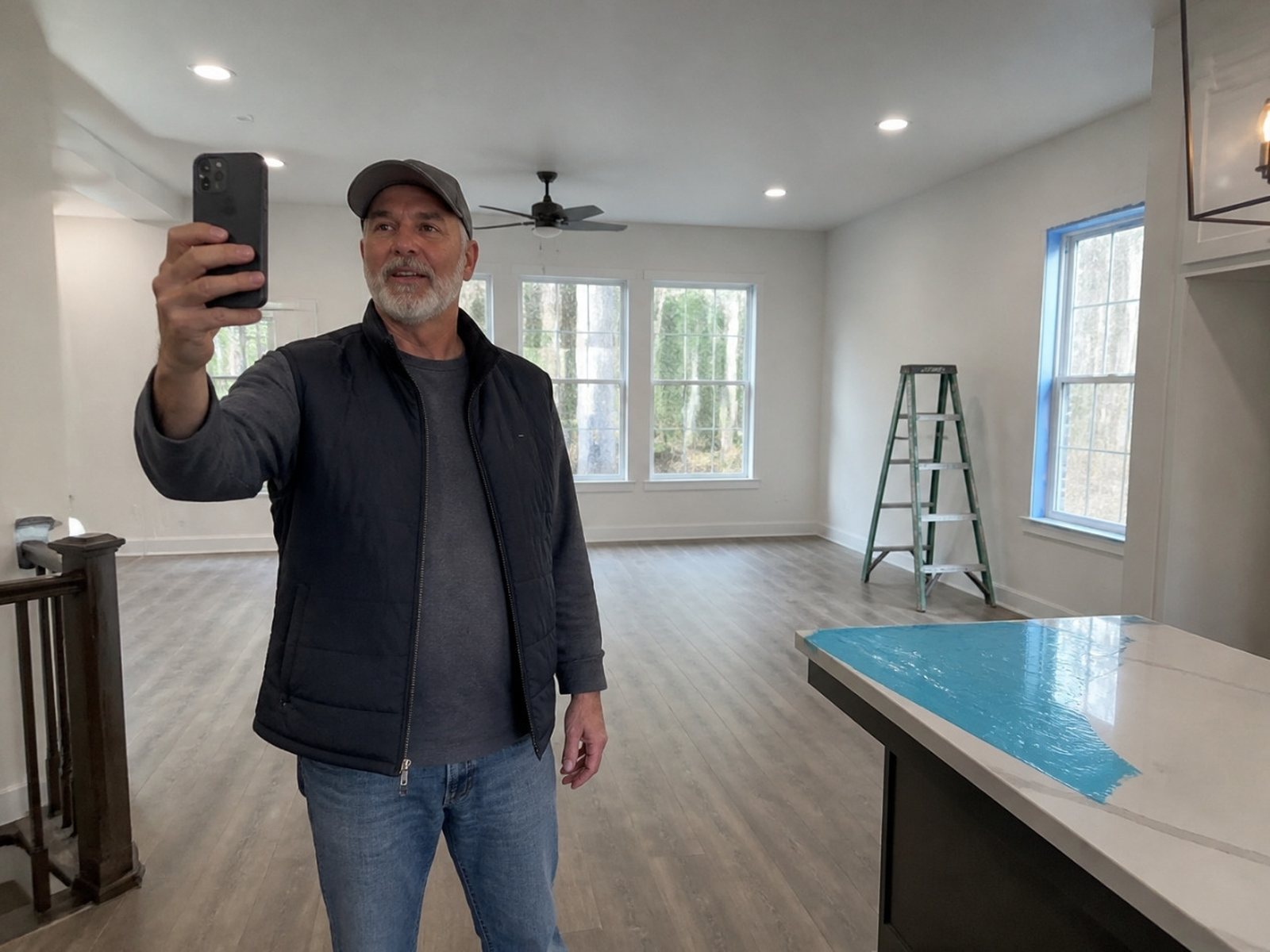
A finished spec home costs you money every month it sits. So it needs its own plan, with a clock on it. Here’s the sequence we’d run from the week the home is complete.
First, know what the wait costs. This is an example, not a benchmark. Say you’ve got $450,000 drawn on a construction loan at 8% interest. That’s about $3,000 a month in interest alone, before taxes, insurance, utilities and lawn care. Put your own numbers in. Once you see the monthly cost, it’s easier to decide when an incentive is cheaper than waiting.
Two to four weeks before completion
- Publish the home’s own page: address or lot number, price, size, beds and baths, a move-in date and a “book a tour” button.
- Add it to your quick move-in list so the searches in our table above have somewhere to land.
- Email every agent who’s brought you a buyer before. Give them the date, the price and how to book a showing.
The week it’s finished
- Book real photos, a walkthrough video and a floor plan. Swap out every rendering on the page.
- Get it on the MLS through your listing agent, if you use one, so buyer agents see it where they already look. Ask the agent which home search sites the listing feeds, and check that the price and photos match your own page.
- Start a small search ad group for the community name plus “move in ready” and “quick move in.” Search comes first because those people are already looking.
- Start Meta ads to the home’s page the same week, set up under the housing category, with the video and the price up front.
- Hold one open house or agent preview, and log every visitor.
Weeks 2 to 4
- Check tour requests and showings every week, not every month.
- Around day 14, send the agent list a second note with the new photos and video.
Days 30 to 60
- Read the numbers: page views, tour requests, showings and feedback from agents. No tours means a reach problem. Tours and no offers usually means a price or product problem, and more ads won’t fix it.
- If tours are thin, add budget to Meta and widen the search keywords before you touch the price.
- Text and email your past leads who asked about that plan or that price range.
Past 60 days
This is when we’d bring up an incentive, using that monthly carrying cost as the yardstick. Closing cost help, a rate buydown and a price cut all cost you money, so compare each one against that monthly number. Advertising the first two comes with rules. More on that in the incentives section.
The Census puts the median finished home still for sale at 2.8 months on the market since completion, as of the end of 2025. That’s about 85 days. So by about day 85, your home has been sitting longer than half the finished homes still for sale. Raise the incentive at day 60 and decide by day 85.
Housing ad rules that change builder targeting
Home builder ads are housing ads. That puts them under rules most contractors never deal with. Google and Meta both strip out targeting options for housing, and federal law controls what your ad can say about who the home is for.
A roofer can aim ads at people over 45 in three ZIP codes. You can’t. Here’s what each platform says, in its own words.
Google Ads
Google’s personalized advertising policy says age, gender, marital status and parental status “may not be used to target Housing, Employment, and Consumer Finance Ads in the United States and Canada.” ZIP code targeting is out too. What’s allowed: radius targeting (at least 1 km around a location), plus city and country targeting.
In practice, we’d target a radius around each community or sales office and let the search terms do the sorting. Someone typing “new construction homes near me” has already told you what they want.
Facebook and Instagram
Meta requires a Special Ad Category for ads about housing. For US audiences, Meta says age, gender, ZIP code, exclusion targeting, lookalike audiences and saved audiences are “limited or unavailable.” Some interests disappear too. City and pin drop audiences get an expanded radius, so your ads will reach past the exact area you pick.
On Meta, the ad itself has to say what you’re selling, because the audience settings won’t narrow it much. A video tour that shows the home clearly, with the price and the community name, lets Meta show it to more people like the ones who watch and click. Don’t write creative to stand in for the age group you can’t target.
What the ad itself can say
The Fair Housing Act makes it unlawful to publish any ad for the sale of a dwelling that “indicates any preference, limitation, or discrimination based on race, color, religion, sex, handicap, familial status, or national origin.” Our rule of thumb: describe the home, not the buyer you want.
- Fine: “Four bedrooms, a fenced yard, 10 minutes to the elementary school.”
- Risky: “Perfect for young families.” That’s about the buyer, and familial status is protected.
- Fine: “Single-story plans with wide doorways.”
- Risky: anything that hints at who the neighbors are, or who “fits in.”
The photos count too. If every family in your ads looks the same, that sends a message even when the words are clean. Vary the people you show across your ads.
55+ communities
The law has a carve-out for “housing for older persons.” Under 42 U.S.C. 3607, a 55+ community can be exempt from the familial status rules if it meets three tests. At least 80% of occupied homes have at least one person 55 or older. The community publishes and follows policies that show it’s meant for that age group. And it verifies occupancy under HUD’s rules.
If your community qualifies, you can say “55+” in the ad. If it doesn’t, don’t. Check with your attorney before launch. And the platform limits still apply: you can’t target by age on Google or Meta, even for a 55+ community.
Advertising rate buydowns and incentives the legal way
Most builders are leaning on incentives right now. In a recent NAHB survey, 64% of builders offered sales incentives and 37% cut prices. The trouble starts when the ad names a rate or a monthly payment, because that triggers federal fine print.
The rule is Regulation Z, section 1026.24. If an ad states a rate, it has to state it as an “annual percentage rate,” using that term. And if the ad mentions any of these four “triggering terms,” it has to add more details:
- The amount or percent of any down payment
- The number of payments or the loan term
- The amount of any payment
- The amount of any finance charge
Once you trigger it, the ad must also show the down payment, the repayment terms over the full loan and the APR, plus a note if the rate can go up after closing.
| Ad line | What happens |
|---|---|
| “Ask about our rate buydown” | No rate, no terms. No extra disclosure needed. |
| “$20,000 toward closing costs” | A seller credit, usually not a triggering term. Spell out the conditions, like which homes qualify. If it requires your preferred lender, say so plainly and have your attorney check the wording. |
| “Rates from 4.99%” | A rate alone. Show the APR right next to it, just as prominent, plus each rate that will apply and how long it lasts. That covers temporary buydowns like a 2-1. |
| “Own it for $2,450 a month” | A payment amount. Triggers the full set of disclosures, plus each payment over the loan and how long each applies. |
| “Just 3.5% down” | A down payment. Triggers the full set of disclosures. |
Short ads can’t fit all that. So we keep the payment math off the ad and put it on the landing page, written with your lender. The ad says “rate buydown available on select homes.” The page shows the full example the lender approves.
NAHB also says a typical existing home sold for only 1% more than a newly built one in 2025. So new homes can compete with resale on price now. Win the rest on the payment, a firm move-in date and the new home warranty.
What home builder marketing from D&J includes
You won’t need all of it on day one.
- Community and inventory pages. One page per community and one per finished home, with price, status, photos and a tour button. Pages update as soon as a home goes under contract. See our construction website design work for how we build them.
- SEO. Pages for the buyer searches in our table, built before the homes are done so they can rank in time.
- Google Ads. Set up as housing ads from the start: radius targeting, ad groups by community and by quick move-in, and keyword lists that keep out job seekers and DIY searches.
- Meta ads. Run under the housing Special Ad Category, with video tours and finished-home photos doing the work the old targeting used to do.
- Google Business Profile. Set up for your sales office or design center, with real hours and photos.
- Reviews. A simple ask at closing and again at your first warranty walkthrough, while the move is still fresh.
- Call tracking and reporting. A tracking number per channel, so we can tell you which ads booked tours.
- Social media. Build progress, finished homes and community posts through BuilderBase, our own social media tool.
- Restoral. Our AI system that answers calls and chats when your sales team can’t and books appointments onto their calendar. It works with Google Calendar, Calendly and Cal.com, and our team sets up the integration.
A custom builder doing a dozen homes a year might start with three things: project pages, a review routine and a small search campaign. A production builder with active communities usually needs the ads and the inventory pages first, because unsold specs cost more every month.
If you’re weighing where builder marketing fits with the rest of your plan, our construction marketing plan guide walks through the bigger picture.
Realtors, lead replies and the long follow-up
Agents can bring buyers your ads miss, and web leads often shop for months. Each needs a list and a schedule.
Treat agents like a channel
NAHB’s 2024 cost survey puts sales commissions at 2.8% of the final price, 3.5 times the 0.8% spent on marketing. If part of your commission bill goes to outside agents, make sure that money buys showings, not just closings:
- Keep a list of every agent who’s shown or sold one of your homes.
- Email them each time a home is finished or a price changes. Keep it short: address, price, move-in date, how to book a showing.
- Make agent registration easy, so an agent who brings a buyer to the model knows they’ll be credited.
- Put your terms for working with buyer agents in writing and share them with every agent who asks, so nobody’s guessing.
Reply fast, then keep in touch
Decide who owns each web lead before the ads go live: an online sales counselor if you have one, or the community’s sales agent if you don’t. A web lead from a home builder ad is often someone early in a long search. The first reply should be quick and useful, not a sales pitch. Here’s a text we’d send within minutes of a form fill (only to leads whose form includes consent to texts, and keep a record of that consent):
“Hi Dana, this is Chris with [Builder]. Thanks for asking about the Willow plan. Two of them are finished and ready now, and one more is done in March. Want me to send the price sheet, or would a quick tour this weekend help more?”
It names the plan they asked about, gives one real fact and offers two easy next steps. If they don’t answer, don’t keep texting. Put them in a monthly email with new finished homes, price changes and build updates for the plan they liked.
Don’t ignore calls. When we audit a contractor’s ad account, missed calls are one of the first leaks we look for. For a builder, that means weekend calls to the sales office. If nobody picks up, the next builder on the search page gets that buyer.
A home builder marketing budget you can defend
Most budget advice for builders is a percent of revenue. That’s easy to approve and hard to spend. We’d rather start with dollars per home and per community.
In the NAHB 2024 cost survey, marketing made up 0.8% of the final price of a home. The average sales price in that survey was $665,298. So 0.8% of that average price works out to about $5,300 a home. That’s our math on NAHB’s numbers. NAHB’s average price runs higher than many builders’ homes, so use your own price.
Now turn that into a plan. This is an example, not a quote:
| Builder | Homes a year | Avg. price | At 0.8% | Per month |
|---|---|---|---|---|
| Custom builder | 10 | $900,000 | $72,000 | $6,000 |
| Spec builder | 20 | $450,000 | $72,000 | $6,000 |
| Production, one community | 60 | $400,000 | $192,000 | $16,000 |
Two builders can land on the same yearly number and need very different plans. The custom builder spends more on photos, video and project pages. The spec builder spends more on ads in the weeks around each finish date.
Here’s one way the spec builder’s $6,000 a month could break down, again as an example: about $3,000 in search ads, $1,000 in Meta ads, $1,000 for photos, video and floor plans on new finishes, and $1,000 for the website, call tracking and reporting. The custom builder might flip it, with more on photos and project pages and less on ads.
Go back to the spec section. If a home costs you around $3,000 a month to hold, then spending an extra $1,500 in ads to sell it a month sooner pays for itself. That’s the math to run if you think 0.8% is a ceiling.
Where we’d spend first, in order: inventory pages that work, search ads by community, then call tracking so you know what booked. Directional signs to the model, yes. Billboards and broad brand ads come later, if at all.
How we measure it: appointments and contracts by community
We don’t report clicks as results. We report on what your sales team cares about: booked appointments and signed contracts, by community and by channel.
- Cost per appointment. Ad spend divided by tours or consults that were booked and kept.
- Cost per contract. The one that matters most, because a costly lead that signs is worth more than a pile of cheap ones that never do.
- Days since completion for every finished spec, next to what we’ve spent marketing it.
- Calls answered vs missed, by hour and day, from the tracking numbers.
- Agent-sourced vs direct buyers, so you can see what your co-broke fees buy.
To get there, your sales team has to mark each lead’s source and outcome in your CRM. We’ll help set that up. It takes a few weeks to get clean, and it’s the step that’s easiest to let slide. Without it, nobody can say which ad sold a house.
What the first 90 days look like
- Month 1. We audit your site, ads, Google profile and call handling. We list every home by stage (finished, going up, not started) and fix the pages for the finished ones first. Tracking numbers go in. Search ads go live by community, set up under Google’s housing ad rules.
- Month 2. New community and inventory pages go up. Meta ads start under the housing category. We build the agent email list and the lead reply texts with your sales team.
- Month 3 and on. We shift spend toward the ad groups that booked appointments and cut the ones that didn’t. SEO pages for upcoming homes and communities keep going up ahead of construction, because search rankings take months to build.
Ads can bring tour requests in the first few weeks. SEO is slower. That’s why we build pages for homes that aren’t finished yet. By the time the home is done, the page has had time to get found.
Why work with D&J
We’re D&J Contractor Marketing, based at 1172 Bedford Street in Stamford, Connecticut, and we do marketing for contractors and home service businesses. We’re a Google Partner, a Meta Business Partner and a Yelp Partner. We’ve worked with more than 30 SERVPRO franchises and have never lost a SERVPRO client.
We do SEO, Google Ads, websites, reviews, social media, call tracking and reporting under one roof. For builders, that means the person running your ads also sees which pages booked tours.
Home builder marketing FAQ
How much should a home builder spend on marketing?
NAHB’s 2024 cost survey found marketing averaged 0.8% of a home’s final price, or roughly $5,300 a home at the survey’s average price. Use that as a starting point, not a cap. If a finished spec costs you thousands a month to carry, spending more to sell it sooner can be the cheaper choice.
How do you market a custom home builder?
Sell trust and process. Build project pages for finished homes with the town, size, timeline and what made each job hard. Ask every client for a review at closing. Then add a small search campaign on “custom home builders” terms around your area, so referrals who look you up find proof right away.
What’s the best marketing channel for home builders?
For most builders we’d start with Google search ads by community, sent to pages that show real homes and prices. Searches like “new construction homes near me” show buyers who are already looking. Agents come next. Social and video work best as support for those two.
Can home builders target ads by age or ZIP code?
Not in the US or Canada. Google bars age, gender, marital status, parental status and ZIP code targeting for housing ads. Meta limits age, gender, ZIP code, lookalike and saved audiences under its housing Special Ad Category. Use a radius around each community and let your search terms and creative do the sorting.
How long does home builder marketing take to work?
Search ads can bring tour requests within the first few weeks once they’re live. SEO takes months, which is why we publish pages for homes and communities before they’re finished. Plan on about three months before you have clean numbers on cost per appointment by community.
Do home builders still need real estate agents?
Most do. NAHB’s survey puts sales commissions at 2.8% of the final price, 3.5 times what builders spend on marketing, so selling still costs far more than advertising. If you pay outside agents, treat them like a channel: keep a list, email them when homes finish or prices change, and make it easy to register a buyer.
What to do this week
- List every home you have by stage: finished, going up, not started. Note how many days each finished home has been done.
- Work out the monthly carrying cost of your oldest finished spec.
- Check that each finished home has its own page with a price, real photos and a tour button.
- Open your Google Ads and Meta accounts and confirm your campaigns are set up as housing ads, with no age or ZIP targeting.
- Read your last five ads out loud. Do they describe the home, or the buyer? Does any of them name a payment or down payment without the full disclosures?
- Call your own sales office on Saturday afternoon and see who picks up.
If you’d like a second set of eyes, start with our free audit. We’ll look at your site, your Google profile and how buyers find you, and tell you what we’d fix first. For more ideas across trades, see our list of contractor marketing ideas, or how we approach remodeling marketing if you also take on renovations.


