
Lawn Care Marketing That Fills Your Routes
How we market lawn care and landscaping companies: neighbors on your routes first, add-ons for current customers, honest reviews, then Local Services Ads.
5.0on Google- Google Partner
- Meta Business Partner
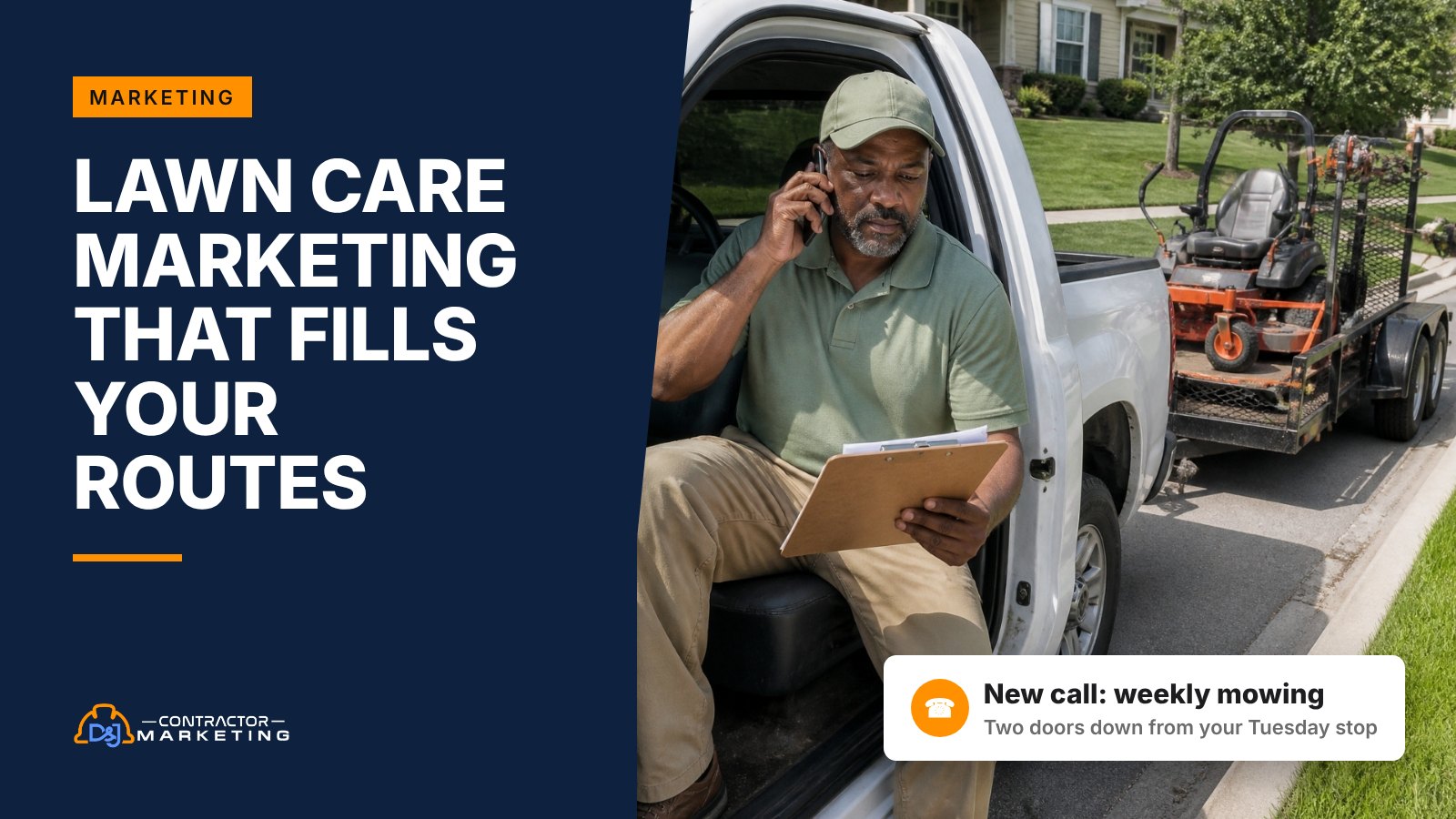
The best lawn care marketing adds customers on streets you already drive. A full schedule spread over four towns can make less money than a tight route in one. Most lawn care marketing advice is a list of ten ideas in no particular order. We start with a different question: which street?
Here’s the plan we run at D&J for lawn care and landscaping companies: what to do first, what it costs, and the rules that trip owners up.
The short answer: start with the streets you already mow (door hangers and EDDM mailers), then sell add-ons like aeration and leaf cleanup to current customers before each season, then build reviews and your Google profile. Add Local Services Ads once you can answer the phone. Judge it all by cost per signed account, not clicks.
Key takeaways
- Market the streets you already mow first, because a new yard on your route adds almost no drive time. Route density
- EDDM retail postage is $0.26 a piece, and a regular 4×6 postcard is too small to qualify. Neighbor mail
- Pitch add-ons early: aeration searches peaked in September, and leaf removal searches jumped from 2,850 in October to 12,377 in November. Add-on calendar
- Ask every customer for a review and never reward one. Google bans rewards for any review, and the FTC bans rewards tied to a positive or negative one. Review rules
- Set your Google service area to the towns your routes run through, by city or ZIP. Profile settings
- LSA screening takes 3 to 4 weeks on average, and a missed call can still count as a lead. Ads for lawn care
- Track cost per signed account by ZIP and watch stops per crew day. If it falls while your account count grows, the marketing is spreading you out. How we measure
Lawn care marketing starts with route density
On a route, not every new customer is worth the same. A weekly cut two doors down from a yard you already mow is worth more than the same cut 25 minutes away. The price is the same. The drive to the neighbor costs you almost nothing.
Say you charge $50 a cut and mow it 28 times a season. That’s $1,400. Now say that yard sits across town and adds 25 minutes of driving to each visit. Over 28 visits that’s almost 12 hours in the truck, unpaid, plus the fuel. The yard on your street brings in the same $1,400 without those 12 hours. (These are example numbers. Plug in your own price and drive time.)
That’s why we market a lawn company in rings, starting close and working out:
- The streets you already mow. Door hangers, postcards and yard signs where your trailer parks every week.
- The people who already pay you. Aeration, leaf cleanup and next year’s sign-up, pitched at the right time of year.
- The map. Reviews and a Google profile set to the towns you actually serve.
- Paid ads. Local Services Ads first, then Google Ads on a few service terms.
- New towns. Only once a route there has enough stops to be worth the drive.
- Brand new with no stops yet? Pick one neighborhood near home and treat it as ring one. Your first ten yards there set up everything else.
A lot of service companies do this list backwards. They pay for clicks from all over the county, then wonder why the schedule is full and the profit isn’t. Our list of marketing ideas for contractors covers the basics. For lawn care, the order matters more than the ideas: close streets first, far towns last.
Mail and door hangers on the streets you already mow
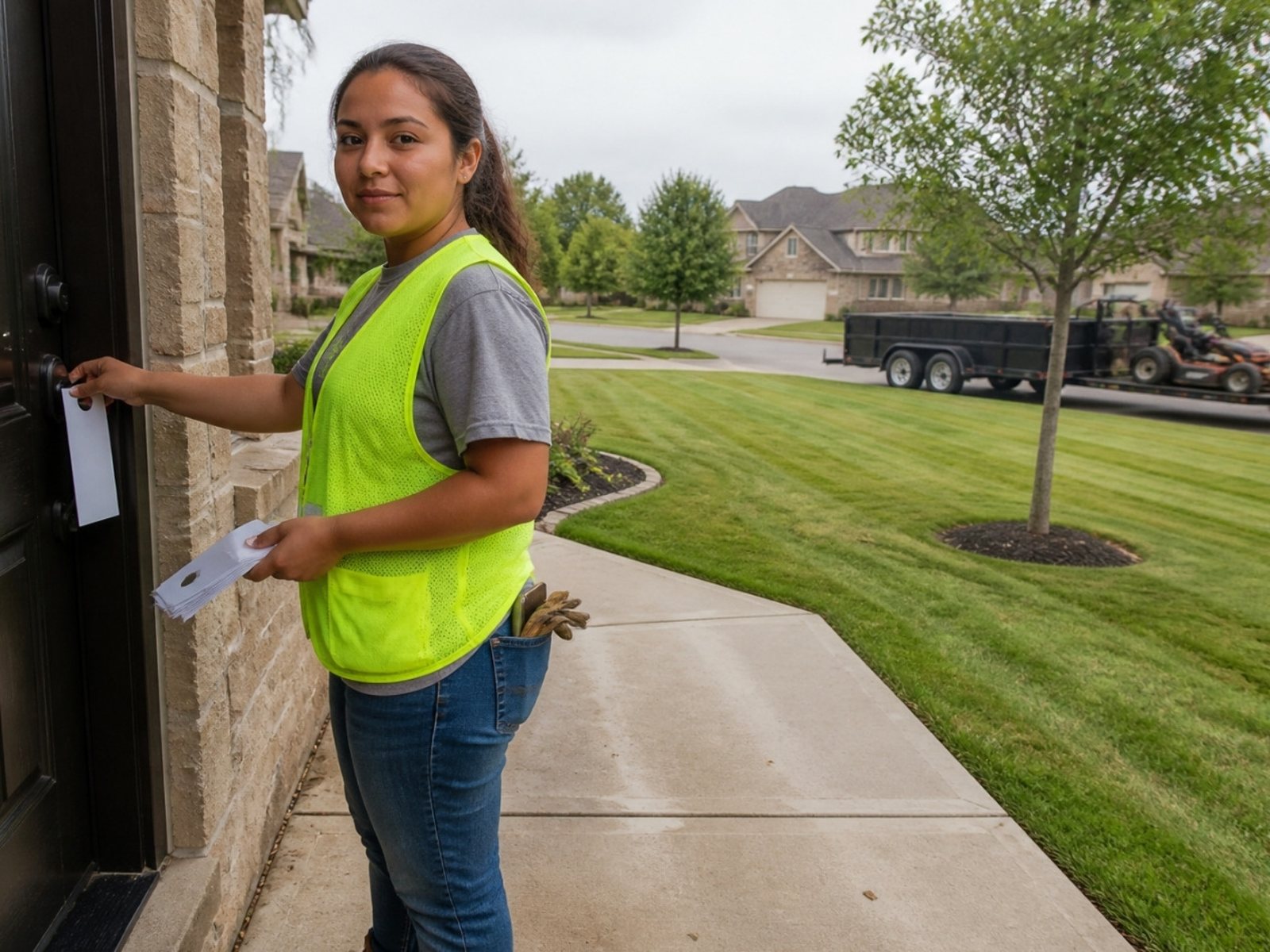
The cheapest new account you’ll ever get lives next to one you already have. Your trailer parks on that street every week. The neighbor has watched your crew, and the lawn next door looks better than theirs. A door hanger or postcard just gives them a nudge.
Two rules before you print anything. First, door hangers go on the door, never in the mailbox. Under federal law (18 U.S.C. 1725), you can be fined for each unstamped flyer put in a mailbox to skip postage, and USPS says a mailbox is for postage-paid mail only. Second, check your own town’s rules on flyers and soliciting before a crew walks a neighborhood.
Every Door Direct Mail, in real numbers
If you’d rather mail than walk, USPS Every Door Direct Mail (EDDM) is built for this. You pick mail carrier routes on a map, address the piece to “Postal Customer,” and it lands at every address on those routes. Retail postage is currently $0.26 a piece. You need at least 200 pieces, you can send up to 5,000 a day per ZIP code, and you don’t need a permit.
Say you pick routes that cover 1,000 homes around your Tuesday stops. Postage is $260. Get a real print quote and add it. If printing runs $200, you’re in for $460.
At the example price of $1,400 a season, one new weekly account brings in three times what the drop cost, and because it’s on a street you already drive, it doesn’t add drive time to earn it. If 1 in 500 homes signs up (an example, not a promise), that’s two accounts from 1,000 homes, or $230 per signed account against $1,400 a season from each one.
Three yards on one street? Walk door hangers down that block before you mail anything.
One catch: EDDM sends to whole carrier routes, not single streets. So pick the routes that overlap your stops the most, and skip the ones that are mostly apartments.
Size matters too. EDDM retail pieces have to be bigger than a letter: USPS rules say longer than 10.5 inches, taller than 6.125 inches, or thicker than a quarter inch, and no more than 3.3 ounces. A regular 4×6 postcard won’t pass. A 6.25 x 9 card clears the height rule, and the max is 15 x 12 inches. Tell your printer it’s for EDDM.
What to put on the hanger
Name the street. “We mow four yards on Maple Street every Tuesday” beats any slogan. Then make one offer, give a phone number that rings a person, and add a QR code to a short sign-up page. Use a different QR link for each street or drop, so you know which one signed people.
| Tactic | What it costs you | Where it works best |
|---|---|---|
| Door hangers by hand | Printing plus crew time | Streets with 3 or more current stops |
| EDDM mailers | $0.26 postage a piece plus printing | Routes that overlap your mowing days |
| Yard sign on a job | The sign, with the owner’s OK | Corner lots and new sod or cleanup jobs |
| “Your neighbor uses us” postcard (only with that customer’s OK) | Hand delivery, or stamped, addressed postcards (EDDM can’t target single houses) | Five to ten homes on each side of a new account |
Sell the second service to yards you already cut
Your current customers already trust your crew, already get your bill and already have your number. A lot of lawn companies only email them when prices go up. That’s a waste, because each add-on has its own season. Pitch it a few weeks before people start searching, and you book the work before they ever call around.
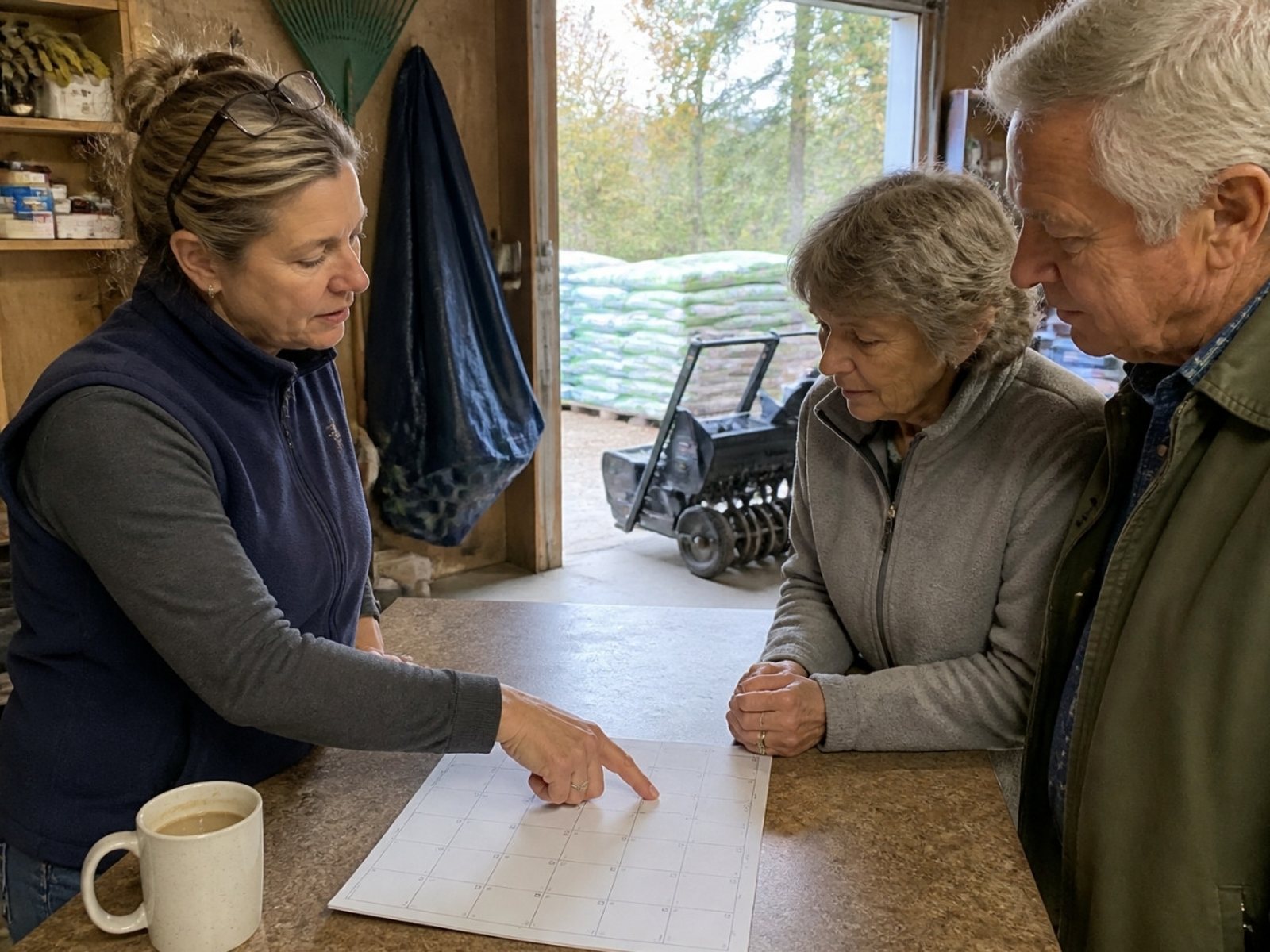
The timing shows up in the search data. In 2025, US searches for “leaf removal service” went from 495 in June to 12,377 in November, according to Ahrefs Keywords Explorer. The chart shows the same climb for mowing and aeration.

One note on aeration: the big “lawn aeration” number is probably mostly do-it-yourself searches. People look up how and when, then rent a machine. We still use it for timing, because do-it-yourself and hire-out interest rise in the same months. “Lawn aeration service” gets about 700 searches a month. That’s why we sell aeration to current customers instead of buying ads for it.
Here’s the calendar we’d run for current customers:
| When | Send this to current customers | Why then |
|---|---|---|
| Late January to February | Next season’s sign-up, with your price for the year | Mowing searches double in March, so your customers should hear from you first |
| March | Spring cleanup, mulch and spring aeration | Aeration’s first hump comes in April |
| Mid-August | Fall aeration and overseeding | Searches peak in September |
| Early October | Leaf cleanup dates | Searches jump in November, and your dates fill first |
| September to October | Snow removal contracts, if you plow | Get them signed before the first freeze, while your crew is still on their lawn every week |
A text that books aeration
Keep it short and from a person, not a “valued customer” blast:
“Hi (first name), it’s (your name) from (your company). We’re aerating and overseeding on your street the week of (date). It’s $(price) for your lawn. Want us to add it? Reply YES and we’ll put it on your next bill. Reply STOP to opt out of texts.”
It works because it gives a date, a price and an easy way to say yes. Only text customers who agreed to get texts from you.
That calendar fits cool-season lawns like tall fescue and Kentucky bluegrass. If you’re in the South on Bermuda or zoysia, move the main aeration offer to April or May. Summer works too while the grass is growing, so a mid-August push is optional, not the main event. Clemson Extension says warm-season grasses are best aerated in late spring and summer, while they’re growing. Use the national numbers for the shape and your own sales history for the dates.
Keep them at renewal
Send the renewal before anyone else knocks, put the new price in plain numbers, and call the few customers who complained last year before you mail them. A short phone call to an unhappy customer usually does more than a coupon in the mail.
Ask for referrals out loud
Give happy customers a reason to say your name. Have the crew lead say it on the way out: “If the neighbors ask who does your lawn, send them our way. We’ll take $25 off your next bill when they sign up for the season.” (Pick your own amount.) Just keep it to referrals. Rewards for reviews are a different story, covered next.
Reviews for lawn care: ask everyone, pay no one
On the map, a homeowner sees your stars and review count before almost anything else. Your photos show the stripes. Reviews tell them whether you show up on the same day every week and answer the phone. Ask every customer, and never pay or reward anyone for a review.
Google and the FTC both spell this out. Google’s review policy bans offering discounts, free services or payment for a review. It also bans asking only your happy customers, which people call review gating. The FTC’s 2024 rule on fake reviews goes after rewards tied to a positive (or negative) review, and fake reviews written by people who never used you.
So “$10 off for a 5-star review” is out. So is “$10 off for any review.” What’s left still works fine:
- Ask after the job that shows best: the spring cleanup, a new sod job, or the third or fourth cut of spring once the lawn has greened up.
- Send one short text with a direct link. Our free review link generator makes one in about a minute.
- Have the crew lead mention it in person: “Mind telling Google how we did? I’ll text you the link.”
- Answer every review, good or bad, within a few days. Thank people by name and mention the work you did.
We’d rather see three or four reviews every month than 40 in one week and then nothing. Google’s policy flags “unusual volumes or patterns” of reviews as possible manipulation, so a sudden pile can look like manipulation and get reviews removed, and a steady stream keeps your newest review recent. For more scripts, see our guide to getting more Google reviews.
Your Google profile and service area
“Near me” searches usually put the map near the top of the page, and your Google Business Profile decides whether you show up in it. Lawn companies tend to get two settings wrong: the category and the service area.
Category. Google has a “Lawn care service” category and a separate “Landscaper” category (you can browse Lawn care service and Landscaper in GMB Everywhere). Pick the primary one for the work that pays your bills. If 80% of your revenue is mowing and treatments, that’s usually Lawn care service, with Landscaper as a second category. A design-build shop would flip it.
Then list each service you sell, by name, so Google knows you do aeration and leaf removal too.
Service area. If customers don’t come to your shop, Google’s guidelines say to hide your address. They also say your service area shouldn’t reach past about two hours of driving from where you’re based.
You set the area by city or ZIP code, not by a radius around your shop. We’d go much tighter than two hours for a mowing company: list the towns your routes run through, plus maybe one you’re actively building. Every town you add tells Google you want calls from it. Set the same towns in LSA and Google Ads too, because those are set separately.
Post real photos every week: a striped lawn, a cleanup before and after, the crew loading up. If you want the full setup, our landscaping SEO service covers the profile, service pages and the rest of the map work.
Local Services Ads and Google Ads for lawn care
Paid ads make sense once your routes have room and your reviews hold up. Before that, you’re paying to send people to a profile with six reviews. For lawn care, we usually start with Local Services Ads, because you pay per lead instead of per click.
Local Services Ads
Lawn care is its own Local Services Ads category in the US, described as mowing, weed control, seeding, installation and upkeep. Landscaping services is a separate one. Google’s screening page says you need a public, verified Google Business Profile, and the checks take 3 to 4 weeks on average once your documents are in.
So if you want ads running when mowing searches double in March, apply in January. Applying early also tells you, before spring, whether Google offers the lawn care category where you work.
Watch your phone. Under Google’s lead rules, a call you miss during your business hours still counts as a lead if the caller stays on the line for more than 20 seconds. Those business hours come from your Google profile. A mowing crew with mowers running all day misses a lot of calls, so either set hours you can actually answer or have someone (or something) pick up. Our missed call calculator shows what those calls cost you.
Google checks lead quality for 30 days and credits leads it finds were poor quality, duplicates or invalid. But its credit rules say it no longer gives credits for “job type not serviced” or “geo not serviced” leads.
A caller from three counties over is your cost, not Google’s. So set your LSA service area to your route ZIPs and your job types to what you actually sell, and rate each lead in the dashboard, which is Google’s own advice when you’re getting leads you don’t want. Our guide on how Local Services Ads work covers setup in more detail.
Google Ads
Regular search ads give you control LSA doesn’t. You can bid only on the services you want more of, in only the ZIP codes your routes cover. Ahrefs estimates clicks on the lawn service terms in the table below at $2.50 to $5.00. Real bids in your ZIPs can run higher, so check Google’s Keyword Planner for your area.
We’d start small and narrow, say $15 to $20 a day (an example, not our price) on three or four service terms in your route ZIPs, and a sign-up page that shows a starting price. Then add more once you can see which searches turn into signed accounts.
Facebook and Instagram ads can work for a spring sign-up push or a leaf cleanup offer aimed at your towns. Treat them as reminders, not the main source of new accounts. Someone scrolling Facebook at 9 p.m. usually isn’t shopping for a lawn guy. The ad just reminds them you exist. The exception is a neighbor asking “who does your lawn?” in a local Facebook group or on Nextdoor. Answer it, or ask a happy customer to tag you.
Lawn care searches we build campaigns around
This is what homeowners in the US type when they want a lawn company, with the channel we’d lean on for each. Volumes are Ahrefs’ current monthly averages, a different window from the 2025 chart, so they won’t match it month to month. Click costs are Ahrefs estimates, checked in November 2026.
| Search | Searches a month | Est. cost per click | Where we’d win it |
|---|---|---|---|
| lawn care near me | 123,000 | $3.50 | Map pack, LSA |
| landscaping companies near me | 20,000 | $2.50 | Map pack, service pages |
| lawn mowing service | 14,000 | $3.00 | Map pack, Google Ads in route ZIPs |
| sod installation | 9,700 | $2.50 | Service page, Google Ads |
| lawn care service near me | 6,900 | $3.50 | Map pack, LSA |
| weed control service | 3,100 | $3.00 | Service page, add-on to mowing list |
| mulch installation | 2,700 | $2.50 | Spring email to current customers |
| leaf removal service | 2,400 | $3.00 | October text to current customers, Google Ads |
| snow removal service | 900 | $3.00 | Fall email, service page |
| lawn aeration service | 700 | $3.00 | August text to current customers |
| lawn fertilization service | 700 | $5.00 | Service page, LSA |
Most of that volume is “near me” searches, which are won on the map more than with ads. The add-on searches are small, and that’s fine. You sell those to the people you already mow for.
What our lawn care marketing covers
When a lawn care or landscaping company hires us, this is the work.
- Route map and neighbor plan. We pull your current stops (an address export from your CRM works), find the streets and carrier routes with the most of them, and plan door hangers and EDDM drops around your mowing days.
- Current-customer calendar. The sign-up, aeration, leaf cleanup and snow texts and emails, written and scheduled ahead of each season.
- Google Business Profile. Categories, services, service area by town, weekly photos and posts.
- Reviews. A simple ask for every customer, review links, and replies, all inside Google’s rules.
- Local Services Ads. Setup, screening help, budget, lead rating, and tight service areas and job types so you pay for fewer bad leads.
- Google Ads. A few service campaigns limited to your route ZIP codes.
- Website and sign-up page. A page that shows a starting price and takes a sign-up on a phone. See a landscaping website built for sign-ups.
- Calls. Call tracking by channel, plus Restoral, our AI system that answers calls and chats and books jobs on your calendar. It works with Jobber and most trade CRMs, and our team sets up the link.
- Social media. Before and after posts through BuilderBase, our own social media tool.
We won’t start everything at once. A two-truck company with open Thursdays gets the neighbor plan and reviews first. A company with full routes and a new crew to fill gets ads aimed at the towns that crew will cover. Commercial and HOA maintenance is a different sale, built on bid lists and property managers instead of door hangers, so it gets its own pages and plan.
What to spend on lawn care marketing at one, three and ten trucks
There’s no right percentage. These are example budgets for ad spend, postage and printing, to show how we’d split the money. They don’t include any agency fee.
| Company | Example monthly spend in season | Where it goes |
|---|---|---|
| One truck, owner on the mower | $300 (the spring EDDM month runs closer to $750) | Door hangers on route streets, one EDDM drop in spring, review links. Profile done yourself. |
| Three crews adding treatments | $1,500 | One EDDM drop a month, rotating between crews’ routes, plus LSA and customer texts for aeration and leaves |
| Ten trucks, maintenance plus design-build | $5,000 | LSA and Google Ads by service, service pages, neighbor mail for new crews, call tracking |
Spend most of it in the weeks before demand climbs, not at the peak. Mowing searches hit about 18,000 a month in April and stay there through June. The companies that mailed in February already have a head start on those yards. In winter, cut paid ads to almost nothing (unless you plow) and spend that time on renewals.
How we measure it, and the first 90 days
We judge lawn care marketing by one number: signed accounts by ZIP code, divided by what you spent to get them. Clicks and calls only matter if they turn into signed accounts.
Each month you get a one-page report with:
- New signed accounts, by channel and by ZIP
- Cost per signed account for each channel
- Stops per crew day and drive minutes between stops, so you can see density going up
- Add-on rate: the share of mowing customers who also bought aeration, leaves or treatments
- Calls answered and missed
Stops per crew day is the number we’d watch closest. Fewer miles between yards means more yards in a day, so it tells you whether marketing is making the business easier to run or just bigger. Big and spread out is how a lot of lawn companies get busy and broke at the same time.
Month 1
Route map, profile cleanup, review links live, call tracking on. If it’s winter, we apply for LSA so screening is done before spring.
Month 2
First neighbor drops on your densest routes. The next seasonal message goes to current customers. LSA goes live once Google approves you.
Month 3 and on
We compare cost per account across channels and move money toward what’s signing people. Google Ads gets added where you have room on a route. Map rankings take months, not weeks. Plan on spring results from work done in winter.
Why D&J for lawn care marketing
We’re an agency for contractors and home service companies, based in Stamford, Connecticut. We’re a Google Partner, a Meta Business Partner and a Yelp Partner. We’ve also worked with more than 30 SERVPRO franchises and have never lost a SERVPRO client.
You can read our case studies to see how we work. What carries over to lawn care is the phone side: answering every call, tracking which ad or mailer made it ring, and getting reviews every month. The route-first plan on this page is how we’d run the rest.
And we won’t run your ads in towns you don’t mow.
What to do this week
- Print your customer list and circle the three streets with the most stops.
- Write a door hanger that names those streets and your day there.
- Put your next add-on (leaf cleanup, snow, or next year’s sign-up) on the calendar with a send date.
- Check your Google profile: primary category, services listed, service area set to your route towns.
- Make a review link and text it to every customer you serviced this week.
Want us to check? We’ll look at your profile, your map rankings in the towns you mow and your website, and tell you what we’d fix first. It’s free. You’ll get a short list, worst problem first.
Rather talk first? Contact our team.
Lawn care marketing FAQ
What is the best marketing for a lawn care business?
For most lawn companies, the best return comes from marketing to the streets you already mow and to your current customers. Door hangers, EDDM mailers and well-timed add-on offers cost little and bring in accounts that fit your routes. Next come steady reviews and a Google profile set to your real towns. Paid ads come after that.
How much should a lawn care company spend on marketing?
There’s no set percentage that fits everyone. Start with what a signed account is worth over a season, then decide what you’d pay to win one. A weekly mowing account that renews for a few seasons can be worth a few hundred dollars to win. A one-time cleanup can’t. Spend most of it in the weeks before demand climbs.
Do door hangers still work for lawn care?
They work best on streets where you already have customers, because neighbors have seen your crew. Name the street and the day you’re there, make one offer, and include a number that a person answers. Hang them on the door, never in the mailbox.
Is Google Local Services Ads worth it for lawn care?
Often, yes. Lawn care is its own category in the US, you pay per lead instead of per click, and Google credits some leads it finds were invalid or poor quality, though not calls from outside your area. The catch is the phone. A missed call during your business hours can still count as a lead if the caller stays on for more than 20 seconds.
Can I give a discount for a Google review?
No. Google’s policy bans discounts, free services or payment in exchange for a review, even if you don’t ask for a good one. The FTC’s 2024 rule also bans rewards tied to positive or negative reviews. Ask every customer, make it easy with a direct link, and leave it at that.
When should a lawn care company start marketing for spring?
Late January or February. In 2025, US searches for “lawn mowing service” went from 4,444 in February to 9,139 in March. Send your renewal and sign-up offer to current customers before that jump, plan your first neighbor drops, and apply for Local Services Ads in January so screening is done in time.