
US searches for “lawn mowing near me” went from about 7,100 in February 2025 to about 43,600 in June, per Ahrefs. To catch that wave, your mowing page needs to be live, and your profile cleaned up, by January.
Landscaping SEO happens in two places: the map and the regular results under it. Google says map results are based mainly on relevance, distance and popularity. In our experience, the regular results favor a strong page for each service.
Phone searches like “lawn care near me” are won in the map pack, mostly with your Google Business Profile and reviews. Bigger jobs like patios and retaining walls are won with a clear page for each service, written for people who compare at a desk. And every page goes live well before its season starts, not during it.
Key takeaways
- 94% of “lawn mowing near me” searches came from phones, but only 17% of “paver patio installation” searches did, so mowing and patio work need different pages. What customers search
- Our rule: pick the main Google category that matches where most of your money comes from. That’s lawn care service for mowing routes and landscaper for design-build. Picking your lane
- Each service you want more of gets its own page, and town pages that only swap the city name can get you in trouble with Google. What the work covers
- In 2025, aeration searches peaked twice (April and September), leaf removal peaked in November, and snow searches hit their low in May and climbed every month after. The search calendar
- If you plow all winter, keep your profile open and update your hours. Google’s guidelines say a business can mark itself temporarily closed in its off-season, which fits owners who truly shut down. Snow and the off-season
- Landscaper, lawn care, snow removal and tree services are all on Google’s US list of services eligible for Local Services Ads. SEO, LSA and ads
- Count booked accounts and projects by service, not calls. In our example math, one weekly mowing account is worth $1,260 a season. How we measure
What your customers type into Google
Most people hiring a mowing service search on their phone. People pricing a patio tend to sit at a desk and compare a few companies. You win the first group on the map and the second on your service pages.
This is what people in the US typed in, how much of it came from phones, and what Google showed on the page.
| Search | US searches a month | On a phone | Map pack? | AI Overview? |
|---|---|---|---|---|
| lawn care near me | 122,000 | 83% | Yes | No |
| landscaping near me | 94,000 | 84% | Yes | No |
| lawn mowing near me | 22,000 | 94% | Yes | No |
| landscaping companies near me | 20,000 | 59% | Yes | No |
| sprinkler repair near me | 15,000 | 55% | Yes | No |
| hardscaping near me | 12,000 | 76% | Yes | Yes |
| landscape design near me | 11,000 | 68% | Yes | No |
| sod installation near me | 11,000 | 41% | Yes | No |
| snow removal near me | 7,400 | 49% | Yes | Yes |
| lawn aeration near me | 6,500 | 33% | Yes | No |
| landscape lighting installation | 3,400 | 29% | Yes | No |
| paver patio installation | 2,900 | 17% | No | Yes |
| retaining wall contractors near me | 2,500 | 19% | Yes | No |
| lawn fertilization service | 700 | 22% | Yes | No |
| commercial landscaping companies near me | 300 | 7% | Yes | No |
Mowing and “near me” lawn care searches are mostly phone searches. Between 83% and 94% of “lawn care near me,” “landscaping near me” and “lawn mowing near me” searches came from phones, and all of the “near me” searches we checked showed the map. That’s the box with three local businesses and pins. How close you are to the searcher matters a lot, and you can’t change it. So the work goes into your Google Business Profile and your reviews.
Big-ticket work looks different. Only 17% of “paver patio installation” searches came from phones. Retaining walls were 19%, and landscape lighting (a broader search, without “near me”) was 29%. Those people sit down and compare. So the page behind your listing has to answer their questions: what it costs, how long it takes, and what your past jobs look like.
Three of these searches also showed an AI Overview, Google’s AI answer at the top: “hardscaping near me,” “snow removal near me” and “paver patio installation.” The patio search had no map at all, so for that buyer your page is the whole pitch. Give them a price range, a timeline, how you prep the base, and photos of your own jobs.
Route, design-build or commercial: pick your lane first
The first question we ask: where does most of your revenue come from? A mowing route, a design-build crew and a commercial team each need a different profile setup, different pages and different proof.
| Your main business | Likely main category | Pages that matter most | What proves you to a buyer |
|---|---|---|---|
| Mowing and maintenance routes | Lawn care service | Mowing, aeration, cleanups, mulch, the towns your trucks run | Lots of recent reviews, clear service days, easy sign-up |
| Design-build and hardscape | Landscaper (add Landscape designer if you design) | Patios, retaining walls, lighting, plantings, a project gallery | Real project photos, process, what drives the price |
| Commercial maintenance | Landscaper (or Lawn care service if it’s mostly mowing) | Commercial maintenance, HOA care, snow and ice, a sites-we-handle page | Crew size, insurance, response times, the kinds of properties you run |
Google’s rule for categories is short. Its guidelines say to choose “the fewest number of categories it takes to describe your overall core business.” Pick ones that finish the sentence “This business IS a,” not “this business HAS a.” And don’t use categories “solely as keywords.”
So a company that mows 300 lawns a week and builds a few patios a year is a lawn care service first. A design-build shop that also mows for its own clients is a landscaper first. If you can’t decide, pull last year’s revenue by service. The biggest slice is your main category.
Just starting with one truck? Keep it simple: a verified profile, a steady stream of reviews and one good mowing page. Skip town pages for now.
Commercial is its own case. “Commercial landscaping companies near me” got about 300 searches a month, and only 7% came from phones. That’s not much search traffic.
A property manager who hears your name may still look you up before inviting you to bid. For them, SEO is less about traffic and more about a site that proves you can handle a 40-acre office park. Put the property types you maintain on the commercial page, offer your insurance certificate as a download, and say who their contact is and how fast you answer.
What our landscaping SEO work covers
We usually work in this order. The profile and the call tracking come first, so every page we add after that gets measured.
A profile that matches how you work
We set the main category from the lane above. Then we fill the services list with the jobs people really search for: aeration, sod, mulch, cleanups, sprinkler repair, lighting. Each one gets a short, plain description.
If you run the business from home or a yard, Google’s rule for service-area businesses is short: “you should hide your business address from customers.” We set the service area to the towns your crews actually reach. Google says it shouldn’t go farther than “about 2 hours of driving time” from your base. For a mowing route, the real number is usually much smaller.
We add photos of your own trucks, crews and finished yards. No stock shots of somebody else’s lawn. Our Google Business Profile setup guide walks through every field.
One page per service you want more of
In our experience, a single “Services” page with a bulleted list rarely ranks for aeration in April or leaf removal in November. Each service you want to grow gets its own page. It says what’s included, when you do it, which towns you cover, and how to get on the schedule.
What we won’t do is copy one page 30 times with a different town name. Google’s spam policies give “pages targeted at specific regions or cities that funnel users to one page” as an example of doorway abuse. So are “substantially similar pages that are closer to search results than a clearly defined, browseable hierarchy.” A town page is only worth building when you have something real to say about that town.
Project pages for design-build work
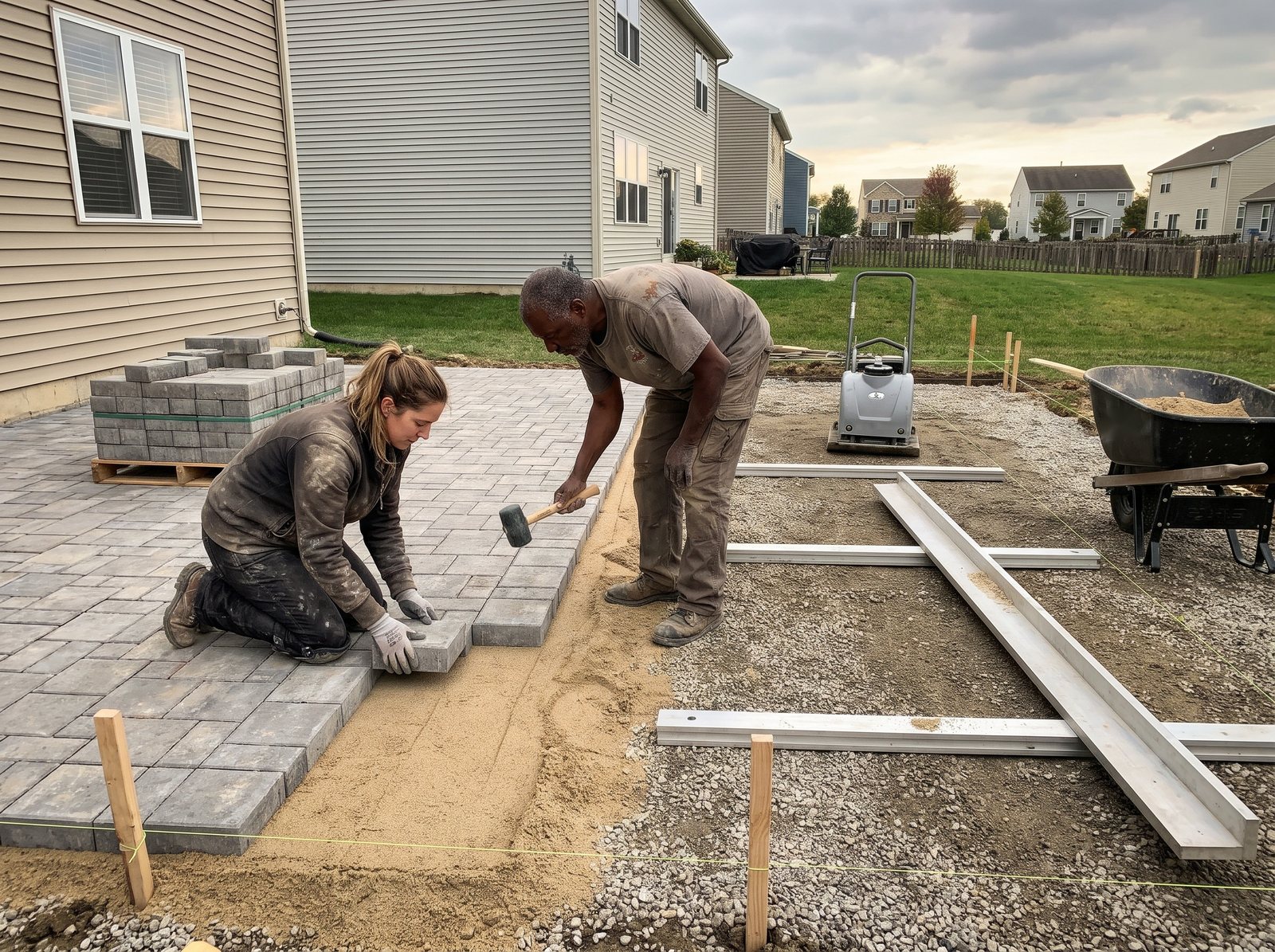
Patio and wall buyers read. Each project type gets a page with before and after photos, the steps from design to cleanup, the things that move the price (access, base prep, materials, drainage), and how long it takes. Then we add single project write-ups as you finish jobs.
Reviews that name the job
Google’s local ranking help page says that “more reviews and positive ratings can help your business’s local ranking.” We set up a simple ask after each job, by text, with a direct link. Ask while the stripes are still fresh. Our free review link generator makes the link and a QR code for your door hangers.
One rule: no discounts or free mows for reviews. Google says it takes “fake and/or incentivized reviews and ratings on businesses very seriously.” Its listed penalties include a profile that can’t get new reviews for a while. More on that in our guide to getting more Google reviews.
Local links you’ve already earned
Your stone yard, nursery or equipment dealer may list local pros. So might HOA vendor lists or the youth team you sponsor. We find those and get your name and site listed right. No bought links, ever.
A site built for phone searchers
Mowing buyers are on their phones. Put a call button at the top of every page, keep the quote form short, and make sure pages load fast on a weak signal. If your site needs a rebuild, our contractor website design page shows how we build them. For the landscaping version, with mowing sign-ups and patio pages, see our landscaping website design guide.
Tracking every call back to a service
A good setup gives your website, your profile and each ad their own tracking number, and tags every form by page. That way your report can say how many calls came from the aeration page, not just “the website got busier.”
The landscaping search calendar
Each service has its own season, and aeration has two. Pages need to be up and indexed before the wave, not while your crews are already slammed.

The 2025 month-by-month numbers from Ahrefs showed this for US searches:
- Mowing: “lawn mowing near me” bottomed out at about 7,100 searches in February, more than doubled by March, and peaked at about 43,600 in June.
- Aeration: “lawn aeration near me” had two peaks, about 12,600 in April and 13,600 in September, with under 3,000 a month in June and July.
- Leaf removal: “leaf removal near me” sat near 650 in June and jumped to about 14,100 in November. It also had a smaller bump in March (about 3,700), probably spring cleanup.
- Snow: “snow removal near me” peaked at about 22,300 in January 2025, bottomed out near 1,340 in May, then climbed every month after: about 4,300 in August and 13,200 by December.
- Patios: “paver patio installation” ran about 735 in January and peaked near 4,300 in June.
Publish your fall aeration page by June, then push it hard in August, when searches jumped from about 2,900 to 10,000. Snow searches start creeping up in June. Nobody’s hooking up a plow yet. But a snow page posted in May has time to get found before searches take off in August.
Our rule of thumb: a new page should be live at least two months before its searches take off. Google needs time to find a page, and you want it settled before the phones ring. For most landscapers, that works out to this plan:
| Publish by | Pages | Why then |
|---|---|---|
| December | Patios, sod, spring aeration | Sod and patio searches started climbing in February, spring aeration in March |
| January | Spring cleanup, mowing sign-up, mulch | Mowing and mulch searches took off in March |
| May | Snow removal | Snow searches crept up from June and took off in August (about 4,300) |
| June | Fall aeration and overseeding, fall cleanup and leaf removal | Fall aeration jumped in August; leaf removal started rising in July and peaked in November |
These are US totals. In the South, the spring climb starts earlier and snow barely shows up, so shift each date to match when your own phones start ringing.

Snow removal and the off-season profile
Some owners mark the business closed while they’re still plowing. Others leave summer hours up all winter. Here’s what Google allows.
Per Google’s profile rules, while you’re open for the season, “set your regular hours of operation.” You can say in your business description that you’re “open only for a specific seasonal period.” And “during off-season, you can mark your business as temporarily closed,” then set your regular hours again when you reopen.
How we apply that:
- You plow or salt all winter: stay open. Update your hours for winter. Add snow removal to your services. Add the “Snow removal service” category only if snow is a big part of the business.
- You still answer the phone and book spring work: stay open with shorter office hours. A profile marked closed in February tells people booking spring cleanups that you’re not taking work.
- You fully shut down for winter: mark the profile temporarily closed, and reopen it by early February, before spring searches climb in March. Taking spring bookings by phone while you’re off? Use the bullet above instead.
If it’s already fall and you plow, post the snow page now anyway. In 2025, searches went from about 8,600 in October to about 13,200 in December. The year’s peak was back in January, at about 22,300, and that’s the month a page posted now needs to be ready for.
Put your applicator license on treatment pages
If you sell fertilization or weed control, your license is a selling point. Put it where buyers can see it, not tucked away on an About page.
The EPA says anyone who applies or supervises the use of restricted use pesticides must be certified. States, territories and tribes certify applicators. The EPA also notes that “many states require all commercial applicators, not only those using RUPs, to be certified.” So check your own state’s rules.
Only 22% of the roughly 700 monthly searches for “lawn fertilization service” came from phones, which suggests people reading before they buy. Parents and dog owners want to know who’s spraying and with what. So every treatment page we build says who on your team holds the license and which state issued it. Add the number too, if you’re fine sharing it.
How SEO, LSA and Google Ads split the work
There are two paid options, and they bill differently.
Local Services Ads (LSA) sit at the very top of some searches. Google’s LSA page lists landscaper, lawn care, snow removal and tree services among the eligible home services in the US. Google describes them as “pay-per-lead listings for verified local service providers” with a Google Verified badge. You pay for a lead, not a click.
Our Local Services Ads guide covers setup and costs, and this post explains how Google Verified works.
Google Ads charge by the click. Ahrefs estimated these average costs per click: about $1.70 for “lawn mowing near me,” $3.50 for “lawn care near me,” $4.00 for “hardscaping near me” and $5.00 for “lawn fertilization service.” Those are averages across the US. Your town could be higher or lower.
SEO doesn’t charge per click or per lead. It costs time and work up front, and it takes months to build.
For most landscapers, we’d split it like this. Use LSA or ads to fill the spring rush while new pages are still finding their footing. Lean on SEO for the steady flow and for the big projects people take their time comparing.
Then trim Google Ads spend on services where you already show up in the map or near the top of the regular results, and judge LSA by cost per booked job. For the same approach across other trades, see our home services SEO page.
Measure accounts and projects, not clicks
A number-one ranking that doesn’t book a single yard is worth nothing to you. For landscapers, that means counting new recurring accounts and signed projects, each by service.
Why the split matters, using example numbers (not anyone’s real prices):
- A mowing account: say you charge $45 a cut and mow a yard 28 times a season. That’s $1,260 for the year. If the customer stays three seasons, it’s $3,780 from one call.
- A patio project: say an average job is $18,000. In this example, one signed patio is worth more than 14 seasons of that mowing account.
- An aeration add-on: say it’s $150 per yard. Ten of them from a September page is $1,500, and a few of those yards might turn into mowing accounts.
So “we got 40 calls” doesn’t tell you much. Forty calls about one-time cleanups and forty calls from people who want weekly service all season are worth very different amounts. We report calls and forms by service, how many turned into booked work, and what that work is worth. If your field service app has a lead source field, fill it in on every new client so you can see which leads booked.
What the first three months look like
Expect the first three months to be setup, not a flood of calls. This is the order we’d work in, so you know what you’re paying for.
Month 1: fix the base
- Check your profile, category, services, service area and hours.
- Set up call tracking and form tracking by source.
- Fix site problems that stop pages from loading fast or showing up.
- Start the review ask after every job.
Month 2: build for the next wave
Pages come next, timed to whatever season is coming. If we start in October, that means spring cleanup, mowing sign-up and patio pages, plus a snow page right away if you plow. If we start in spring, it’s fall aeration, leaf removal and snow. We also clean up your business listings on other sites so your name, phone and address match.
Month 3 and on: grow what works
Now there’s data. We add project write-ups, go after the local links we found, and rewrite pages that get seen but don’t get calls. Then we put more effort behind whichever services bring booked work.
We can’t give you a ranking date, and you should be wary of anyone who does. How fast it moves depends on your town and your competitors. It also depends on where your site and profile start, because a five-year-old site with 80 reviews and a brand-new one with six are not starting from the same place.
What to ask any landscaping SEO company
Whether you hire us or someone else, ask these before you sign.
- Which category would you pick for my profile, and why?
- When would my aeration, leaf and snow pages go live?
- Will you build town pages? What goes on each one besides the town name?
- How will I know which calls came from SEO, and which service they were for?
- Who owns the website, the profile and the tracking numbers if I leave?
- Do you ever buy links?
- Do you ever offer customers discounts or freebies for reviews?
- How long is the contract, and what happens in month four if nothing has moved?
If the answer to 6 or 7 is anything but a flat no, walk away. Google’s spam policies name “buying or selling links for ranking purposes.” And an incentivized review problem can stop new reviews on your profile for a while, which is the last thing you want in April.
Why D&J for landscaping SEO
We’re a marketing agency for contractors and home service businesses, based in Stamford, Connecticut. We’re a Google Partner, a Meta Business Partner and a Yelp Partner.
Besides SEO, we run Google Ads and Local Services Ads, build websites, and handle reviews and call tracking. When you’re on a mower all day, Restoral, our own AI system, can answer calls and chats and book jobs onto your calendar. It works with Google Calendar, Jobber and most trade CRMs, and our team sets up the connection.
If you run more than one trade, our contractor SEO page covers the general version.
Landscaping SEO FAQ
How long does landscaping SEO take to work?
Profile fixes and new reviews often help sooner than new pages. New service pages can take a few months to settle in, which is why we publish each one well before its season. Nobody can promise a date, because it depends on your town and how strong your competitors are.
How much does SEO cost for a landscaping company?
It depends on how many towns and services you want to grow and how much work your site and profile need. A one-truck mowing company and a design-build firm with three crews need very different plans. The free audit shows what we’d fix first, so you can judge the scope before talking price.
Should my Google category be Landscaper or Lawn care service?
Pick the one that matches where most of your revenue comes from. Google says to choose categories that finish the sentence “This business IS a.” Mostly weekly mowing and maintenance points to lawn care service. Mostly design, planting and hardscape points to landscaper. Add others only if they’re a real part of the business.
Do I need a page for every town I mow in?
No. Pages that only swap the town name can count as doorway abuse under Google’s spam policies. Build a town page only where you have real things to say, like jobs you’ve done there or local rules. List your other towns on your service pages and set them as your service area in your profile.
Is SEO or Local Services Ads better for landscapers?
They do different jobs. Local Services Ads are pay-per-lead and can start bringing calls once your business passes Google’s checks. Google lists landscaper, lawn care, snow removal and tree services as eligible categories in the US. SEO takes longer but doesn’t charge per click or per lead. For most landscapers, we’d use ads for the spring rush while SEO builds up.
Should I mark my profile closed in winter?
Only if you truly stop working. Google’s guidelines say an off-season business can mark itself temporarily closed and set regular hours again when it reopens. If you plow, salt or still book spring work by phone, stay open and update your hours for winter instead.
What to do this week
Four free things you can do this week:
- Open your Google Business Profile. Check that your main category matches how you make most of your money.
- Set your winter hours, or plan the date you’ll reopen if you close for the season.
- Write down the three services you want more of next spring. Those are your first three pages. Patio and sod pages should be live by December, mowing and cleanup pages by January.
- Text your last ten happy customers (the ones who’ve agreed to get texts from you) a review link. Don’t offer anything for it.
If you want an outside view, start with our local SEO audit. It costs nothing, and there’s nothing to sign.


