

A plumbing service agreement can fill your slow weeks and keep customers from calling whoever shows up first on Google. But a lot of plumbing plans are a one-page sign-up form and a vague promise. Members don’t know what they get, techs don’t sell it, and renewals fade.
Below is a free template you can edit, plus the visit checklist, the pricing math, the scripts and the legal lines to watch before you sell your first plan.
The short answer: a plumbing service agreement is a yearly plan that gives a homeowner one scheduled inspection, priority service and member pricing on repairs for a set fee. Write down what the visit checks, what’s excluded and how it renews. Never promise free repairs, or it can start to look like a regulated home warranty.
Key takeaways
- A plumbing plan sells an inspection, priority and a repair discount, never free repairs, which can look like a regulated home warranty. What a plan covers
- The free Word and PDF template includes the checklist, tier table, exclusions and renewal terms. Get the template
- Build the visit around the water heater, hidden leaks, water pressure and drains, and leave a written report. Inspection checklist
- “Frozen pipes” searches jumped from about 1,100 in October 2025 to about 38,000 in January 2026, so book member visits in the fall. When to schedule visits
- Price from your slow-week visit cost; in our example a $140 visit leaves $59 on a $199 plan. Pricing worksheet
- A plan sold during a repair call can fall under the FTC’s three-day Cooling-Off Rule. Scripts and the in-home rule
- Auto-renew plans need clear consent and reminders in states like California. Renewal rules
What a plumbing service agreement covers (and what it doesn’t)
A plumbing service agreement is a yearly plan. The member pays a set price and gets a scheduled inspection, a spot near the front of the line when something breaks, and a discount on repairs. It does not make repairs free.
Members who think repairs are free are the ones who cancel angry. So say it in the agreement, say it at the kitchen table, and print it on the invoice.
Most plumbing plans we see come down to four things:
- One inspection visit a year with a written checklist. Some shops add a second visit in a top tier.
- Priority scheduling when the member calls with a problem.
- A discount on repairs, often with the trip or dispatch fee waived.
- A renewal date and clear rules on how the plan ends.
Thompson Bros. Plumbing’s published plumbing care agreement is a good real-world look. It includes one check per contract year, preferred customer pricing on repairs, and 10% off regular pricing for equipment the plan doesn’t list. It also says, in plain words, “this is not an insurance policy.”
Why “free repairs” is a trap
Some shops try to sell more plans by promising to fix whatever breaks. Don’t. Once you promise to pay for repairs caused by wear and tear, your plan can start to look like a home warranty, and many states regulate those.
Florida is a good example. Its home warranty law covers any agreement where a business “undertakes to indemnify the warranty holder against the cost of repair or replacement, or actually furnishes repair or replacement” of parts of a home “necessitated by wear and tear.” Florida puts that definition in its insurance code, Chapter 634, which tells you how the state sees it.
A maintenance plan sells your time, your eyes and a discount. Keep it that way and ask your attorney how your state treats service contracts before you add any repair coverage.
Download the free plumbing service agreement template
The template below is a Word file you can edit, plus a PDF and a filled-in example so you can see how a finished one reads. Preview the pages first, then download the version you want. We wrote it for residential plumbing plans, one home per agreement.
Here’s what’s inside:
- Customer, property and plan details, with a box for the renewal date
- A three-tier price table you fill in with your own numbers
- The annual inspection checklist, split by water heater, fixtures, pressure and drains
- Member benefits, scheduling rules and a missed-appointment fee line
- A “not a warranty or insurance” clause and a list of exclusions
- Auto-renewal and cancellation terms, a transfer clause and signature lines
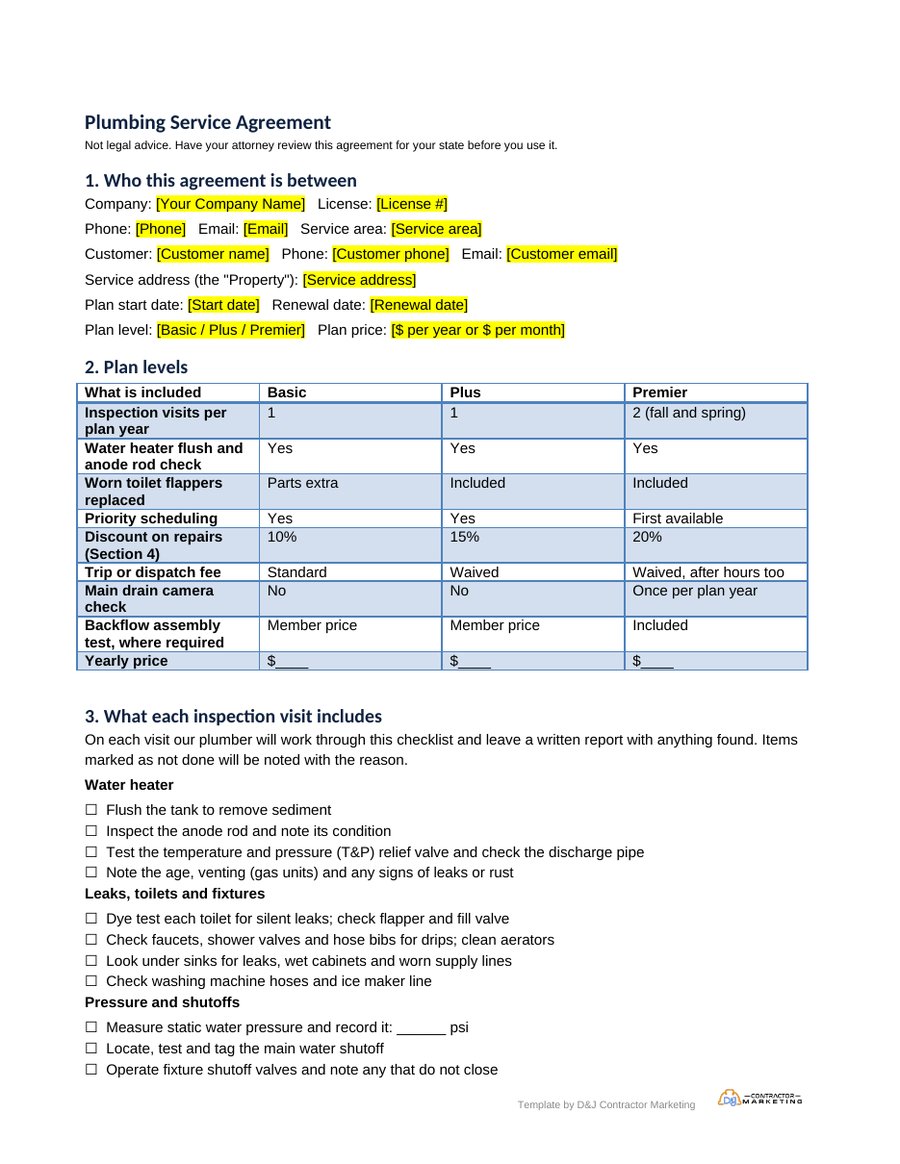 Template, page 1Your details, tiers and the checklist
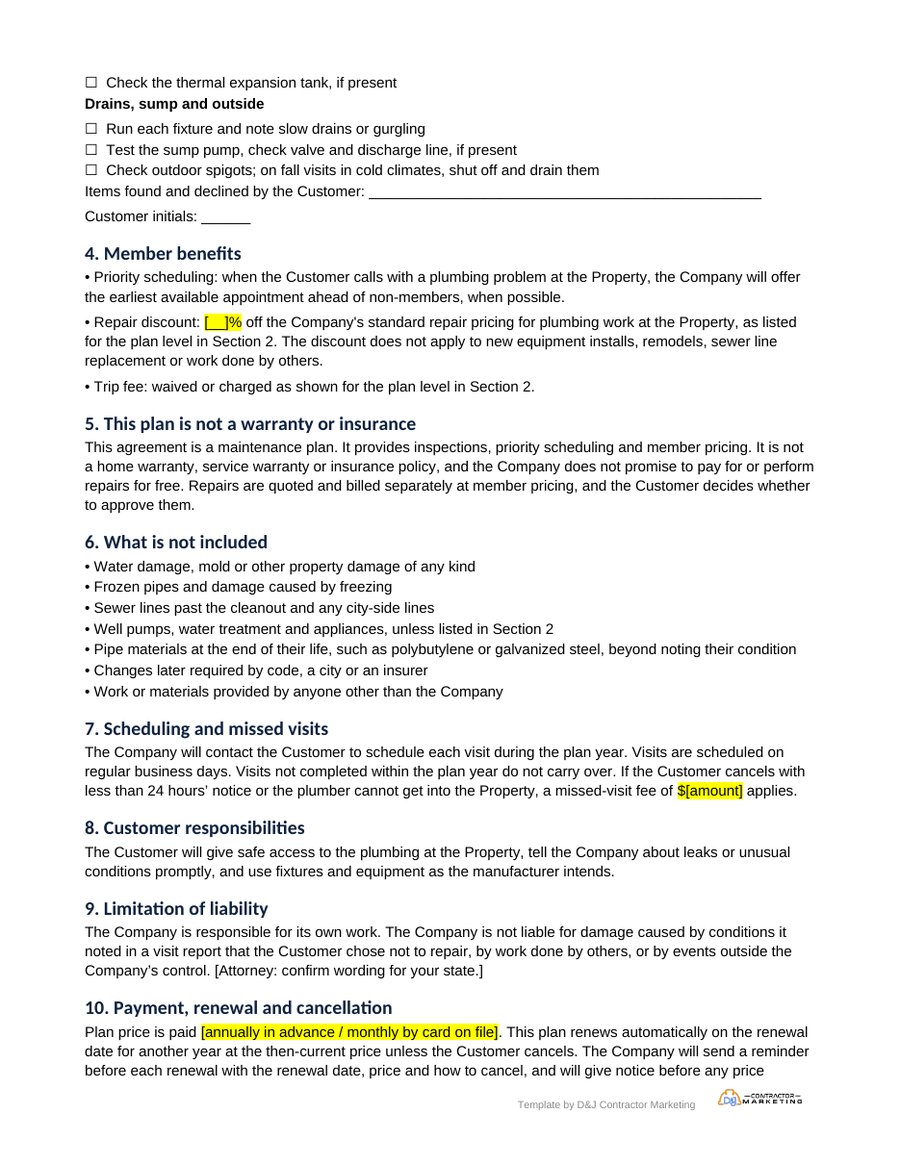 Template, page 2Benefits, exclusions and renewal terms
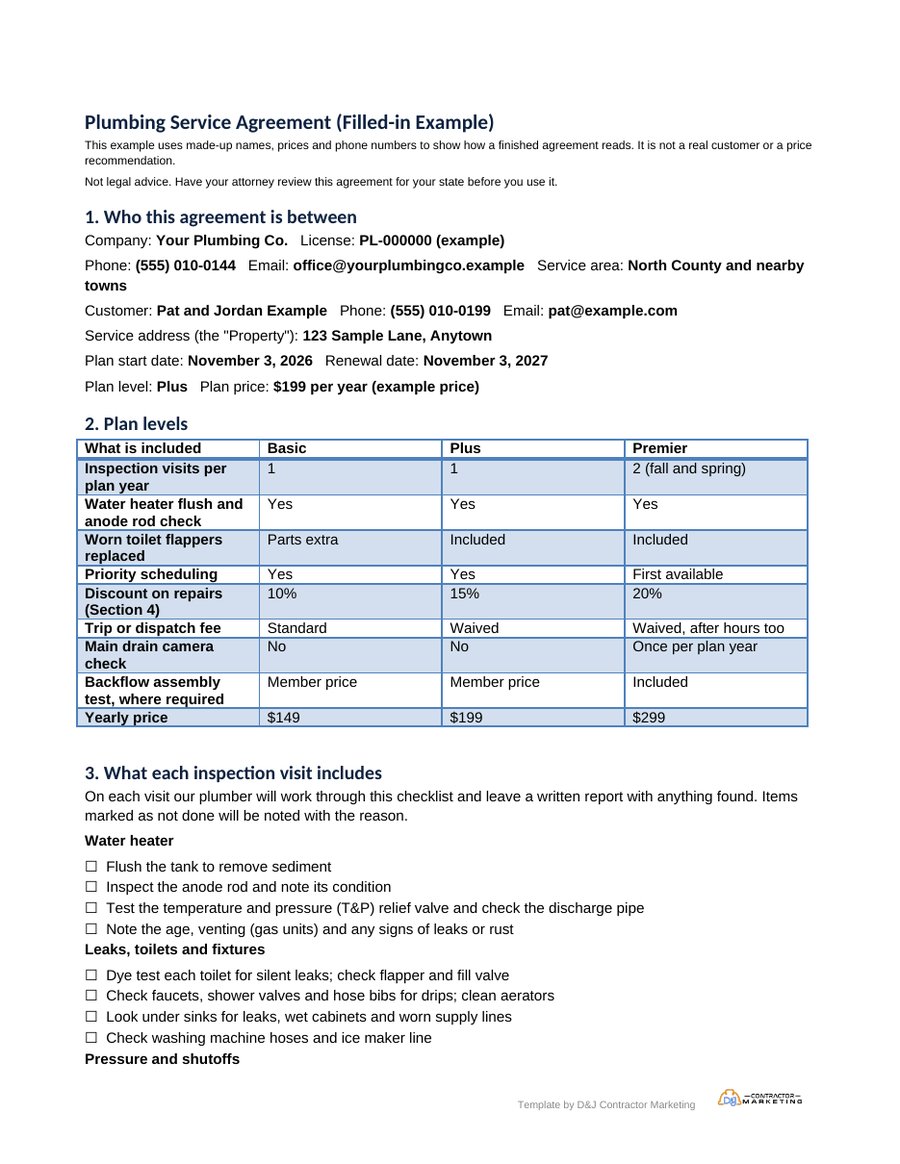 Filled-in exampleMade-up names and prices
To make it yours, swap in your business name, license number and service area. Then set your prices in the tier table and cross out any checklist line your plumbers won’t do. If it’s not on the checklist, don’t promise it.
This template is a starting point, not legal advice. Have your attorney review it before you sign up your first member, since rules on renewals and service contracts change from state to state.
Need to bill for the work you find on the visit? Pair this with our free contractor invoice template. If you also run HVAC, our HVAC service agreement guide covers the spring and fall tune-up side.
The clauses that matter most in a plumbing agreement
Most agreements fall apart over the same handful of things. Who books the visit, what a visit includes, what the discount applies to, what’s excluded and how the plan renews.
Here’s how we’d handle each one for a plumbing shop. The sample wording is in the template, too.
| Clause | Why it matters for plumbers | Sample wording |
|---|---|---|
| Scope of the visit | Members remember what you promised, not what you meant. | “One plumbing inspection per plan year, using the checklist in Section 3.” |
| Scheduling | If nobody books the visit, the member feels cheated at renewal. | “We will contact you to schedule. Visits not completed within the plan year do not carry over.” |
| Missed appointments | A no-show costs you a truck and a slot. | “Cancel at least 24 hours ahead or a missed-visit fee of $[amount] applies.” |
| Discount | Say what it applies to so nobody expects it on a full repipe or a new water heater at cost. | “[__]% off standard repair pricing for covered plumbing at this address.” |
| Not a warranty | Keeps the plan from reading like a home warranty or insurance. | “This plan is not a warranty or insurance. Repairs are billed at member pricing.” |
| Exclusions | Stops fights over well pumps, frozen lines and old pipe. | “Not included: see Section 6.” |
| Liability | Water damage claims are the big risk in plumbing. | “We are not liable for water damage from conditions we noted and you chose not to repair.” |
| Renewal and cancellation | State laws set rules for automatic renewals. | “Renews each year unless you cancel. We will remind you before it renews.” |
| Transfer | Homes sell. A plan that moves with the house is a nice perk. | “This plan stays with the property and may be transferred to a new owner.” |
The liability line. When your plumber spots a corroded supply line and the homeowner says “not today,” write it down and have them sign. If that line lets go in March, your note shows you warned them. We’d make “items found and declined” a standard box on every visit report.
The missed-visit fee. Thompson Bros. charges an $85 “Service Call” fee when a member doesn’t give 24 hours’ notice. You don’t have to match that number. But pick one, put it in writing and actually charge it, or your schedule will fill with no-shows.
What the annual plumbing inspection checks
Members judge the plan by the visit. If your plumber walks in, flushes the water heater and leaves in 20 minutes, the member won’t renew. Give them a checklist with a box for every item, and leave a copy on the counter.
Matt Michel, writing in Plumbing & Mechanical in 2020, suggested letting your plumbers build the list themselves. His prompts: flush the water heater, check the anode rod, dye test each toilet, replace flappers, clean faucet aerators. We like that idea, because techs sell what they believe in. Here’s the list we’d start them from.
Water heater
- Flush the tank. On an older heater, warn the member that a worn drain valve may not reseat. A. O. Smith’s water heater maintenance guide says most tank heaters need flushing at least once a year, and more often with hard water.
- Pull and check the anode rod. The same guide recommends inspecting it once a year. If it’s seized, note it rather than forcing it.
- Test the T&P relief valve and look at the discharge pipe. On an older valve, warn the member first. If it drips afterward, A. O. Smith says to control water pressure and add a thermal expansion tank before replacing it.
- Note the age from the serial number and the venting condition on gas units.
Leaks, toilets and fixtures
- Dye test every toilet for silent leaks. The EPA says to check the flapper periodically and replace it at least every five years.
- Check faucets, shower valves and hose bibs for drips. Clean aerators.
- Look under every sink for wet cabinets, corroded supply lines and slow drains.
- Check washing machine hoses and the ice maker line.
Pressure and shutoffs
- Put a gauge on a hose bib and write down the static pressure. The 2021 International Plumbing Code (section 604.8) calls for a pressure-reducing valve when static pressure inside a building goes over 80 psi. Your local code may set a different number.
- Find and tag the main shutoff, and test the fixture stops. On old gate or multi-turn valves, tell the member first and note it on the report. A stop that starts dripping after you turn it is now your call.
- Check the expansion tank on closed systems.
Drains, sump and outside
- Run water at every fixture and watch for slow drains or gurgling.
- Test the sump pump by filling the pit, and check the check valve and discharge line.
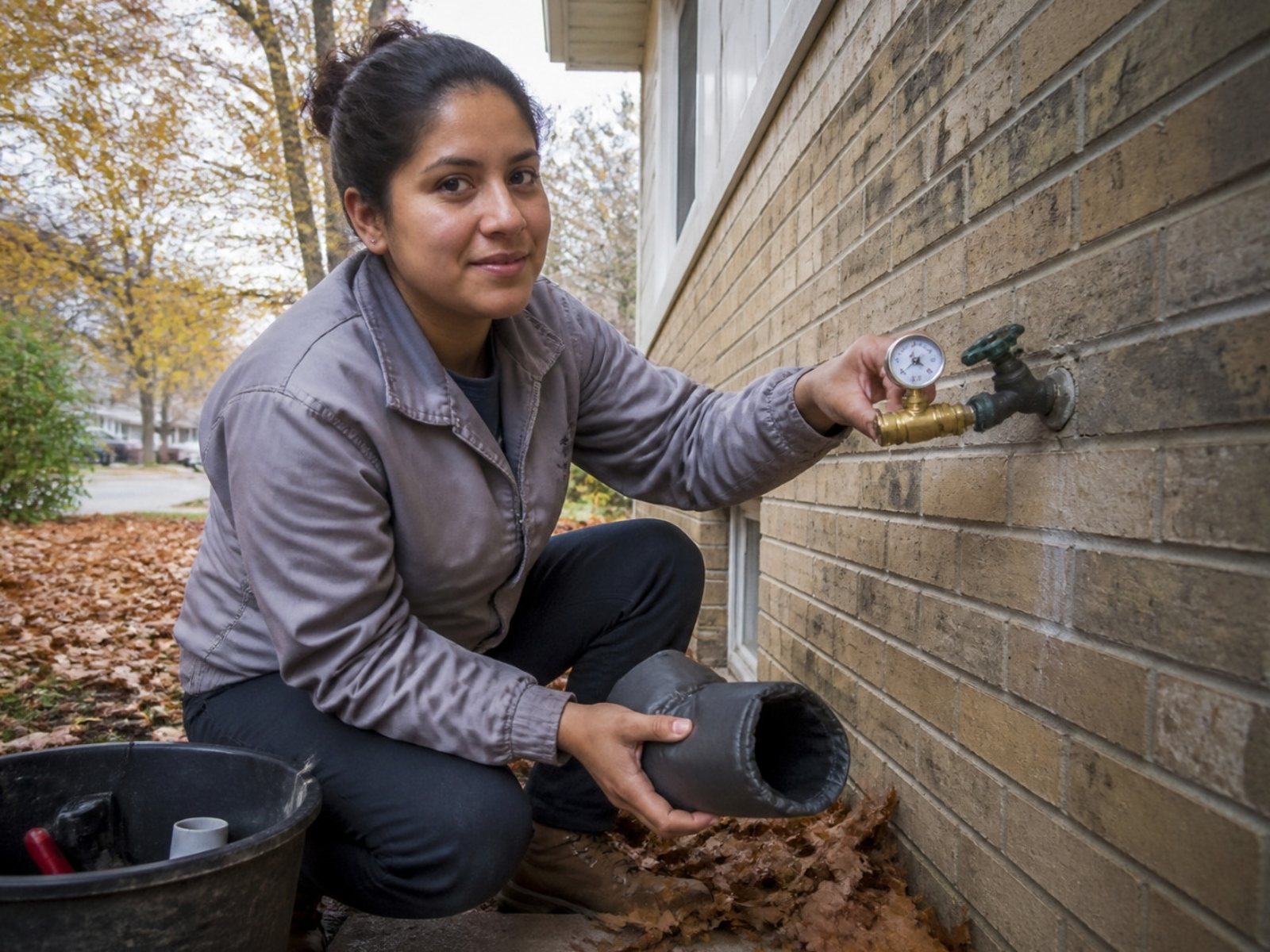
- Check outdoor spigots, and in cold climates, shut off and drain them on the fall visit.
Homes with lawn sprinklers often have a testable backflow assembly. Some places require a yearly test. In Washington, for example, the state plumbing code rules call for testing by a certified tester at install and “at least on an annual schedule thereafter.” If you have certified testers, offer the test as a member add-on at a member price.
Time member visits around the freeze
Nationally, January is when “frozen pipes” searches peak. In Ahrefs’ estimates of US Google searches, “frozen pipes” went from about 1,100 searches in October 2025 to about 38,000 in January 2026. By July it was under 1,000 again.

Those January searches are your no-heat, no-water, burst-line calls. You don’t want 200 member inspections on the board that month. You want them done already.
So in cold climates, we’d push member visits into October and November and sell them as a “winter-ready” check: shut off and drain hose bibs, find the main shutoff, look for pipes in outside walls and crawl spaces. Then use the quiet weeks in spring for the rest.
Michel made the same point from the cost side. He said to price the plan knowing you’ll do the visits “during slow periods when you would not be busy otherwise.” A visit in a dead week costs you far less than one that bumps a paying emergency.
In warm climates without a freeze, pull 12 months of calls and find your two slowest months. Book plan visits there and keep your peak free for repairs.
How to price a plumbing maintenance plan
Price the plan from your own costs, not from a competitor’s website. Their truck, labor and call mix aren’t yours. Start with what a visit costs you in a slow week, then count the discount you’re giving away.
Step by step: an example calculation
These numbers are made up to show the math. Plug in your own.
- Task value. Have your plumbers put a standard price on each checklist task. Michel said the plan price should “remain well under the value assigned by your plumbers,” so the member sees the deal.
- Visit cost. A full checklist in a three-bath house takes closer to two hours than one. At a loaded labor cost of $45 an hour, that’s $90. Add $25 for the truck and drive, and $10 for flappers, aerators and supplies. Total: $125.
- Sales spiff. Michel suggested paying plumbers “a small spiff of $10 to $20” per plan sold. Use $15. Now you’re at $140.
- Plan price. Pick a price that covers that $140 with room left over. In this example we’ll use $199 a year, which leaves $59 after the visit. And that $59 still has to cover any perks you give away.
Now the part that scares owners: the discount. Say a member books one $400 repair a year and gets 15% off. That’s $60 less than a non-member would pay. Add a waived $79 trip fee and that’s $139 in perks, more than the $59 the plan left you. That’s why the next step matters.
Michel’s answer was to flip how you set prices. The member price is your real price, the one that hits your target profit. Everyone else pays more. With a $250 billable rate and a 20% member discount, he worked the standard rate out to $312.50 ($250 divided by 0.8). Build your price book that way and the “discount” is just the gap between two prices you chose on purpose.
Your member price is your real price. Non-members pay 25% more.
So check two things. Does the plan price cover the visit at its slow-week cost? And does your member repair price still hit your margin? Price the waived trip fee into your member rate too, or keep it only in the top tier. If both answers are yes, the plan makes money, and the repairs members book with you instead of the next ad they see are a bonus.
| Line | Example | Your number |
|---|---|---|
| Labor for one visit (2 hours) | $90 | |
| Truck and drive | $25 | |
| Supplies | $10 | |
| Sales spiff | $15 | |
| Visit cost | $140 | |
| Plan price | $199 | |
| Left after the visit | $59 |
Monthly billing makes the price easier to say yes to. $199 a year is about $16.58 a month. Just make sure your card processor and your renewal terms are set up before you offer it.
Good, better, best plumbing membership tiers
Three levels give people a choice that isn’t yes or no. Keep the gap between them clear so the middle one looks like the smart pick. Here’s a layout we’d test. The prices are blanks on purpose: use your own math from the last section.
| What’s included | Basic | Plus | Premier |
|---|---|---|---|
| Inspection visits per year | 1 | 1 | 2 (fall and spring) |
| Water heater flush and anode check | Yes | Yes | Yes |
| Toilet flappers replaced if worn | Parts extra | Included | Included |
| Priority scheduling | Yes | Yes | Front of the line |
| Repair discount | 10% | 15% | 20% |
| Trip or dispatch fee | Normal | Waived | Waived, after hours too |
| Main drain camera look | No | No | Once a year |
| Backflow test (where required) | Member price | Member price | Included |
| Yearly price | $____ | $____ | $____ |
Spell out what the discount covers. We’d apply it to repairs and replacement parts, and use a separate member price for big jobs like a new water heater or a repipe, so nobody expects 20% off a $3,000 install.
A few more notes. Don’t stack too many perks in Basic, or nobody moves up. Put the thing people worry about most (a slow main drain, a 12-year-old water heater) in Premier. And keep the names plain. “Plus” beats a clever name nobody can remember on the phone.
Only want one plan? Launch the middle one first, and add the other two once your plumbers are comfortable offering it on every call without feeling like they’re pushing.
Exclusions that save you from arguments
Plumbing has a few exclusions that come up over and over. Thompson Bros.’ agreement leaves out exterior plumbing, well pumps, frozen pipes and the damage they cause, and polybutylene piping. That’s a sensible list to start from.
Here’s what we’d put in the exclusions section, and why:
- Water damage and mold. You inspect the plumbing. You don’t insure the house. Say so in plain words.
- Frozen pipes and freeze damage. Offer the fall winter-ready check instead, so the member still feels covered.
- Sewer lines past the cleanout, and city-side lines. Root intrusion and collapsed laterals are big jobs. Quote them separately.
- Well pumps, water treatment and appliances, unless you service them and price them in.
- Old pipe materials like polybutylene or galvanized lines at the end of their life. Inspect and note them; don’t promise to keep them alive.
- Code upgrades. If a city or insurer requires a change later, that’s a separate job.
- Work by others. If another company or the homeowner changes the system, you can’t stand behind it.
Read this list out loud to your office manager. If any line would be hard to explain to an angry member on the phone, rewrite it until it isn’t.
Scripts your plumbers can use on a repair call
Most plans get sold by the plumber who just fixed something. These scripts are short enough to say while you write up the invoice, without sounding like a pitch. Have each tech put them in their own words.
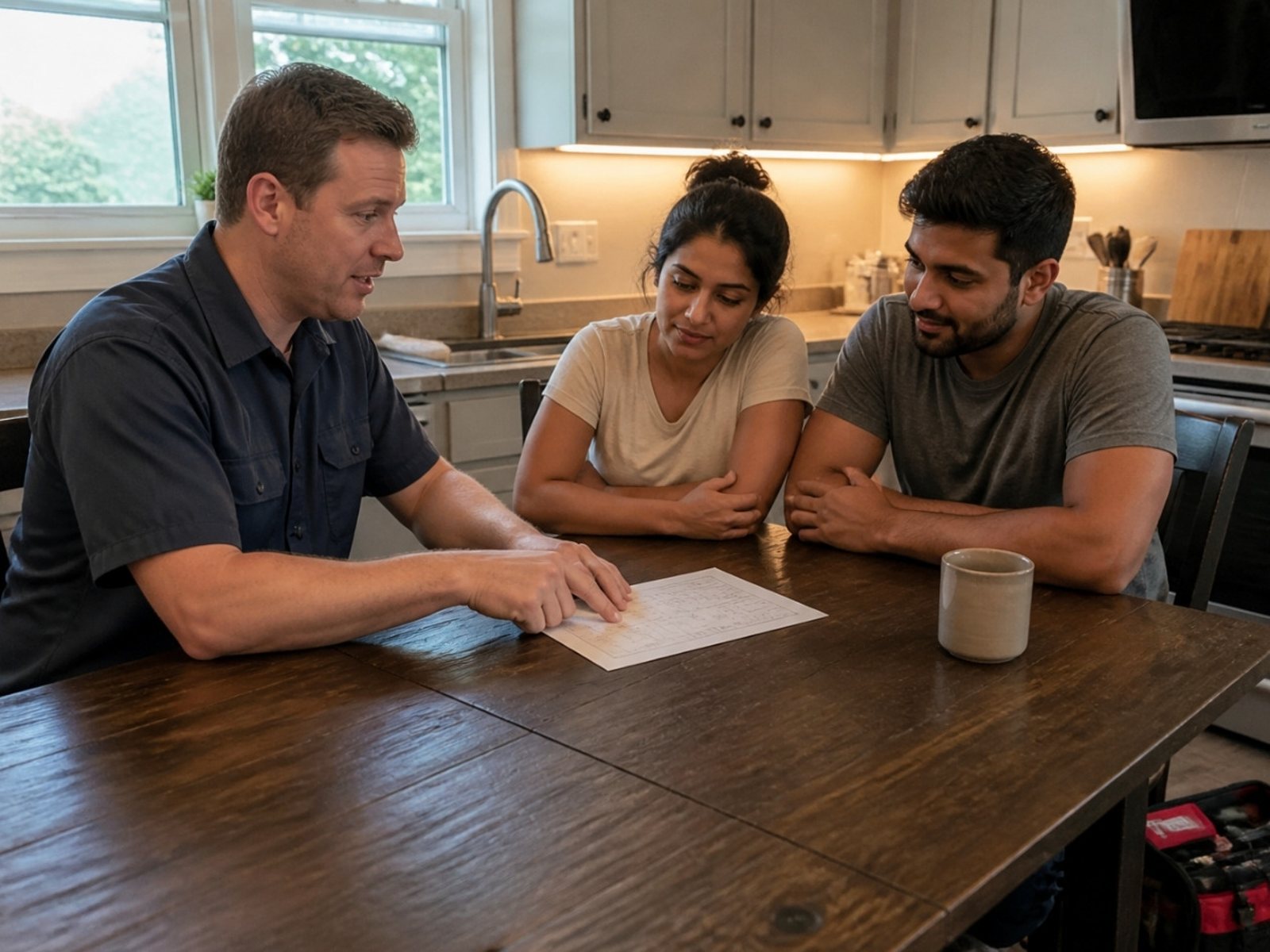
1. When you write up the repair
“Before I write this up, quick question. We have a yearly plan where I come back, flush the water heater, check every toilet and valve, and you get 15% off repairs. If you join today, today’s repair gets member pricing. Want me to show you the price both ways?”
Showing two prices side by side does the selling. Michel called this a three-column invoice: member price, standard price and the savings. Real plans do this, too. Thompson Bros.’ terms say that if the plan is bought at the time of a repair, member pricing applies and that visit counts as the first year’s maintenance check.
2. When you find something they’re not ready to fix
“Your water heater’s 11 years old and the anode is about gone. It’s not leaking, so no rush. If you’re on the plan, I’ll check it every year and you’ll get the member price when it’s time.”
3. The text the next day
“Hi [Name], it’s [Tech] from [Company]. Thanks for having us out yesterday. Here’s the plan I mentioned, if you want it: (your plan page). Today’s repair still gets member pricing if you join this week.”
Only promise that last part if your office can actually apply the credit after the fact.
A rule to know before you sell in the home
The FTC’s Cooling-Off Rule gives buyers three days to cancel certain sales made at their home of $25 or more. It doesn’t cover a repair the homeowner asked you to come do. But the FTC also says “things you buy beyond that repair or maintenance request are covered.”
A plan sold on a repair call can fall in that second group. So the safe move is to give the cancellation notice the rule requires with every plan signed in the home. Ask your attorney to add it to your paperwork, and check your state’s rules, too.
Renewals, auto-renew and the rules to know
Year two is where a plan pays off, because you don’t pay to get that member again. If you don’t have a renewal process, you’ll lose people who would have stayed if anyone had asked.
Here’s the simple version we’d set up:
- Book the visit early. A member who got their inspection renews. One who didn’t, often won’t. Have the office call 60 days before the plan year ends if the visit isn’t done.
- Send the reminder. 30 days out, send a text or email with the renewal date, the price and how to cancel.
- Show what they got. List what you did that year: the flush, the flapper you swapped, the money they saved on that disposal repair.
- Thank them after it renews. Then ask for a review with your Google review link. They just saw what you did for them all year, so it’s a good time to ask.
Auto-renew is easier for everyone, but it comes with rules in some states. California’s automatic renewal law is a good one to study. It bars charging a card on an auto-renew plan unless the customer gave “affirmative consent” to the renewal terms when they signed up. It also requires an annual reminder for yearly auto-renew plans. And if you raise the price, you have to give notice no less than 7 and no more than 30 days before the change.
Not in California? Do it anyway. A member who got a reminder with the price and the cancel steps has little ground to dispute the charge.
Get your plumbing maintenance plan in front of customers
A plan nobody hears about only sells on repair calls. That’s a fine start, but it caps how many members you’ll ever have. Three places to start:
- A plan page on your site. Tiers, what the visit checks, the price and a sign-up button. Link it from your main menu and every service page. Our plumbing website guide shows where it fits.
- Your Google Business Profile. Add the plan as a service and post about the fall winter-ready check in October.
- Every invoice. Print the member price next to the standard price, even when they don’t join.
Homeowners care about their water bill, not your anode rod. The EPA says the average home’s leaks can waste more than 9,300 gallons of water a year, and that fixing easy leaks can save about 10% on water bills. A yearly check that catches the running toilet is easy to explain.
For more ways to keep the board full, see our plumbing marketing ideas.
Plumbing service agreement FAQ
What is a plumbing service agreement?
It’s a yearly plan between a plumbing company and a homeowner. The homeowner pays a set price and gets a scheduled inspection, priority scheduling and member pricing on repairs. It is not a warranty or insurance, so repairs are still billed, just at a lower price. Most plans renew on the anniversary of the start date.
How much should I charge for a plumbing maintenance plan?
Work it out from your own costs. Add up labor, truck time, supplies and any sales spiff for one visit in a slow week. Then set a plan price that covers that visit with room to spare. Treat the repair discount as the gap between your member price and your standard price, not as lost money.
Is a plumbing maintenance plan the same as a home warranty?
No, and you should keep it that way. A maintenance plan sells inspections, priority and a discount. A home warranty promises to pay for or perform repairs caused by wear and tear, and many states regulate those. If you want to add any repair coverage, ask your attorney how your state treats it first.
How often should a plan member get an inspection?
Once a year is the norm for residential plumbing plans, and it lines up with yearly water heater care. A. O. Smith says most tank heaters need flushing at least once a year and the anode rod checked yearly. A top tier can add a second visit, often split between fall and spring.
Can I use this template for commercial customers?
Not as is. It’s written for one home per agreement. Commercial work usually needs a list of each building and its equipment, more visits, backflow test schedules, after-hours rates and insurance terms the client’s property manager will ask for. Use it as a starting outline and have your attorney build a commercial version.
What to do this week
You don’t need new software to start. You need the template, a price and one plumber who will offer it.
- Download the template and fill in your name, license number and service area.
- At your next team meeting, let your plumbers mark up the checklist.
- Run the pricing worksheet with your real labor and truck costs and pick one plan price.
- Send the agreement to your attorney with a note about auto-renewal and in-home sales.
- Add member and standard prices to your invoice, then start offering the plan on every repair call.
Once the plan is live, the next job is getting more homeowners to call you in the first place. That’s what our plumbing marketing and plumber SEO work is for. Want to know where you stand on Google right now? Start with a free audit.


