
Should Your Restoration Company Join a TPA? Run the Math First
What TPA restoration programs charge, what 379 restorers say about them, and the job math that tells you whether to join, wait or skip.
 ChatGPT
 Claude
 Perplexity
 Google AI
 Grok
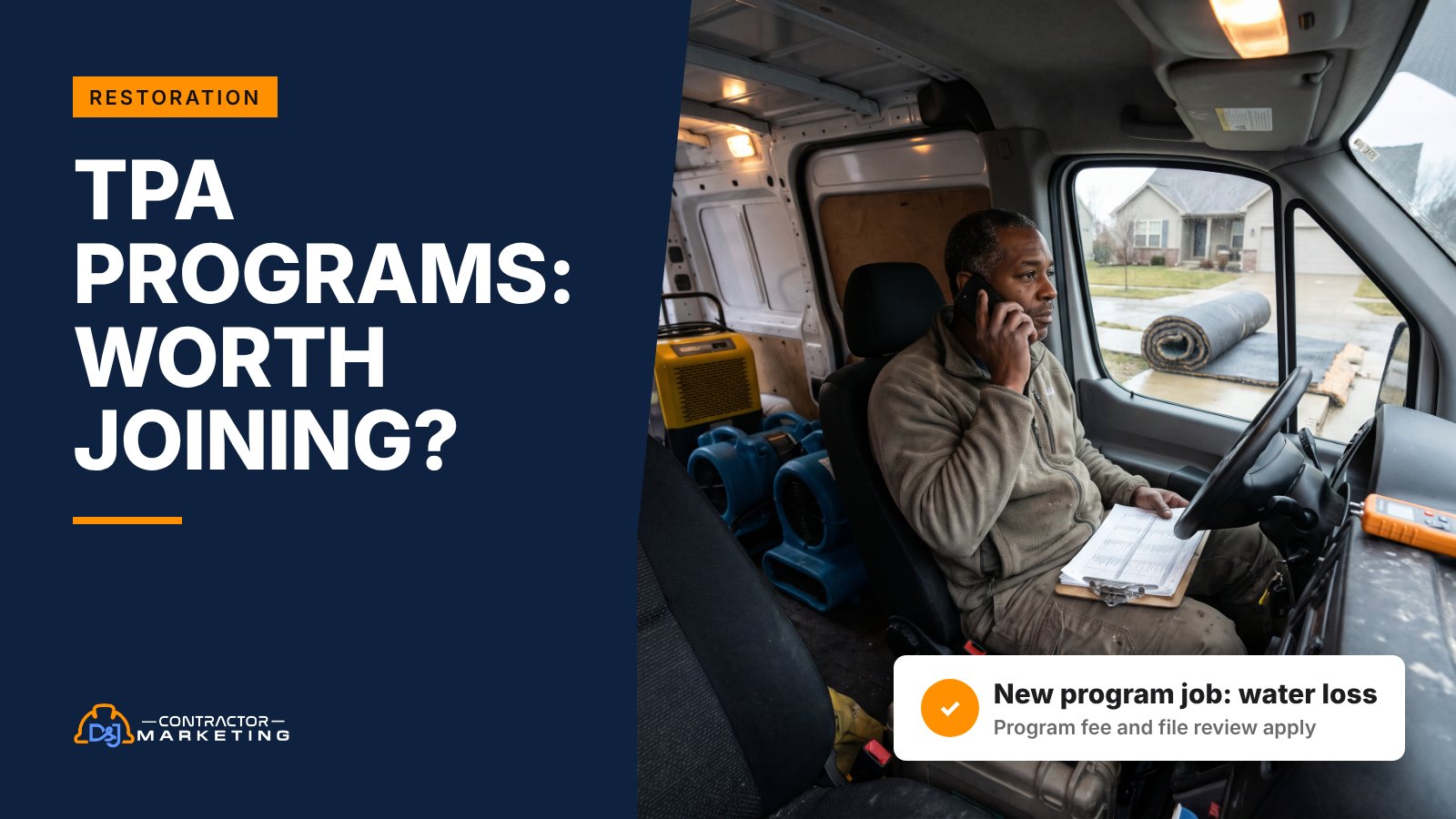
A TPA can fill your trucks in February. It can also take a cut of every job, trim your estimate and make you wait on the money. Whether TPA restoration work is worth it comes down to two numbers: what a program job leaves you after fees, cuts and office time, and what a direct job leaves you after marketing.
The short answer: join a TPA if your crews sit idle part of the year, you can staff the paperwork, and you’ve seen sample approved files, so you have a rough idea how hard reviewers cut. Wait or skip if a direct job already costs you little to land. On an example $8,000 water job, a 10% estimate cut ($800) costs you more than double the 4.5% fee.
Key takeaways
- Accuserve says it charges no sign-up, membership or renewal fees, while an older Contractor Connection schedule listed $250 to apply, 4.5% per job, plus a yearly membership fee of $0 to $5,000 based on program revenue. Program fees
- In our example, a 10% estimate cut left $704 less than a direct job, while the fee alone barely mattered. The job math
- In RIA’s 2025 survey, 379 restoration contractors and industry pros gave TPAs an average of 2.7 out of 5, with claim volume rated lowest at 2.3. RIA scorecard
- Shops with idle crews and someone to run portals are the best fit; brand-new shops should wait, and busy direct shops can probably skip or use one program for overflow zips. Who should join
- California bars insurers from requiring a specific contractor, so your own marketing can still win the job first. Your own marketing
What a TPA does in restoration
A third-party administrator (TPA) sits between the insurance carrier and your crew. It sends you the job. It also grades your estimate, your response time and your paperwork. You don’t buy it like a lead. You sign a contract to write estimates on their price list, by their rules.
Recruiters call it a managed repair program, a preferred vendor program or a contractor network. The deal works about the same way:
- A homeowner reports a loss to their carrier.
- The carrier hands the repair side to a program it works with.
- The program picks a contractor from its network in that zip code.
- You call the homeowner, inspect, write the estimate in the program’s software and do the work under its guidelines.
- The program reviews your file, scores your job and often handles or tracks the payment.
How do they pick you? Sedgwick says its assignments are based on “expertise, location, capacity and performance.” Performance there likely means your scorecard, so ask the recruiter what’s on it. It shapes how many assignments come your way after that.
Contractor Connection, run by Crawford, says on its homepage that it has 5,000 general and specialty contractors and handles 500,000 assignments a year. Networks also change hands. In January 2026, Alacrity announced its managed repair division would become an independent company, Altimeter Solutions Group, after an investment from BV Investment Partners. So if a recruiter from “Altimeter” calls, that’s the network that used to be Alacrity’s managed repair side.
What TPA programs charge restoration contractors
Most networks don’t post a full price list, but a few say plenty on their own pages. Accuserve says it has no sign-up, membership or renewal fees. Westhill charges a small percentage when you finish a job. And an older Contractor Connection schedule spells out every fee for its general contractor, specialty, mitigation and dry cleaning programs. Its consumer program used a different fee structure.
Here’s what each program’s own page or paperwork says, checked on November 24, 2026, next to its overall score from restorers in the RIA’s 2025 survey (out of 5):
| Program | What it says about fees | RIA 2025 score | What to ask |
|---|---|---|---|
| Accuserve | “No sign-up fees. No membership fees. No renewal fees.” (contractor page) | 2.1 | Are there any per-job, software or admin charges? How is program pricing set? |
| Westhill | No charge to enroll or when it sends a job. “When you complete a job, contractors pay a small percentage of the total contract value.” (contractor page) | 2.9 | What is the exact percentage, and is it figured on the original or the final contract? |
| Contractor Connection | Older published schedule: $250 online application ($350 on paper), 4.5% sales fee per job sold, yearly membership fee of $0 to $5,000 based on program revenue (program requirements PDF) | 2.6 | Is this schedule still current? Has the percentage or the cap changed? |
| Sedgwick | No fee schedule on its public network page. It points to a supply program with “preferred pricing” on materials. (network page) | 3.0 | Ask for every fee in writing before you fill out the full application. |
The other networks in RIA’s survey scored like this: ONCORE 3.1, Lionsbridge 3.0, Preferred Repair Network/Hancock 2.9, DCMG 2.8, Eberl 2.7, Alacrity Solutions/Nexxus (its managed repair division announced in January 2026 it would become Altimeter Solutions Group) 2.7, HOMEE 2.6, Brightserv 2.6 and IPN 2.4.
Accuserve, the one with no sign-up or membership fees, scored lowest. It also scored lowest on Value (1.9 against a 2.9 average), and RIA’s Value score counts fees, admin time and warranties together. So ask what you pay in other ways: per-job charges, pricing, admin time.
A word on that Contractor Connection document. Merlin Law Group’s property insurance blog posted it online around May 2022, and the document is older than that. It still tells you to use Internet Explorer. So treat the numbers as a well-documented example of how a big network has charged, not as today’s price. Call the recruiting line and ask.
Here’s how that schedule set its fees:
- Sales fee: 4.5% of each job sold, capped at $4,000 on jobs under $100,000. Bigger jobs had higher caps, up to $11,000 on jobs of $600,000 and up.
- Late fee: the fee invoice was due in 15 days, with $125 a month added if you paid late.
- Membership: $0 if you did under $50,000 in program jobs over the past 12 months, $250 from $50,000, $500 from $100,000, and on up to $5,000 at $4 million or more.
- Fast track: $125 extra to have your finances checked by credit report (you needed a “Low Risk” rating) instead of sending year-end financials, balance sheets or tax forms. It applied to the application only, not yearly renewal.
The PDF also says paying the application fee “does not constitute a guarantee of selection by one of our clients.” You can be approved and still wait for work. The bigger costs are estimate cuts and office hours. Here’s the math.
The math on a program job vs a direct job
Here’s one water job run both ways.
Example calculation with round numbers. Swap in your own. Say you’re a water mitigation shop and a burst supply line floods a kitchen and hallway. You’d bill $8,000 for it. Your labor, equipment and materials cost $4,000 either way.
- Direct job. The homeowner found you on Google. Say your ads and marketing cost $600 for each job you sign. No program fee. The carrier’s adjuster still reviews your estimate, so we’ll also show a version where the carrier trims it 5%.
- Program job, estimate approved as written. A 4.5% fee on $8,000 is $360. Your office spends six extra hours on portal uploads, photo sets and review notes, on top of what a normal insurance file takes. We count only that extra time. At $30 an hour for office pay, that’s $180.
- Program job, estimate cut 10%. The reviewer trims the file to $7,200. If the fee is figured on the final approved amount (the schedule doesn’t say, so ask), 4.5% drops to $324. The six office hours don’t drop at all.
| Example $8,000 water job | Direct | Direct, carrier trims 5% | Program, no cut | Program, 10% cut |
|---|---|---|---|---|
| Amount paid | $8,000 | $7,600 | $8,000 | $7,200 |
| Labor, equipment, materials | $4,000 | $4,000 | $4,000 | $4,000 |
| Cost to get the job | $600 marketing | $600 marketing | $360 fee | $324 fee |
| Extra office time | $0 | $0 | $180 | $180 |
| What you keep | $3,400 | $3,000 | $3,460 | $2,696 |

The program job with no cut beats the direct job by $60. The 10% program cut drops you $704 below a fully paid direct job, and $304 below a direct job the carrier trimmed 5%. Every dollar cut comes straight out of the part you keep, because your cost to dry that kitchen didn’t shrink.
Now flip it. If your direct marketing costs $1,400 per signed job instead of $600, the direct job keeps $2,600 and even the trimmed program job wins.
So skip “is 4.5% too much?” and ask two things: what does a direct job cost me to land, and how often do program reviews cut my files? Compare program cuts to the cuts carriers make on your direct files. The difference between those two cut rates is what program work really costs you.
Your cut rate is simple: total approved divided by total submitted, across the same files. If you don’t track it on program and direct files, start with your last 20 of each.
Two more costs don’t fit neatly in a table. Payment timing is one: if program money lands two weeks after your direct insurance checks, you carry payroll two weeks longer on every program file. Track days-to-paid for both. The other is the job you couldn’t take. A crew tied up on a trimmed program file can’t run the $12,000 direct call that came in the same afternoon.
A file that gets approved as written is worth more than a lower program fee.
What restorers say after they join
Restorers who work programs rate them below the middle of the scale. In the Restoration Industry Association’s 2025 TPA Scorecard, 379 restoration contractors and industry pros rated the TPAs they’d worked with in the past 12 months. The average across 13 programs was 2.7 out of 5 stars.
ONCORE scored highest at 3.1, and Accuserve (formerly CodeBlue) scored lowest at 2.1. The average was 2.5 in RIA’s first survey in 2020, rose to 2.7 in 2022 and is still 2.7 in 2025. Credentialing slipped from 3.2 in 2022 to 3.0.
RIA also asked how much each part of the deal matters, on a 5-point scale, then put that next to how TPAs scored:
| Part of the deal | How much it matters | Average TPA score |
|---|---|---|
| Claims process (efficiency, fairness, competence) | 4.4 | 2.7 |
| Contractor support (grievance process, standing up for you with the carrier) | 4.2 | 2.5 |
| Claim volume meeting expectations | 4.2 | 2.3 |
| Value (return on time and money) | 4.2 | 2.9 |
| Guidelines (how easy they are to work within) | 4.1 | 2.8 |
| Credentialing | 3.9 | 3.0 |
| Geographic coverage of your service area | 3.8 | 2.8 |
| Clarity of the scoring system | 3.8 | 2.8 |
Claim volume, which restorers rated among the most important parts of the deal (4.2 of 5), scored lowest of any category at 2.3. Credentialing, the approval and paperwork side, scored best at 3.0. TPAs are better at approving you than at sending you work.
If volume is why you’re joining, the programs that scored best on claim volume were ONCORE, Alacrity and Contractor Connection (2.7 each) and Sedgwick (2.6). HOMEE scored lowest at 1.8.
Sample sizes vary a lot, too. Contractor Connection, Sedgwick and Alacrity each drew 250 or more ratings, while ONCORE drew 46 and Eberl 22, so treat small-program scores as rougher.
When RIA asked what TPAs should fix, the top answers across all programs were:
- Be a better advocate for the contractor with carriers (32%)
- Pricing that matches current market value (30%)
- Payment of overhead and profit (27%)
- More flexible guidelines for unusual jobs (27%)
- More field experience for the people reviewing estimates (26%)
- A better partnership between contractor and TPA (26%)
The top ask, at 32%, was a TPA that backs you when the carrier pushes back. Most of the rest are about money and review: pricing, overhead and profit, and reviewer experience. Those are the same lines that shrank the program job in the table.
RIA’s own guide to using the scorecard calls TPAs “a double-edged sword”: a steady stream of assignments that’s “especially attractive during slow periods,” along with “complex requirements, strict metrics, delayed payments, and limited job profitability.” RIA members get the full report free. Non-members can buy it for $49.99.
Should your restoration company join a TPA?
Three things decide it: how full your trucks are, what a direct job costs you to land, and whether someone in your office can own the portals.
| Your shop | Our call | Why |
|---|---|---|
| Under a year old, no commercial space yet | Wait | The older Contractor Connection schedule asked for a year under current ownership and expected a commercially zoned location, with exceptions in special cases. Build reviews and direct calls first. |
| One to three years in, crews idle in slow months | Join one program | RIA notes program work is “especially attractive during slow periods,” even while calling TPAs a double-edged sword. Keep it to one program until you know your numbers. |
| Strong direct work, busy most of the year | Probably skip, or pick one for overflow zips | If a direct job already costs you little to land, program cuts and admin hours eat the gain. |
| Over half your revenue from programs | Stay, but build direct work now | One scoring change or a crowded zip code can drop your volume. You want a second leg to stand on. |
| Big rebuild department | Look closely at the per-job fee caps | On the older Contractor Connection schedule, 4.5% of a $250,000 fire rebuild is $11,250, but the cap at that size was $8,000. Ask how caps work today. |
| Cut back or dropped by a program | Ask why, in writing, then build direct | Ask which score or zip change caused it and what gets you back. Meanwhile, start the direct sources below so the next change hurts less. |
| Franchise owner | Ask your franchisor first | Before you apply anywhere, ask your franchisor: Does it already send program work in my territory? Can I join outside networks too? Who owns the customer if a job comes through both? |
| No one to run portals and photo uploads | Wait | Late uploads can hurt your score, and networks like Sedgwick say performance is one of the things that decides your assignments. Hire or train that person first. |
We’ve worked with more than 30 SERVPRO franchises, and the first planning question we’d ask is what happens to payroll if program jobs become most of the schedule and a score dip or a new shop in your zip codes cuts the flow.
If you’re not sure which row you’re in, pull your last 12 months of jobs. Mark which came from a program, which came direct, and what each one netted. That one spreadsheet answers most of this table for you.
How to become a preferred vendor in a TPA network
Getting into a network means proving you’re insured, licensed and able to do the work. Some of it, like commercial space, an IICRC Certified Firm certificate and clean year-end financials (up to three years’ worth), can take months to line up. The older Contractor Connection requirements are a good preview of what big programs ask for. Current rules can differ, so treat this as a prep list and get each program’s real list before you apply.

Before you apply, that schedule asked for:
- At least one year in business under current ownership
- Year-end financials: the last three years if you’d been open three years or more, or every year including the partial start-up year if you were newer. Or a $125 credit-report “fast track” at application only. If the credit check didn’t come back “Low Risk,” you sent the full financials anyway. New financials were due every year at recertification.
- Every license your state requires, in your company’s DBA name
- EPA lead-safe (RRP) certification and an IICRC Certified Firm certificate
- Photos of your building with signage, your office, your trucks with signage and your equipment
- A business location zoned commercial or industrial (absent special circumstances), plus uniforms and marked vehicles
- A separate application for each facility that handles assignments
Once a carrier picks you for a program, the list got longer. The PDF says the insurance and software rules “do not have to be met until selected for a program by a client,” so you don’t have to buy it all up front:
- $1 million in general liability and $1 million in auto coverage
- Workers’ comp “regardless of individual State laws”
- $1 million contractors pollution liability if you do water mitigation (with mold and bacteria named in the wording), or $1 million excess liability if you’re GC only
- $250,000 bailment coverage if you clean contents
- Crawford and its carrier clients named as additional insureds
- Xactimate, with an XactNet address for each facility (budget for the license if you don’t have it)
- Background checks on owners and every employee who goes into customers’ homes, before activation and every three years after
- Subrogation awareness training within 90 days of being selected
That program also didn’t let you subcontract water mitigation “under any circumstances.” If you farm out drying today, you’d have to bring it in-house first.
Westhill’s qualification list adds a few more: extended workmanship warranties, professional affiliations and a “strong online reputation & reviews.” Westhill lists reviews as a qualification, so expect a recruiter to look at your Google profile. If your Google profile shows a handful of reviews, an old address and hours nobody keeps, fix that before you apply. Our guide to getting more Google reviews covers the fastest honest way to do it.
If you’re still new, our page on starting a restoration company walks through the certifications in order, since the Contractor Connection list above wanted IICRC and RRP up front.
Questions to ask a TPA before you sign
The RIA complaint list is also your question list. Ask every one of these before you sign, and get the answers in an email or in the agreement. A recruiter’s “don’t worry about that” on the phone won’t help you in month six.
Copy these into your notes for the call:
- “What are all the fees, in dollars or percent?” Application, membership, per job, software, late fees. Ask if the percentage comes off the first estimate or the final paid amount.
- “Whose price list do you use, and how often is it updated?” Pricing came up in 30% of the responses in RIA’s survey. Ask for a sample approved estimate for a job like your typical one.
- “Do you pay overhead and profit, and when?” It came up in 27% of responses. Get the rule in writing.
- “What share of files get cut in review, and by how much?” If they won’t give a number, ask for three sample files with the reviewer’s notes.
- “How many contractors do you already have in my zip codes?” Restorers asked programs to limit crowding by zip code. More shops in your area means fewer jobs for each.
- “Can I turn down estimate-only assignments?” It came up in 14% of responses. Estimate-only work takes office time and may never turn into a paid job.
- “How is my score figured, and what drops my volume?” Ask for the score sheet. Ask whether response time, upload deadlines and customer surveys are on it, and how much each counts.
- “Who pays me, and how long does it take?” Ask whether checks go through the program, the carrier or the homeowner, and what happens when the carrier pays less than your invoice.
- “What warranty do I owe, and for how long?” Contractor Connection’s homepage talks up a five-year workmanship warranty. Find out how much of any warranty like that sits on you.
- “Does the fee apply to supplements, and to mitigation and rebuild separately?” One claim can carry several invoices. Know which ones the percentage hits.
- “Can I join other networks, and is anything exclusive?” Ask about exclusivity and non-solicit language before you sign, not after.
- “Who collects the deductible?” And what happens when the homeowner doesn’t pay it.
- “How long do approval and the first assignment usually take in my zip codes?” Plan cash flow around their answer, not your hopes.
- “If I leave, what happens to open jobs and warranties?” Ask before you sign, so you know how long warranty callbacks stay on you after you leave.
Then hand the agreement to your attorney and your insurance agent. Your attorney reads the contract terms. Your agent checks whether your current policy matches the coverage and wording the program requires. An hour with each costs less than finding out your pollution coverage wording doesn’t match after a sewage job goes wrong.
Why your own marketing still matters
Program jobs mostly start with the homeowner calling the carrier. And in California, at least, the carrier can’t require them to use its pick.
In California, it’s in the regulations. Under 10 CCR 2695.9, “No insurer shall require that the insured have the property repaired by a specific individual or entity.” An insurer can only suggest a contractor if the homeowner asks, or after telling them in writing that they have the right to pick their own.
If the homeowner takes the insurer’s pick, the insurer has to make sure the repair is done right at no extra cost beyond the policy. That promise, that the carrier will see the repair done right, is what your marketing has to beat. Other states have their own rules, so check yours with an attorney or your state insurance department before you lean on this in your marketing.
Some homeowners standing in an inch of water search Google before they ever call their agent. If your shop shows up first, with good reviews and a phone that gets answered, those calls can come straight to you. No program fee and no program reviewer. The carrier’s adjuster can still adjust your estimate, so keep your files tight.
The direct sources we’d build next to any program:
- A Google Business Profile set up for water, fire and mold, with real photos and steady reviews. This is the core of restoration SEO.
- Local Services Ads, where you pay per lead and can show at the top of Google search.
- Plumbers, property managers and insurance agents who send you calls. Ask each one what they need from you after a job.
- A phone that gets picked up at 2 a.m., whether that’s your own on-call tech or an answering service built for restoration.
We’ve laid out how each source compares on cost in our breakdown of where water damage leads come from. Program volume can drop when your score dips or the network adds shops in your zip codes. Direct calls depend on things you can work on: your reviews, your profile and how fast you answer.
How to join without letting a program run your schedule
If you join, set your own rules before the first assignment shows up.
Step 1 (month 1): Start with one program
Each network has its own portal, photo rules and deadlines. Learn one well before you add a second. Ask the recruiter how new contractors are scored and whether early files count more.
Step 2 (month 1): Give it its own line in your books
Tag every program job in your CRM or job software. Each month, total what you billed, what got cut in review, the fees, the office hours and how long the money took. That’s the “program ROI” RIA tells restorers to measure.
Step 3 (month 2): Pick a ceiling and write it down
Decide how much of your revenue you’ll let one program carry. We won’t give you a percentage. Pick the share you could lose without missing payroll. If that program cut your zip codes tomorrow, how many months could you cover? Your ceiling should leave room for that answer.
Step 4 (month 2): Grow one direct source at the same time
The same quarter you join, start one direct source. For most shops we’d pick Local Services Ads or review requests on every job. Program money can pay for it.
Step 5 (month 3 and every quarter after): Review it
Compare what a program job kept you against what a direct job kept you, using the same math as the table above. If program jobs keep less and your direct work is growing, start turning down the weakest assignments. Before you do, ask the program in writing how a declined job counts on your score, since you don’t want one “no” to cost you the next ten jobs. If program jobs keep more, hire or add a truck before you add a second program.
What to do this week
Here’s a short list you can finish by Friday:
- Pull your last 12 months of jobs and tag each one program or direct.
- Work out what a direct job cost you to land: total marketing spend divided by direct jobs signed.
- If you already work programs, add up the estimate cuts on your last 20 program files.
- Put both numbers into the example table above, swapping in your own.
- If you’re applying, ask local agents and adjusters which programs their carriers use, then call that network’s recruiting line with the questions list open.
If your direct jobs cost more to land than a program fee plus cuts, the fix is lowering that cost. That’s what our restoration marketing work is built for: water, fire and mold calls that come to you first. Start with a free audit to see where your shop shows up today.
FAQ: TPA restoration programs
What does TPA mean in restoration?
TPA stands for third-party administrator. In restoration, it’s a company that handles the repair side of insurance claims for carriers. It keeps a network of approved contractors, sends them jobs, reviews their estimates and scores their work. You’ll also hear it called a managed repair program or a preferred vendor program.
How much do TPA programs charge restoration contractors?
It depends on the program. Accuserve says it has no sign-up, membership or renewal fees. Westhill charges a small percentage of the contract on jobs you complete. An older Contractor Connection schedule listed a $250 online application fee, 4.5% of each job sold and a yearly membership fee of $0 to $5,000. Ask each program for its current fees in writing.
How do I become a preferred vendor for insurance companies?
When a carrier uses a TPA or managed repair network, you apply to the network. Some carriers may run their own vendor list, so ask the carrier’s claims office whether it has one in your area. Have your licenses, certificates of insurance, IICRC and RRP certifications, financials and facility photos ready. Once a carrier selects you, expect background checks and Xactimate. Approval doesn’t promise jobs. Carriers pick contractors from the network as they need them in each area.
Can an insurance company make a homeowner use its preferred contractor?
In California, no. State rules say no insurer shall require the insured to have the property repaired by a specific person or company. An insurer can only suggest one if the homeowner asks, or after telling them in writing they can choose. Rules differ in other states, so check yours with an attorney.
How many TPA programs should a restoration company join?
Start with one. Each program has its own portal, photo rules and score sheet, and your score can affect how much work you get, so ask how new contractors are scored. Track that program’s jobs on their own line for a few months. Add a second only if the first one pays and your office can handle another set of deadlines.
Do TPA jobs pay overhead and profit?
It depends on the program and the carrier’s guidelines, and it’s one of the top complaints. In RIA’s 2025 TPA survey, payment of overhead and profit came up in 27% of the responses when restorers picked what each program should fix. Ask each program for its overhead and profit rule in writing before you sign, and check it against a sample approved estimate.

Written by Dory Aine, co-founder of D&J Contractor Marketing