
Masonry and Concrete SEO That Books Estimates
Masonry SEO built on real US search data: the concrete, brick and hardscape pages to build first, when each one peaks, and how we count booked estimates.
5.0on Google- Google Partner
- Meta Business Partner
Masonry SEO means two things: getting your Google profile into the map box when people search “concrete contractors near me” (about 23,000 US searches a month), and giving every job you want more of its own page. Most of those job searches, like “concrete driveway” or “tuckpointing,” score under 10 out of 100 on Ahrefs’ difficulty scale.
Homeowners search when the driveway cracks, the chimney leaks or the patio plan finally gets a budget.
The short version: set up your Google profile for the work that pays best, collect reviews that name the job, and build pages for your driveway, patio and repair work in your buyers’ words. Get them live before spring, since flatwork searches peak in May. Don’t count on Local Services Ads, since Google’s US list has no masonry or concrete category. Answer every call, and count booked estimates, not clicks.
Key takeaways
- Most service searches like “concrete driveway” (12,000 a month) and “concrete leveling” (17,000) score under 10 for difficulty. What homeowners search
- “Tuckpointing” gets about six times the searches of “repointing,” so write in your buyers’ words. The words buyers use
- Stamped concrete searches climb from about 9,900 in December to 33,900 in May, while “chimney repair near me” peaks in October. The year in searches
- Treat flatwork, masonry and hardscape as three businesses online, with pages for each, but keep one Google profile. Three businesses
- Google’s US Local Services Ads list has no masonry or concrete category, so for most shops, search ads and SEO do the work. What we do
- Build your best-paying job page first, then your showpiece, one repair page and a cost page. Pages to build first
- Rename, caption and place project photos next to the job text, the way Google’s image guide recommends. Project photos
- We count booked estimates and sold jobs by source, not clicks. How we measure
What homeowners type when they need masonry or concrete work
Most homeowners search for the job, not the trade: a driveway, a stamped patio, a crumbling chimney, a sinking slab.
We pulled these from Ahrefs Keywords Explorer for the US on November 23, 2026. Volume is average searches a month. KD is Ahrefs’ keyword difficulty, from 0 (easy) to 100 (very hard). CPC is Ahrefs’ estimate of what one ad click costs.
| Search | What they want | Searches a month | KD | Est. CPC |
|---|---|---|---|---|
| concrete contractors near me | A company nearby | 23,000 | 28 | $3 |
| stamped concrete | Ideas, a price or a crew | 22,000 | 13 | $1.60 |
| concrete leveling | A sunken slab lifted | 17,000 | 3 | $5 |
| concrete patio | A new patio | 13,000 | 5 | $3 |
| concrete driveway | A new or replaced driveway | 12,000 | 0 | $3 |
| paver patio | A paver patio | 12,000 | 7 | $1.50 |
| chimney repair | A repair | 10,000 | 32 | $4.50 |
| chimney repair near me | A repair nearby | 9,300 | 48 | $4 |
| concrete repair near me | A repair nearby | 8,400 | 0 | $4.50 |
| hardscaping near me | A hardscape company | 7,600 | 0 | $4 |
| masonry contractors near me | A mason nearby | 4,900 | 0 | $3 |
| masonry near me | A mason nearby | 3,800 | 33 | $3.50 |
| concrete driveway cost | A price | 4,600 | 12 | $2.50 |
| tuckpointing | Mortar repair, or what the word means | 3,700 | 0 | $3 |
| mudjacking | A sunken slab lifted | 2,800 | 3 | $5 |
| retaining wall cost | A price | 2,200 | 3 | $2 |
| retaining wall contractors near me | A wall builder nearby | 2,200 | 0 | $4 |
| cement contractors near me | A concrete company (wrong word, same job) | 1,500 | 30 | $3 |
| chimney crown repair | A repair | 1,400 | 0 | $1.60 |
| brick repair near me | A repair nearby | 1,000 | 0 | $4 |
| repointing | Mortar repair | 600 | 5 | $3 |
Most of these score under 10 for difficulty. The hardest is “chimney repair near me” at 48. Keep in mind KD is a national score. Ahrefs counts how many websites link to the top 10 pages. In your town, the map box and your reviews matter more, so search the job yourself and see who shows up. CPC is a rough national guess too. Check Google’s Keyword Planner for your own area before you set an ad budget.
Now look at the words. “Tuckpointing” gets about six times the searches of “repointing.” And 1,500 people a month type “cement contractors near me.” Your page should use the words your buyers use, even when a mason would say it differently. Put “tuckpointing (also called repointing)” on the page and you catch both.
Cost searches are big too. “Concrete driveway cost” gets 4,600 a month and “concrete slab cost” gets 4,700. People shopping on price will land on someone’s cost page. Build one.
The masonry and concrete year in searches
Searches start climbing in February, months before the busy season. Patio and stamped concrete searches more than triple from December to May. Searches for “chimney repair near me” run the other way and peak in October.
These are Ahrefs’ monthly US search counts from November 2025 to October 2026, lowest month against highest:

Here’s how we plan around it:
- Get flatwork pages live by February. Stamped concrete searches climb from about 15,900 in February to 33,900 in May. A new page needs time to get found, so build it in winter, not when the phone is already ringing.
- Push chimney and repair work in late summer. “Chimney repair near me” goes from about 7,300 in February to 12,700 in October. If you do both brick and flatwork, chimney pages can keep crews busy as patio season fades.
- Treat leveling as year-round. “Concrete leveling” never drops below about 11,300 a month. If you lift slabs, that page earns calls in every season.
One surprise: “concrete contractors near me” peaked in October 2026 at about 27,200, not in May. So keep your profile and reviews working in the fall, and book fall quotes for spring pours.
Flatwork, masonry and hardscape are three businesses online
A flatwork crew, a brick and stone shop and a paver outfit all get called “masonry.” But they sell different jobs to different buyers. Online, treat them as three businesses, even if you do all three.
| Flatwork | Masonry | Hardscape | |
|---|---|---|---|
| Typical jobs | Driveways, patios, sidewalks, slabs, stamped concrete, leveling | Brick and block, stone veneer, tuckpointing, chimneys, steps | Paver patios, walkways, retaining walls, fire pits |
| Buyer’s trigger | Cracked or sunken concrete, a new build, a backyard plan | Crumbling mortar, a leaking chimney, an inspection report | A backyard project, a slope that’s washing out |
| Big searches | concrete driveway, stamped concrete, concrete leveling | chimney repair, tuckpointing, brick repair near me | paver patio, hardscaping near me, retaining wall cost |
| Peak search month | May | October for chimney repair, August for tuckpointing | May for paver patios, April for retaining walls |
In regular search results, Google ranks pages. A homepage that lists every job is a weak match for any one of them. One page per job type gives Google a clear match for each search.
Your Google Business Profile is different. Google’s guidelines say to “choose the fewest number of categories it takes to describe your overall core business.” So pick your primary category for the work that makes you the most money. Then add a few secondary ones for the rest. Don’t add a category for something you did once.
Got a stone yard or a showroom? If customers come there, Google lets you set up a hybrid profile that shows the address and a service area. Without permanent signage, though, Google says it should be a service-area business. If you work out of a shop customers never visit, you’re a service-area business and you take the address off the profile. Either way, Google wants one profile per business, not one for concrete and another for masonry.
Only do pavers and walls? Read this page for the hardscape pieces, then see our landscaping SEO page.
What our masonry and concrete SEO service covers
Here’s what we set up and run for masonry, concrete and hardscape companies, and how each piece works for this trade.
 Google Business Profile and reviews
The profile is what gets you into the map box for “concrete contractors near me” and “masonry near me.” We set the right primary category, list your services in plain words (“stamped concrete patios,” “chimney crown repair”), and set service areas around the towns you want. Google allows up to 20 service areas, and the whole area shouldn’t be more than about 2 hours of driving from your base.
Then reviews. A review that says “they replaced our cracked driveway in two days” helps more than “great job.” We set up a simple ask after the final walkthrough and a link that goes straight to your review form. More on that in our guide to getting more Google reviews.
 Website and service pages
One page per job you want more of, each with real project photos, what affects the price, how long it takes and what happens on the day. We write them in your buyers’ words, so the tuckpointing page also says “repointing” and “mortar repair.” The next section covers which pages to build first.
 Local Services Ads and Google Ads
Google’s US list of Local Services Ads categories has no masonry or concrete category. We checked the full list on November 23, 2026. It has roofers, fencing, foundations services, landscaping services and general contractors, but nothing for masons, flatwork or chimney repair.
Some shops may fit under one of those categories. Google decides that when you apply. For most, though, paid calls come from regular Google Ads search campaigns. We build those around the jobs you want, with separate ad groups for driveways and for repairs, and we keep them off searches like “how to mix mortar.” Our page on Google Ads management for contractors explains how we run them.
 Answering and booking
Your crew is on a pour or up on a chimney when the phone rings. A missed call on a driveway job goes to the next name in the map. Restoral, our AI system, answers calls and chats and books the estimate right onto your calendar. It works with Google Calendar, Jobber and most trade CRMs.
 Call tracking and reporting
Every call and form gets tagged by source: map listing, website page, ad. Each month you see how many estimates came from each, which jobs they were for and what you spent to get them. If a page isn’t bringing in estimates, we change it.
The service pages to build first
Start with the jobs that pay best and the searches that are easiest to win. For most shops that’s the driveway page, the patio page and one repair page. Here’s the order we usually go in:
- Your best-paying job. For flatwork that’s usually driveways (“concrete driveway,” 12,000 a month, KD 0). For brick shops, chimney work or tuckpointing. For hardscapers, paver patios.
- Your showpiece job. Stamped concrete patios (“stamped concrete patio” gets 11,000 a month at KD 4, a narrower search than “stamped concrete”) or stone veneer. These are the jobs people pick from photos.
- One repair page. Concrete leveling, crack repair, chimney crown repair or brick repair. Repair buyers usually have a problem now, like a trip hazard or a leaking chimney.
- A cost page. Ranges, what moves the price (size, thickness, finish, demo, access) and a link to book an estimate.
- Project pages. One short page per finished job worth showing: town, what was there, what you did, photos.
What goes on each page? Here’s an example we designed for a made-up company, Your Masonry Co. It’s a stamped concrete patio page, on a laptop and a phone.
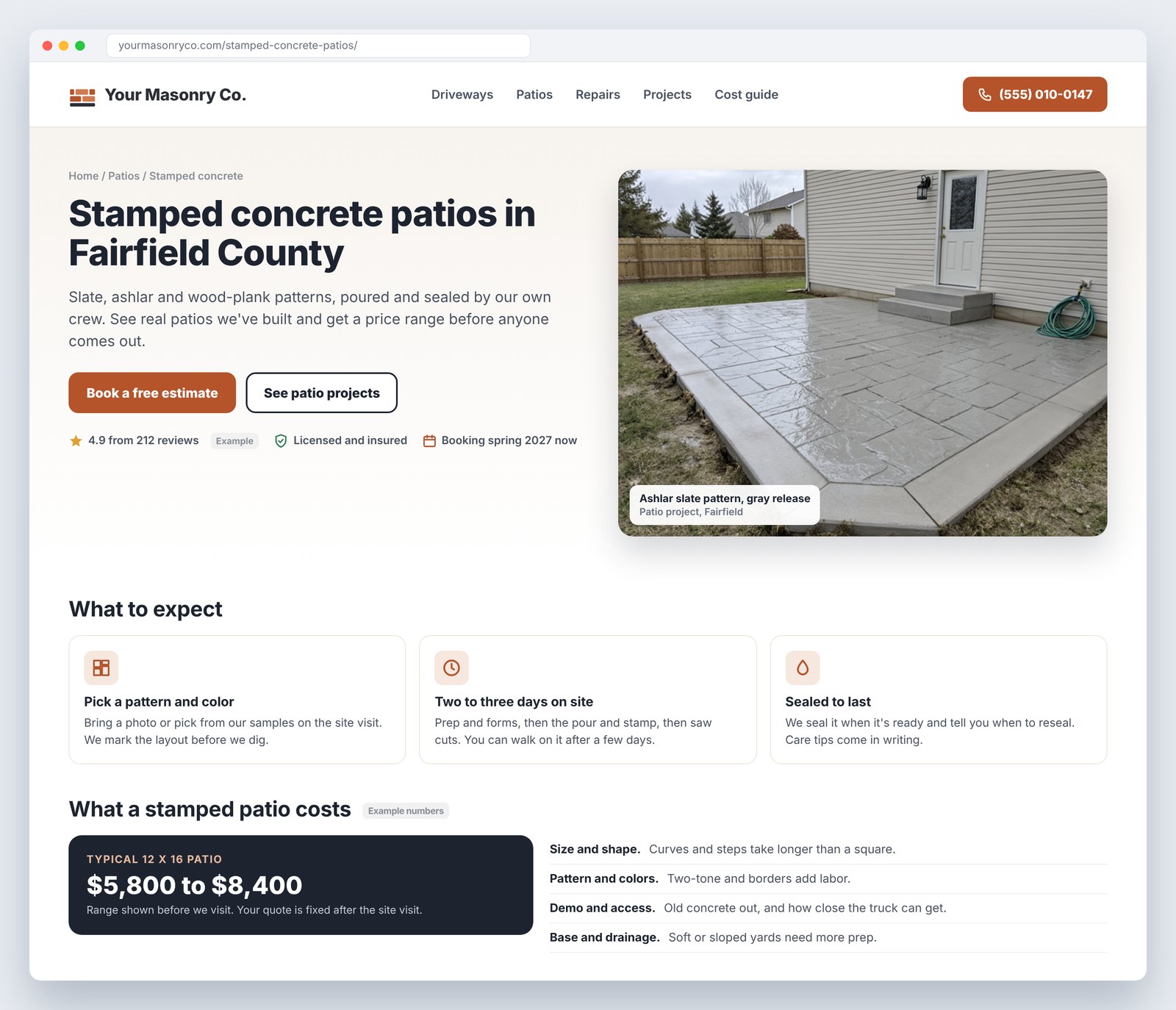
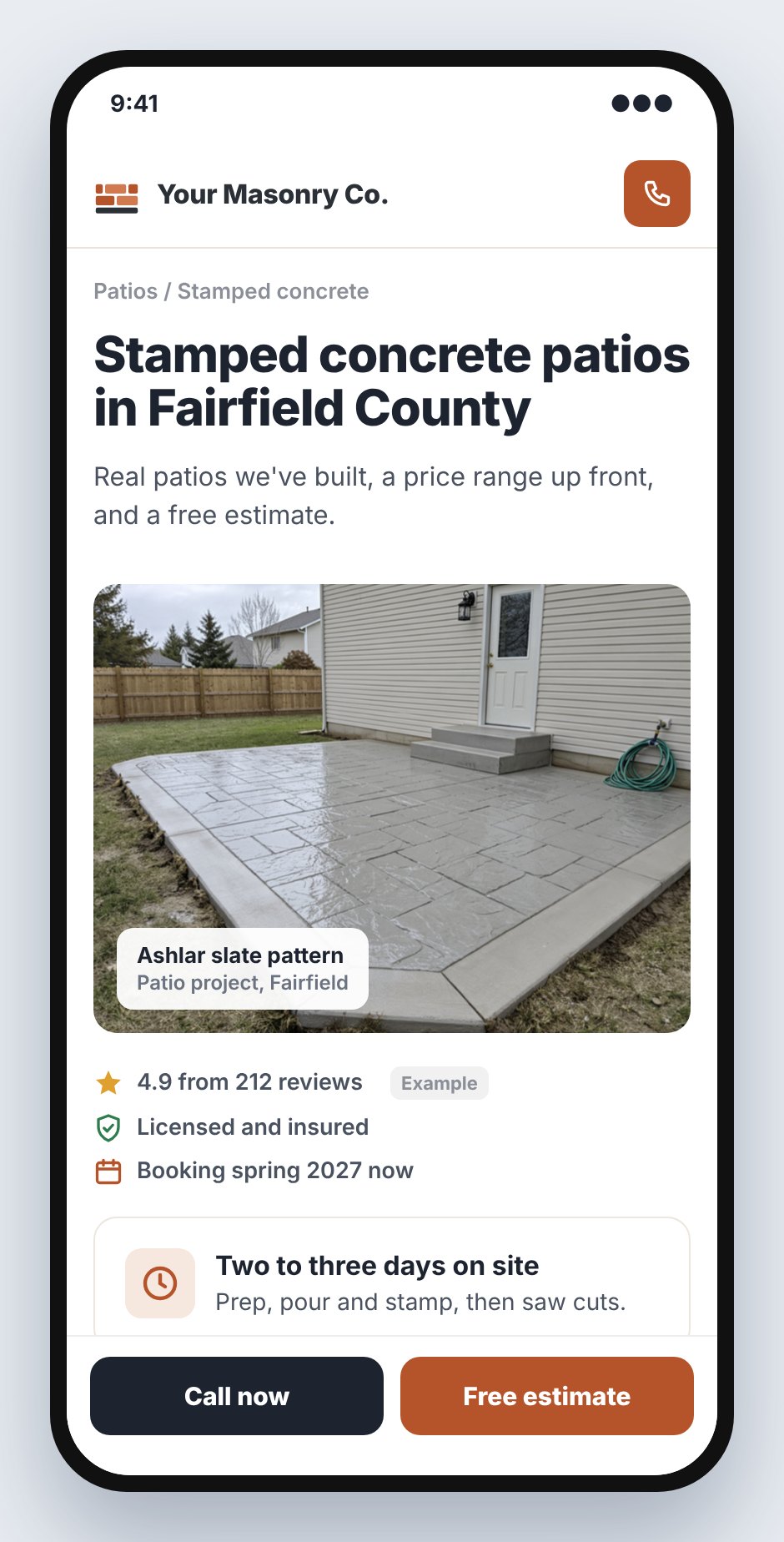
A few things to copy from it. The headline names the job and the area. A call button and an estimate button sit at the top. The page has to work on both screens: Ahrefs puts about 57% of “stamped concrete” searches and 66% of “chimney repair near me” searches on phones. Plenty of people still plan a patio from a laptop.
Real project photos come before the long text. The price section gives a range and explains what changes it. And the page answers the questions you get on every estimate visit: how long it takes, when you can walk on it, how to care for it.
Do you need a page for every town? No. Pages built for many towns that only swap the town name are what Google’s spam policies call doorway abuse. Google says sites that break those policies may rank lower or not show at all. Set your towns as service areas on your profile, mention the places you work most on your service pages, and let your project pages show the towns with real jobs.
Make your project photos findable
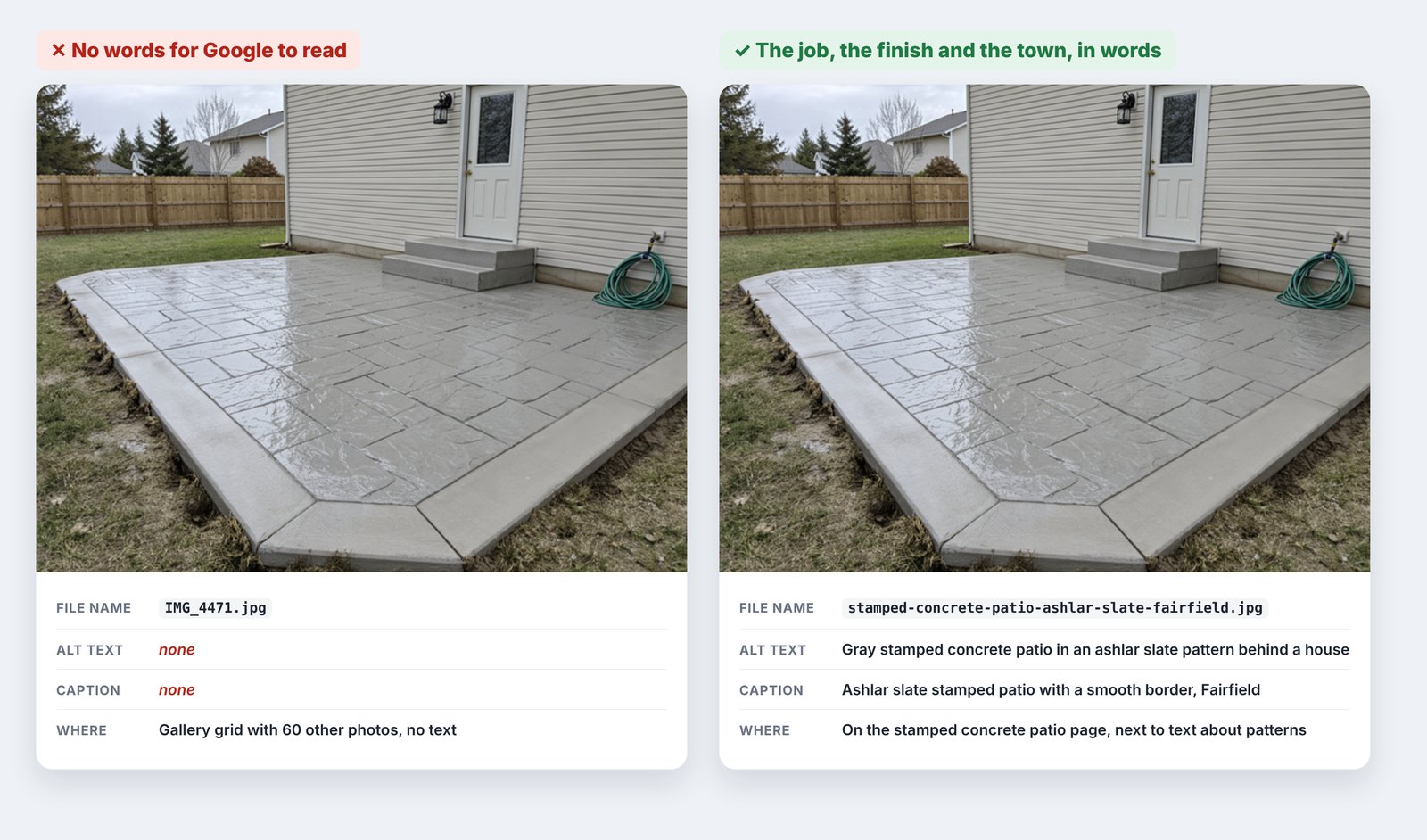
Homeowners pick a patio crew from photos. But a photo with no words around it gives Google very little to go on. Plenty of galleries are a grid of photos named IMG_4471.jpg with no words at all.
Google spells out what it reads. It says it “extracts information about the subject matter of the image from the content of the page, including captions and image titles.” It also says “my-new-black-kitten.jpg is better than IMG00023.JPG.” And it uses alt text “along with computer vision algorithms and the contents of the page” to understand a picture.
Here’s the same patio photo two ways:
The checklist for every project photo:
- Rename the file before you upload it: stamped-concrete-patio-ashlar-slate-fairfield.jpg.
- Write alt text that says what’s in the picture. Say it like you would on the phone. Don’t stuff it with keywords. Google warns against that.
- Add a one-line caption with the job, the finish or material and the town.
- Put the photo on the page for that job, next to text about that job, not only in a gallery.
- Shoot a before photo every time. Cracked driveways and crumbling mortar sell the after.
Short on time to post? BuilderBase, our own app, can pull new job photos from Google Drive, Dropbox or CompanyCam. It turns them into post drafts for your social pages and your Google Business Profile.
Proof that wins the estimate
A driveway or a chimney rebuild is a big check for a homeowner. Before they let you tear anything out, they want proof you’re licensed and insured. And proof you do good work.
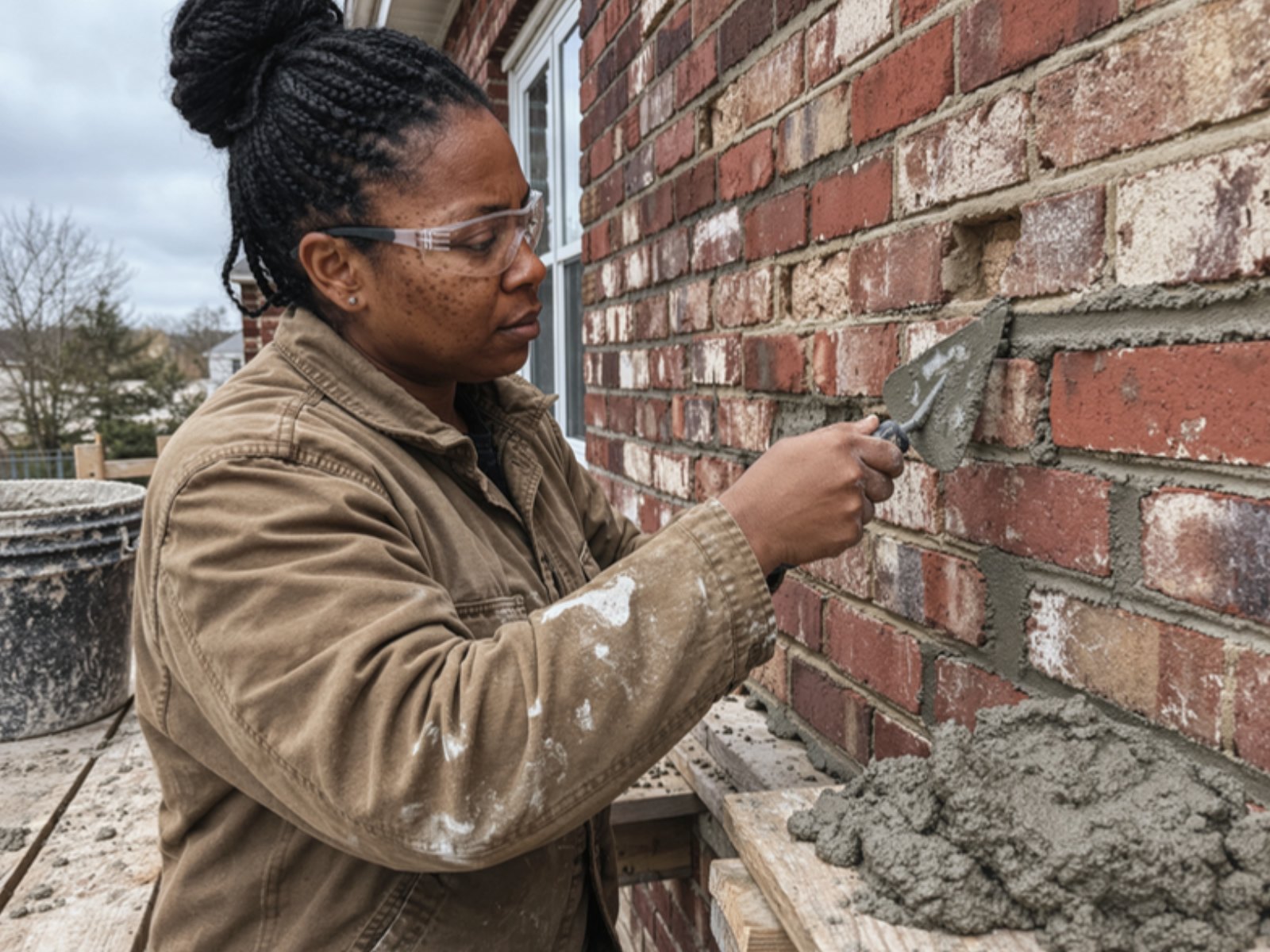
Show your license the way your state names it. Licensing rules for concrete and masonry work change from state to state. California is a clear example. Its license board has a C-8 Concrete class for a contractor who “forms, pours, places, finishes and installs” flat and other concrete work.
It has a separate C-29 Masonry class that covers brick, block, “natural and manufactured stone” and fire brick. If you hold one, put the class and number in your footer and on every service page. It answers the first question a careful buyer asks.
Spell out what you stand behind. If you offer a workmanship warranty, say what it covers in plain words. Cracking is a common worry on driveway estimates. Explain what’s normal, what you do to limit it and what you’ll fix.
Ask for reviews that name the job. “Rebuilt our front steps and matched the old brick” helps a stranger more than five stars and no words. One rule to keep in mind: Google says offering “free or discounted goods or services” in exchange for reviews is strictly prohibited. So no “10% off for a review.” Just ask, and make it easy. A text the day you finish works well:
“Thanks for having us out for the new driveway. If you’re happy with it, a quick Google review that says what we did helps your neighbors find us. Here’s the link.”
Show the crew. A photo of your actual crew and trucks on a job does more for trust than a stock photo of a smiling man in a hard hat.
What to do when it’s too cold to pour
Cold makes concrete slow and costly. The National Ready Mixed Concrete Association says fresh concrete “freezes if its temperature falls below about 25°F” and should be protected from freezing for about two days after it’s placed. The same guide covers winter pours with insulated blankets, enclosures and heaters. It can be done, but every pour takes more gear and more planning.
The search data says winter is quiet too. Stamped concrete drops to about 9,900 searches in December. But that’s exactly when to do the work that makes spring pay:
- Write the driveway, patio and cost pages now, so they’re live before the February climb.
- Turn this year’s best jobs into project pages while the photos are fresh in your phone.
- Ask every customer from this season for a review that names the job.
- Run estimates for spring. “We’re booking April and May now” is a good reason to call.
- Push the work you can still do: chimney repair, interior stone, fireplaces, small repairs.
If you’re in a warm state, your slow months may look different. Pull your own numbers from your calendar and plan pages a season ahead of your peak.
Commercial and GC work: where SEO fits
If most of your work is bidding for general contractors, SEO is a smaller part of the plan. GCs find subs through bid lists and people they’ve worked with. Nobody types “masonry sub near me” and hires the top result for a school job.
Your website still matters, just for a different reader. An estimator checking you out wants a project list with building types and sizes, your license and insurance info, safety info and a clear contact for bids. Make that easy to find and easy to send.
Many commercial shops also take residential repair work in slow stretches. If that’s you, the residential pages above work the same way. Keep the two apart on the site so a homeowner doesn’t land on your bid page.
How we measure masonry SEO: booked estimates, not clicks
We count booked estimates and sold jobs by source. Rankings and clicks are only how we get there. A page that ranks third and books six driveway estimates a month beats a page that ranks first for a search nobody hires from.
Here’s what your monthly report shows:
- Calls and forms by source: map listing, each service page, ads.
- How many turned into booked estimates, and for which job type.
- Sold jobs and their value, from your CRM or your notes.
- Cost per booked estimate, by channel.
- What we changed this month and what we’re doing next.
Here’s the math with made-up numbers. Say you spend $2,000 in a month and book 10 estimates from it. That’s $200 per estimate. If you close 3 of them at an average of $9,000, that’s $27,000 in sold work for $2,000. Run that same math every month and you’ll know which pages and ads to keep. Our marketing budget calculator works it backward from the jobs you want.
What the first three months look like
SEO for a masonry or concrete shop takes months, not weeks. Here’s what happens in the first three.
Month 1: profile, tracking and phones
We audit your Google profile and fix the categories and service areas. Then we set up call tracking so every lead has a source. We check how your phone gets answered during a pour. If you want ads running while SEO builds, we launch a small search campaign on your best-paying job.
Month 2: the first service pages
We write and publish your top two or three service pages from the list above, with your photos renamed and captioned. We start the review ask with your recent customers.
Month 3 and on: the cost page and project pages
Then comes the cost page, then project pages from finished jobs, then more service pages for the rest of what you do. Each month we look at which pages bring estimates and put more into those. The smaller searches usually move first. The big “near me” searches take longer, because they lean on your profile and your reviews, and Google says local results are mainly based on relevance, distance and popularity. Distance is how far you are from the person searching.
How we’d split $1,500, $5,000 or $15,000 a month
Here’s how we’d think about three common monthly budgets for a masonry or concrete company. These totals include ad spend and our work. They’re starting points to plan with, not price quotes, and your market, season and job mix change them.
| Monthly budget | Where we’d put it | Best for |
|---|---|---|
| $1,500 | Google profile, reviews, call tracking and one new service page a month. No ads, or a very small campaign in peak season. | A one or two crew shop that wants steady calls without big spend |
| $5,000 | Everything above, plus two to three pages a month, project pages, and a Google Ads search campaign for your top job in season. | A shop with several crews that wants a full spring schedule |
| $15,000 | Everything above, plus campaigns for each job type and more ad spend in April to June and in chimney season. | A larger company covering flatwork, masonry and hardscape |
A tip on timing: if your budget is fixed for the year, don’t spread it evenly. Spend more on ads from March to June for flatwork and from August to October for chimney work, and put winter money into pages. Call answering with Restoral can be added at any budget.
Why work with D&J
We do marketing for contractors and home service businesses, from Stamford, Connecticut. SEO, Google Ads, websites, reviews, social media and call tracking all sit under one roof. So the jobs in your ads match the jobs on your pages.
We’re a Google Partner and a Meta Business Partner. We built BuilderBase, our own app that writes your posts with AI and posts them to your pages and your Google Business Profile. And Restoral, our AI system, picks up the calls your crew can’t while they’re finishing a slab.
We won’t promise rankings or a set number of jobs. We’ll show you what we did each month and what it brought in. Our case studies show how we report results for other trades.
What to do this week
Five things you can do before the spring calls start:
- Search “concrete contractors near me” or “masonry near me” from the middle of your best town and write down who’s in the map box.
- Check your Google profile’s primary category. Does it match the work that pays you most?
- Pick the two jobs you want more of next year. Those are your first two pages.
- Find your ten best project photos from this year and rename them with the job and the town.
- Call your own number at 10 a.m. on a weekday, when the crew is on a pour, and see what happens.
Want us to look first? Get a free local SEO audit and we’ll show you where your profile and pages stand. For the bigger picture across trades, see our contractor SEO page and our local SEO checklist for contractors. Doing hardscape too? Our landscaping SEO page covers the overlap, and foundation repair marketing covers the structural side.
Masonry and concrete SEO FAQ
How long does masonry SEO take?
Expect a few months before service pages show up for smaller searches like chimney crown repair or tuckpointing. The big “near me” searches lean on your Google profile, your reviews and where the searcher is, so they take longer. If you need calls this spring, run Google Ads while the pages grow. Anyone who promises page one in 30 days is guessing.
Can concrete contractors run Local Services Ads?
Google’s US list of Local Services Ads categories had no masonry, concrete or chimney category when we checked on November 23, 2026. Some shops may fit a listed category like foundations services or general contractor, and Google decides that when you apply. For most masonry and concrete companies, paid calls come from regular Google Ads search campaigns.
Should we post prices for driveways and patios?
Post ranges and explain what moves the price: size, thickness, finish, demo of the old slab and access for the truck. “Concrete driveway cost” gets about 4,600 searches a month, so a cost page brings in shoppers who are close to deciding. A range sets expectations without locking you into a number before you see the site.
Do we need a separate page for every town?
No. Pages built for many towns that only swap the town name are what Google’s spam policies call doorway abuse, and Google says sites that break those policies may rank lower or not appear at all. Set your towns as service areas on your Google profile, name the places you work most on your service pages, and build project pages for real jobs in those towns.
Is SEO worth it if we mostly do commercial work?
Less than for residential work. General contractors find subs through bid lists, past jobs and people they trust. Your website still needs a clear project list, license and insurance info and a bid contact, because estimators check. If you take residential repair work in slow months, the service pages on this page work the same way.
What should a concrete company do in winter?
Write pages and book spring work. Winter is when to write your driveway, patio and cost pages so they’re live before searches climb in February. Turn this year’s jobs into project pages, ask last season’s customers for reviews, book spring estimates and push the work you can still do, like chimney and interior stone work.