
Foundation Repair Marketing That Books Inspections
Foundation repair marketing built on what homeowners actually search: the pages to build first, Local Services Ads, the insurance question, and how we count booked inspections.
5.0on Google- Google Partner
- Meta Business Partner
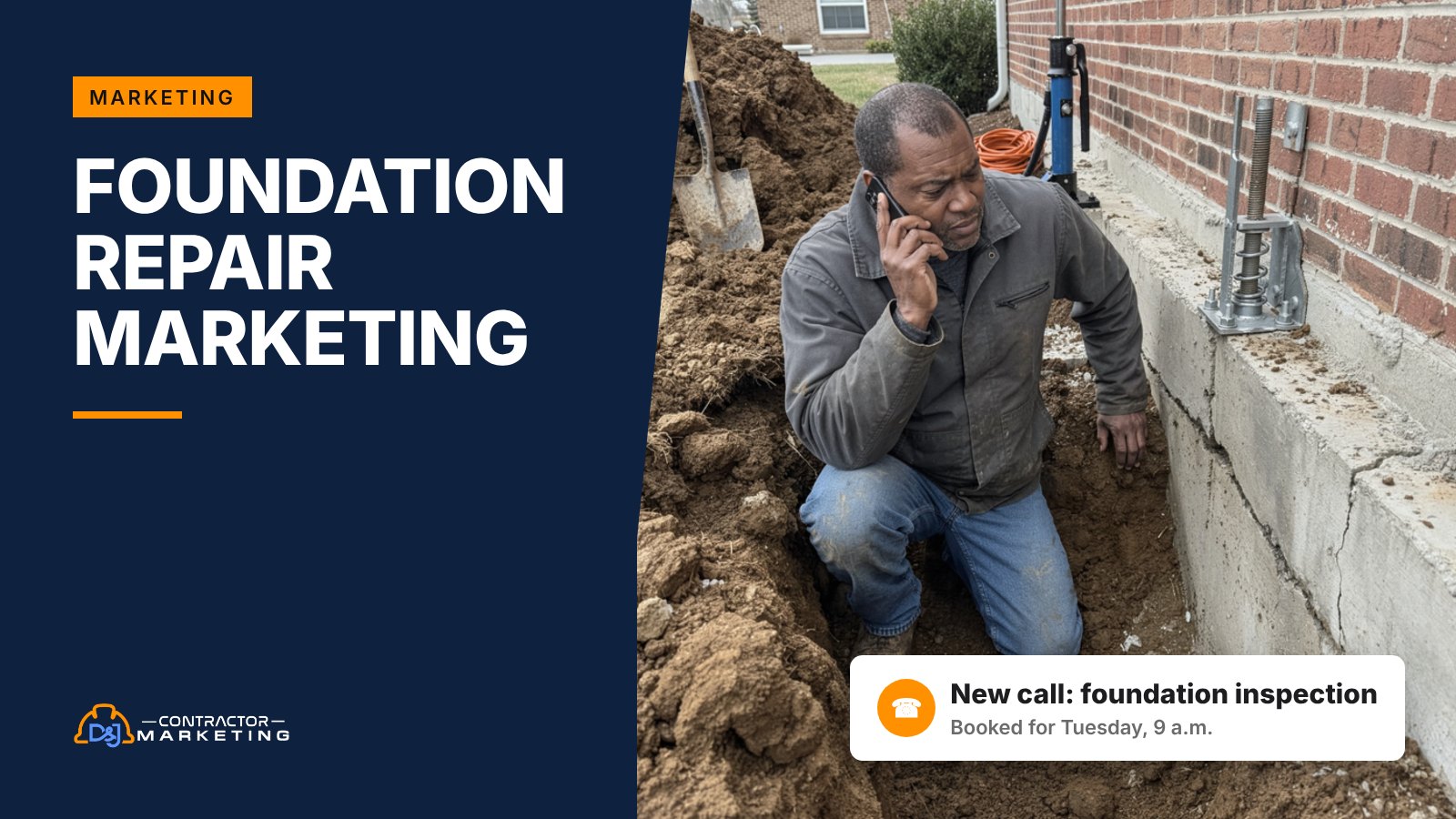
“Foundation repair near me” gets about 42,000 US searches a month, and Ahrefs gives it a difficulty score of 58. “Foundation crack repair” gets 14,000 and scores 1. Foundation repair marketing starts with the searches you can win with a page. Win the big ones through your Google profile.
Homeowners who spot a crack, a sloping floor or a wet basement search Google for a company, a fix or a price. They pick from the ads, the map pack or the regular results, and they call whoever looks most trustworthy.
The short version: set up your Google profile as a service-area business, collect reviews that name the fix, and build one page per method, problem and service, plus an honest cost page. Add Local Services Ads (“Foundations services” is a US category) if you need calls now. Then answer every call and count booked inspections, not clicks.
Key takeaways
- Most method and problem searches, like “helical piers” (KD 5) and “slab foundation repair” (KD 0), are far easier to rank for than “foundation repair near me” (KD 58). What homeowners search
- “Basement waterproofing” (46,000 a month) is almost as big as “foundation repair” (49,000), and “crawl space repair” (37,000) isn’t far behind, so they deserve their own pages. Waterproofing and crawl space
- From December 2024 to August 2025, “foundation repair” searches went from about 23,000 a month to over 80,000, but 2026 stayed between about 46,000 and 52,000. Seasons
- “Foundations services” is a US Local Services Ads category, where you pay for leads instead of clicks. Local Services Ads
- Angi’s 2026 guide puts the average foundation repair at $5,175, and “foundation repair cost” gets about 6,900 searches a month, so an honest cost page is worth building. Cost and method pages
- Insurance questions add up to about 3,150 searches a month, and in many cases the answer is no. Insurance page
- We count booked inspections and sold jobs by source, not clicks. How we measure
What homeowners type into Google
Homeowners search for what they see: a crack, a sloping floor, a wet basement, a price. Below are the big ones in the US, and the ones a local shop can actually win.
We pulled these numbers from Ahrefs Keywords Explorer for the US in November 2026. Volume is average searches a month. KD is Ahrefs’ keyword difficulty, from 0 (easy) to 100 (very hard). CPC is Ahrefs’ estimate of what one ad click costs.
| Search | What they want | Searches a month | KD | Est. CPC |
|---|---|---|---|---|
| foundation repair | A company or an answer | 49,000 | 3 | $11 |
| foundation repair near me | A company nearby | 42,000 | 58 | $9 |
| foundation repair companies | A company | 9,000 | 1 | $16 |
| foundation repair contractors | A company | 5,300 | 31 | $6 |
| foundation inspection | Someone to look at it | 8,100 | 1 | $12 |
| foundation inspection near me | Someone to look at it | 4,800 | 0 | $11 |
| foundation crack repair | A fix | 14,000 | 1 | $6 |
| helical piers | A method | 14,000 | 5 | $1.10 |
| slab foundation repair | A method | 5,000 | 0 | $4 |
| pier and beam foundation repair | A method | 3,700 | 0 | $7 |
| foundation repair cost | A price | 6,900 | 8 | $3.50 |
| sinking foundation | An answer | 1,900 | 0 | $2.50 |
“Foundation repair near me” scores 58 on KD, and 10 of the other 11 score under 10. Don’t try to win “near me” with a page at first.
Plain “foundation repair” has 49,000 searches and a KD of 3, but Ahrefs shows a map pack for it and for the “near me” version: the box with three businesses and their pins. Google weighs your profile, your reviews and how close you are to the person searching. We work on the first two in month 1. Use pages to win the method and problem searches.
The method and problem searches are different. Someone typing “pier and beam foundation repair” or “foundation crack repair” wants to understand the fix. A clear page with photos, steps and a price range can rank for those. One note: “helical piers” has a low estimated CPC ($1.10), so few advertisers pay much for it. We’d still build it, but based on what advertisers pay, we’d expect crack repair and inspection pages to bring more calls.
KD is a US-wide score, not a score for your town. A low number means a solid page can compete. The shops in your market still decide how fast you climb.
Waterproofing and crawl space are their own markets
“Basement waterproofing” gets about 46,000 searches a month. That’s nearly the 49,000 for “foundation repair.” If waterproofing gets one line on your homepage, those searches go to someone else.
The rest of the water and leveling work, from the same Ahrefs pull:
- basement waterproofing: 46,000 a month, KD 0
- basement waterproofing near me: 35,000, KD 1
- crawl space repair: 37,000, KD 0, est. CPC $13
- crawl space encapsulation: 37,000, KD 1
- crawl space encapsulation cost: 5,900, KD 0
- concrete leveling: 17,000, KD 3
Ahrefs shows a map pack for “basement waterproofing” and “basement waterproofing near me” too, so your profile and reviews count as much as the page.
These are also different jobs with different buyers. A homeowner with a wet basement in March isn’t thinking about piers. Give each service its own page with its own photos, steps and price range. Then link them together, so a reader with a wet basement can find your foundation pages too.
Concrete leveling is the odd one out. Angi lists mud- or slab-jacking at $500 to $1,300, well below its foundation repair average. We’d keep that on its own page so it doesn’t water down your foundation pages. If you’re a concrete lifting shop adding foundation work, build the foundation pages separately, link the two, and only list methods your crew already installs. For driveway, patio and brick work, see our page on SEO for concrete and masonry contractors.
Foundation searches: a big 2025 summer spike, a flat 2026
From December 2024 to August 2025, “foundation repair” searches went from about 23,000 a month to over 80,000, according to Ahrefs’ monthly history. Then 2026 looked very different. Through October, searches stayed between about 46,000 and 52,000 a month, with a small high point in August.

Basement waterproofing jumped the same way in 2025. Ahrefs shows about 16,500 searches in December 2024 and about 72,000 in July 2025.
We can’t tell from national data which year is normal. From November 2025 to January 2026, searches stayed above 46,000 a month, so we wouldn’t cut marketing in winter on the strength of one bad December. We also can’t tell which pattern your town follows, so here’s a plan that works either way:
- November to February: build and fix pages, collect reviews from fall jobs, and clean up your Google profile. SEO takes months to show, so start it before the busy season. Keep ads running if your calls hold up.
- March to May: check last year’s calls and raise ad budgets if your phone got busier in spring. In 2025, searches were already above 45,000 by March.
- June to September: run ads at full budget, answer every call, and book inspections fast. August was the highest month both years, though only by a small margin in 2026.
- October: ask every summer customer for a review while the job is fresh.
Your market may not match the national curve. Check your own call logs from the last two years, month by month, and mark when the phone got busy and when it went quiet.
What our foundation repair marketing covers
Five parts. You don’t need them all in month one.
 Google Business Profile and reviews
Most foundation crews work at the customer’s house, not at an office. Google says that if you don’t serve customers at your business address, remove the address from your profile. You can then list up to 20 service areas, and the whole area shouldn’t be more than about 2 hours of driving from your base. Our service-area business setup guide walks through it.
For categories, Google says to choose the fewest categories that describe your core business. We pick the primary one based on the work that makes you the most money, then add waterproofing or concrete work only if you really do it. We also list each service in the profile, from piers to crawl space sealing.
Angi puts home settling repairs at $5,000 to $25,000. When the job costs that much, homeowners compare reviews before they call. We set up a simple text after each job asking for a review. The best reviews name the problem and the fix, like “bowing wall in the basement, fixed with wall anchors.” Here’s how to ask for reviews without sounding pushy.
 Website and service pages
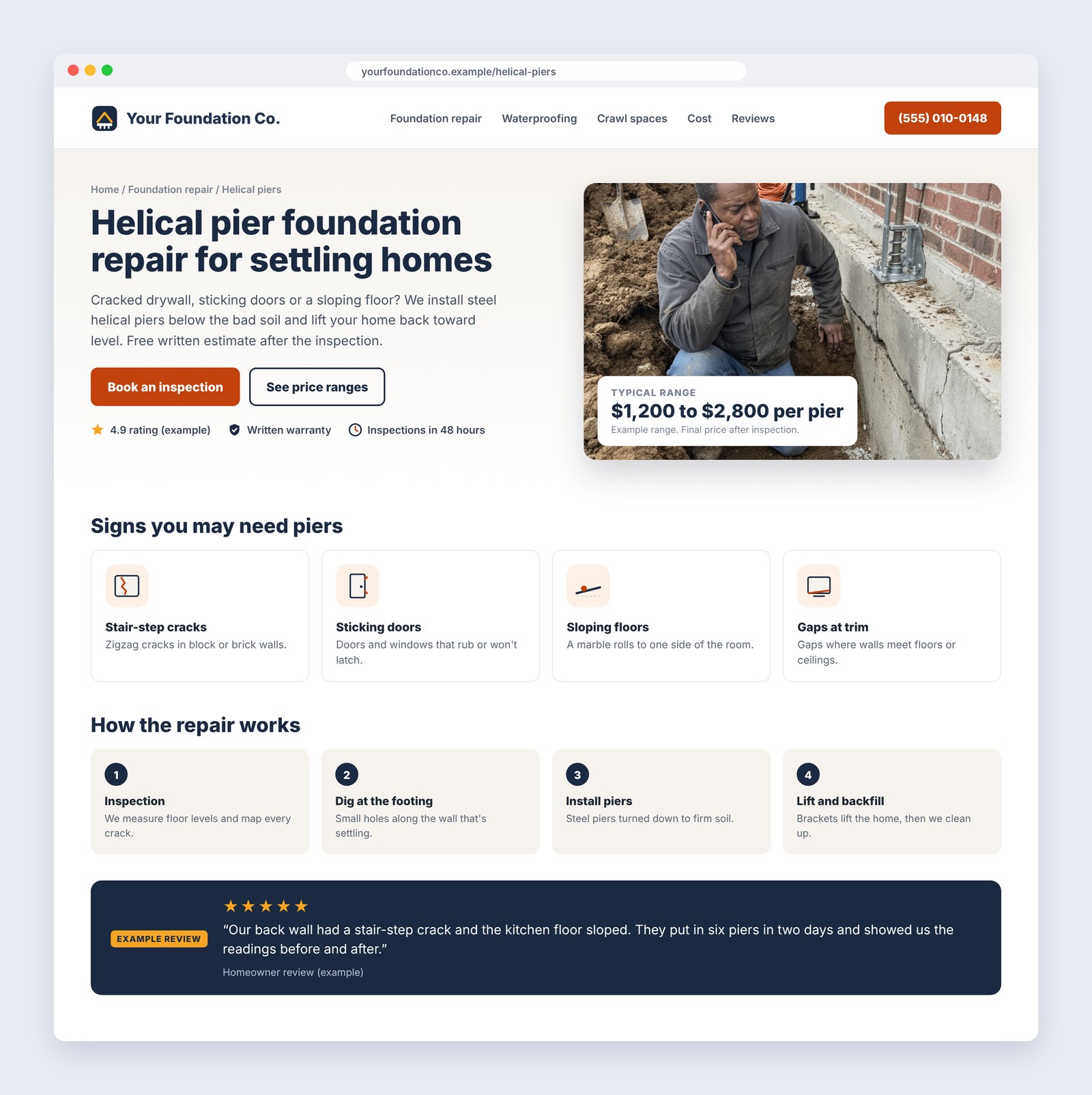
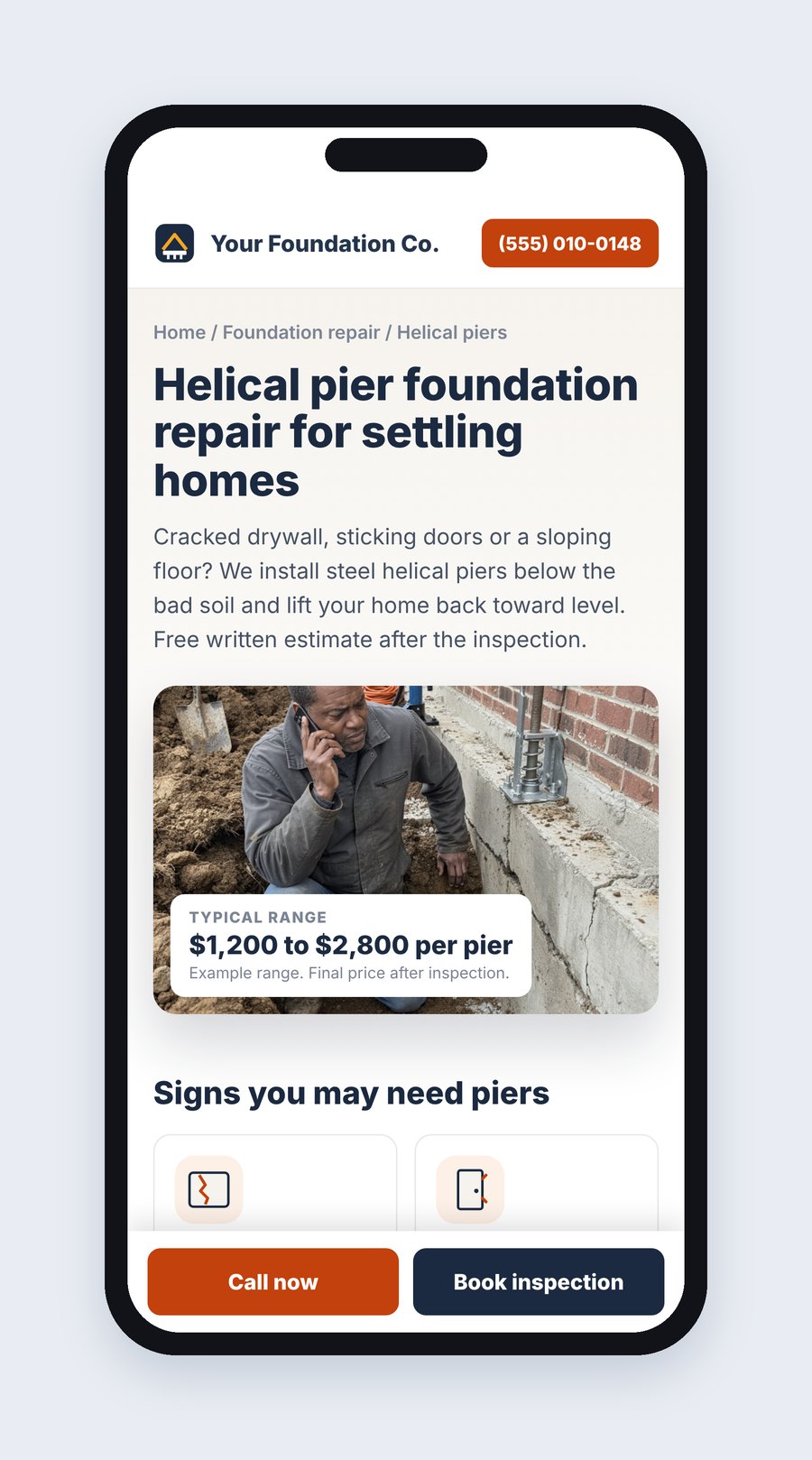
We build one page for each method, each problem and each service, plus a cost page. Every page gets your own job photos, the steps of the repair, what the homeowner should expect on install day, and a clear way to book an inspection. More on which pages to build first in the next section.
 Local Services Ads
Google lists “Foundations services” as a US Local Services Ads category. You pay for leads, not clicks, and Google shows these ads prominently in search results. Pre-badge ads can run after you pass Google’s first checks, while you finish the rest. For those, Google asks for a license or business registration, confirmation that you hold the licenses your work needs, reviews (based on the category’s rules), and billing with a budget.
Google says if you regularly fail to answer calls or respond to messages, your ad ranking may be affected. So someone has to pick up. One more catch: pre-badge ads show below companies that have finished all the checks and earned the Google badge, so finish the full process. If you also waterproof or seal crawl spaces, we check which of your services Google lets you pick during setup. Our Local Services Ads guide covers the full setup.
 Answering and booking
Foundation calls usually come right after something scary: a door that won’t close, a new crack in the drywall, water on the basement floor after a storm. If you don’t answer, that homeowner is probably dialing the next company before your voicemail ends.
We set up Restoral, our AI system, to answer your calls and chats, ask the right questions (crack, water, sloping floors, selling the house?), and book the inspection on your calendar. It works with Google Calendar, Calendly, Cal.com, Jobber and most trade CRMs, and our team sets up the connection. If you’d rather have people answer, read our answering service for contractors page.
 Call tracking and reporting
The Google profile, the website and Google Ads each get their own tracking number. Local Services Ads calls come through Google’s own number, so we pull those leads from the Local Services Ads dashboard into the same report. Then every report shows calls, booked inspections and sold jobs by source, so you can see which one isn’t booking inspections and cut it.
Build method, problem and cost pages first
Outside the map pack, your service pages usually do most of the work. One page per method, one per problem, and one honest cost page usually beats a single “Services” page. This is the order we’d start in, using the same Ahrefs data.
Crack repair is first because it ties for the most searches (14,000) and scores 1 on KD. It’s often a small job ($250 to $800, per Angi), but it gets you in the door for an inspection. If piers or leveling pay you more, put those first. Inspection sits second even though helical piers gets more searches. Ahrefs estimates about $12 a click for “foundation inspection” and about $1.10 for “helical piers.” Higher click prices usually mean advertisers see buyers there.
| Page to build | Main search it targets | Searches a month | KD |
|---|---|---|---|
| Foundation crack repair | foundation crack repair | 14,000 | 1 |
| Foundation inspection | foundation inspection | 8,100 | 1 |
| Helical piers | helical piers | 14,000 | 5 |
| Foundation repair cost | foundation repair cost | 6,900 | 8 |
| Slab foundation repair | slab foundation repair | 5,000 | 0 |
| Pier and beam repair | pier and beam foundation repair | 3,700 | 0 |
| House leveling | house leveling | 1,900 | 0 |
| Bowing basement walls | bowing basement wall repair | 100 | 0 |
Only build pages for work you actually do. If you don’t install helical piers, skip that page. A page that promises a method your crew doesn’t use will cost you a bad review later.
The cost page
Many sites just say “call for pricing.” We think that’s a mistake. People search “foundation repair cost” about 6,900 times a month, and they’ll read whoever answers.
You don’t need a price list. Give ranges and explain what moves the number. For context, Angi’s cost guide (updated October 26, 2026) puts the national average at $5,175, with most homeowners paying between $2,225 and $8,133. Angi lists foundation cracks at $250 to $800 and home settling at $5,000 to $25,000. Use your own ranges on your page, and say what an inspection tells you that a phone call can’t.
What a good method page looks like
We designed this for a made-up company, so every price, phone number and review on it is an example.
Pages for the towns you serve
Build a town page only where you have real work to show. A town page earns its place when it has jobs you did there, photos from those jobs, and the problems your crews see in that area. If you’d just swap the town name into the same text, skip it. Google’s spam policies list “pages targeted at specific regions or cities that funnel users to one page” as an example of doorway abuse.
Answer the insurance question honestly
About 3,150 searches a month ask some version of “does insurance cover foundation repair,” and in many cases the answer is no. If your page tells them that up front, they trust you before you show up to inspect.
Ahrefs shows “does home insurance cover foundation repair” at about 1,400 searches a month. Add the close versions (“does homeowners insurance cover foundation repair,” “will homeowners insurance cover foundation repair,” “is foundation repair covered by insurance” and two more), and it’s about 3,150 a month. All of them score under 10 on KD.
On what to say, Angi’s guide on the topic sums it up: a policy covers sudden events like fires, vandalism or fallen trees, but not gradual issues, and it excludes things like foundation settlement, poor construction, tree root damage and soil movement.
Angi also says coverage is usually based on the cause of the problem. So your page should explain that in plain words: a sudden event like a fallen tree may be covered, slow settling usually isn’t (per Angi), and the homeowner should read their own policy or call their agent.
Then explain how people actually pay for the work. If you offer financing, say so and link to it. If you don’t, say that too. “How to pay for foundation repair” gets searched about 100 times a month, so it’s a small but real question.
Don’t promise anyone their claim will be approved, and don’t write the page like you’re the insurance company. Say what you know and send them to their agent.
Home sales bring their own foundation leads
Some foundation calls start when a home inspector writes something scary in a report during a sale. Buyers, sellers and agents all need a fast, clear answer, and they search for one.
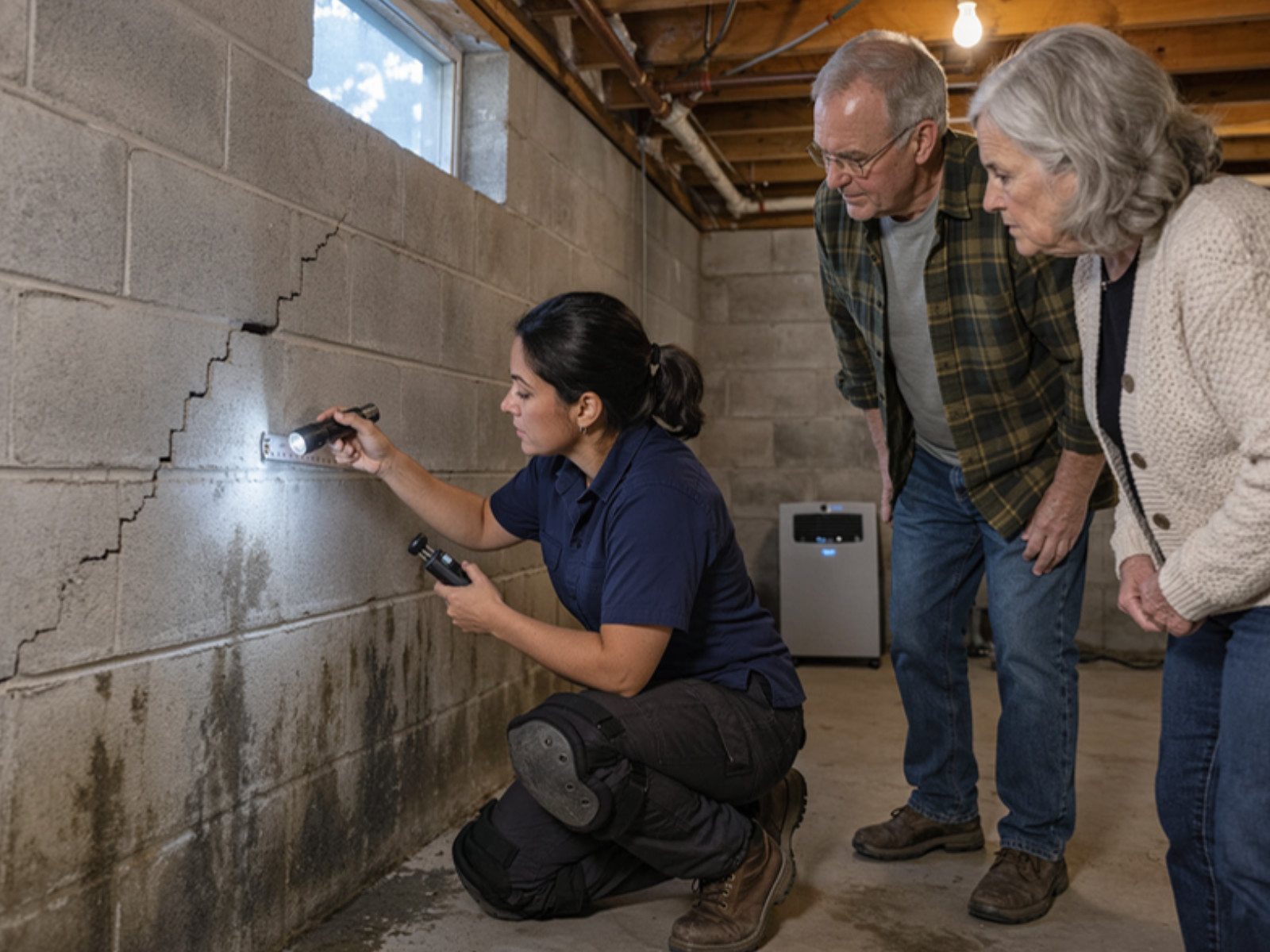
The searches are small but easy. “Should I buy a house with foundation repair” gets about 350 searches a month at KD 0. “Structural engineer foundation inspection” gets about 600. “Does foundation repair affect home value” gets about 100. These people are often on a deadline. The deal has a closing date, the buyer wants a number, and the seller wants to know whether the sale will fall apart.
We’d build one page just for home sales, with these five things on it:
- How fast you can inspect when a sale is pending, if you offer that.
- What your written report includes, and a sample with the address blacked out.
- Whether your warranty transfers to a new owner, in your own words. If it doesn’t, say so.
- When you send people to a structural engineer instead, and why.
- A short section for agents: how to send you a referral and what they’ll get back.
The page also gives you something to send local agents and home inspectors. Agents can send it to a nervous buyer. And when a closing goes well, ask the agent for a Google review too.
How a local shop competes with national brands
In a lot of markets, a three-crew foundation shop is up against big brands with bigger ad budgets. You won’t outspend them. But a homeowner about to spend $5,000 or more wants to know who’s coming to the house, and a local owner can show that better than a big brand can.
What we lean on for smaller shops:
- The owner’s face. Put the owner’s photo and name on the site and the profile. Say who shows up for the inspection.
- Local job photos. Real before and after shots from houses in your area, not stock images.
- Reviews that name the fix. A review that says “they fixed the bowing wall in our basement” helps more than “great job.”
- The local cause. Write about the problems your crews actually see, in your own words. That might be clay soil that swells and shrinks, basement walls pushed in by wet soil, or damp crawl spaces. Use your own job photos to show it.
- Speed. Answer the phone, call back forms within minutes, and get the inspection on the calendar on the first call.
- A tight service area. Focus on the towns you can reach fast instead of a huge circle you can’t serve well.
Most of this costs the owner’s time, not money: photos, review texts and calling leads back.
How we measure it: booked inspections, not clicks
Every call and form gets traced back to where it came from.
Each month you’ll see these numbers by source:
- Calls and forms that were real leads (not spam or job seekers)
- Booked inspections
- Sold jobs and their value, from your CRM or a simple shared sheet
- Cost per booked inspection, and spend against revenue
- Map pack and page rankings for your main searches
Cost per inspection tells you more than cost per lead. Say you’re a foundation shop that spends $3,000 in a month and gets 20 booked inspections. That’s $150 per inspection. If 1 in 4 turns into a sale and your average job is $5,000, those 5 jobs bring in $25,000. This is an example calculation, not a promise. And that’s revenue, not profit: take out materials, labor and the inspections that didn’t sell. Plug in your own close rate and ticket.
Sometimes the problem is lots of calls but few inspections. Listen to every call recording from the month first.
Mark each one. Was it in your area, for work you do, from someone who owns the house and wants it looked at soon, or was it a job seeker, a supplier or a makeup shopper? Are they in your area and for work you do? If they are, the problem is usually how the phone gets answered or the offer. That’s why our reports go past the lead, all the way to whether the job sold.
What the first three months look like
Foundation repair SEO takes months, not weeks. This is what happens in each of the first three.
Month 1: profile, tracking and phones
We fix your Google Business Profile: the right setup for a service-area business, the primary category, every service listed, and fresh job photos. We set up call tracking and your review texts. If you want calls fast, we start Local Services Ads or Google Ads this month, since pages take longer to rank.
Month 2: method, problem and cost pages
We write and publish the first pages from the table above, starting with the work that pays you best. Then the cost page and the insurance page. Every page gets your photos and a booking button. We also clean up old pages that compete with each other.
Month 3 and on: grow what works
We add waterproofing, crawl space and home sale pages, keep reviews coming, and move ad money toward the sources that book inspections. Pages often start showing up for smaller searches in this window. The bigger searches can take six months or more, depending on who you’re up against.
How we’d split $1,500, $5,000 or $15,000 a month
A bigger budget mostly buys speed: more pages sooner and ads that run through your busy months. This is how we’d split three total marketing budgets, ad spend included. These are not D&J packages or prices. Your plan depends on your crews, your area and your goals.
| Total monthly budget | Where most of it goes | What comes slowly |
|---|---|---|
| $1,500 | Local Services Ads, plus your Google profile, review texts and call tracking | New pages, maybe one a month |
| $5,000 | Local Services Ads and Google Ads on your best searches, plus steady work on method, cost and insurance pages | Waterproofing and crawl space pages, added over a few months |
| $15,000 | Ads at full budget in your busy months, pages for every service, and the home sale page | Little. At this level, check whether your team can run the extra inspections |
We lean on Local Services Ads at the low end because search ad clicks aren’t cheap in this trade. Ahrefs estimates up to $16 a click for “foundation repair companies” and $12 for “foundation inspection,” though smaller searches run $3.50 to $7. Local Services Ads charge per lead instead. Check the lead price Google shows for your trade and area during setup before you set a budget.
Watch for wasted clicks too. “Foundation” is also a makeup product, so we add negative keywords like makeup, concealer, jobs, hiring and salary before an ad goes live. Our PPC management for contractors page explains the rest.
To check your own number, try our marketing budget calculator. It works backward from the jobs you want to the leads and dollars it takes, then checks the plan against your gross profit.
Questions to ask any foundation repair marketing company
Whoever you hire, ask these before you sign. Ask us the same questions.
- Will you report booked inspections and sold jobs, or just leads and clicks?
- Which pages would you build first for my services, and why?
- Do I own my website, my Google profile, my ad accounts and my tracking numbers if we part ways?
- Are the leads only mine, or are they sold to other foundation companies too?
- How will you handle my slow months?
- Who writes the pages, and will they use my job photos or stock photos?
- What’s the contract length, and what does it take to cancel?
Question 4 matters if you’ve bought foundation repair leads before. Shared leads mean you’re racing other companies to the same homeowner. Our Angi leads review covers how one big lead platform works, so you can compare.
Why work with D&J
We’re a marketing agency for contractors and home service businesses, based in Stamford, Connecticut. We handle SEO, local SEO, Google Ads, Local Services Ads, websites, reviews, social media and call tracking.
We’re a Google Partner and a Meta Business Partner. We built Restoral, our AI system that answers calls and chats and books jobs on your calendar, and BuilderBase, our app that writes and posts your social media and Google posts for you. We’ve also worked with more than 30 SERVPRO franchises and have never lost one as a client. See our case studies for real examples.
What to do this week
You don’t need an agency to start. Here are five things you can do in the next seven days.
- Open your Google Business Profile. If customers don’t come to your office, remove the address and set your service areas.
- Add every service you do to the profile, from crack repair to crawl space sealing.
- Text your last 10 customers a review link. Ask every customer, not just the happy ones, and ask them to say what you fixed.
- Write down your price ranges for your three most common jobs. That’s the start of your cost page.
- Call your own number after hours. If nobody picks up, fix that first.
We’ll look at your Google profile and your site and show you what to fix first, free. For more ideas across trades, see more contractor marketing ideas.
Foundation repair marketing FAQ
How long does SEO take for a foundation repair company?
Expect a few months before pages show up for smaller searches like a method or a problem, and often six months or more for the big ones. Your Google profile and reviews can help sooner. If you need calls right away, run Local Services Ads or Google Ads while the pages grow. Anyone who promises page one in 30 days is guessing.
Are Local Services Ads available for foundation repair?
Yes. Google lists “Foundations services” as a US Local Services Ads category, and you pay per lead instead of per click. Google checks your license or business registration, asks you to confirm you hold the licenses your work needs, may require reviews depending on the category, and has you set up billing. Finish the full checks so your ads aren’t stuck below the companies that have the Google badge.
Should we offer free foundation inspections?
It depends on your close rate and your calendar. Free inspections bring more calls, but some of them are just curious. A small fee you credit back if they hire you can weed those out. People search “foundation inspection” about 8,100 times a month, so say clearly on your site whether yours is free.
Should a foundation repair company write about insurance?
Yes, if you keep it honest. About 3,150 searches a month ask about it. Angi’s guide says policies cover sudden events like fires or fallen trees but not gradual problems like settlement. Explain that, tell people to check their own policy, and never promise a claim will be approved.
Should waterproofing and crawl space work get their own pages?
Yes. Both are big searches on their own, and Ahrefs scores them as easy to rank for (see the waterproofing section above). They’re different jobs with different buyers, so give each one its own page with its own photos and steps. Link them to your foundation pages.
How much should a foundation repair company spend on marketing?
Start from the jobs you want, not a percent of revenue. Work out how many inspections it takes to sell one job, then what an inspection costs from each source. Our budget calculator does that math for you, and the budget section above shows how we’d split $1,500, $5,000 or $15,000 a month.